

Are you struggling to package liquids in stand-up pouches efficiently? Manual filling is slow and messy, but a large machine is too much. You need a better way.
A rotary1 desktop stand-up pouch filling and capping machine is perfect for many liquid and semi-liquid products. It excels with items in the food and daily chemical industries, such as milk, jelly, juice, laundry detergent, and shampoo, offering an automated solution for various viscosities2.
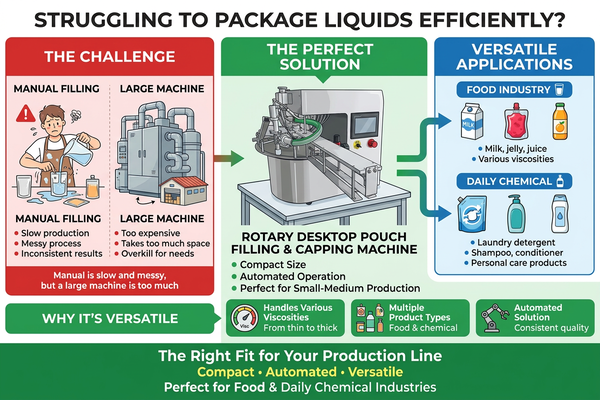
This machine offers a compact and automated solution for modern packaging needs. But knowing it works for "juice" or "shampoo" is just the beginning. The real value comes from understanding why it's so versatile and how its features match specific product characteristics. Let's explore the details to see if it's the right fit for your production line.
How Does Liquid Viscosity Affect Product Suitability?
You have a great liquid product, but you're worried it's too thick or thin to be filled correctly. Inconsistent fills can ruin your product quality and waste money.
A product's suitability depends on the machine's filling system. Our rotary desktop machines use advanced piston fillers that can be adjusted to handle a wide range of viscosities, from thin liquids like water to thick products like jelly or cream, ensuring accurate and clean fills every time.
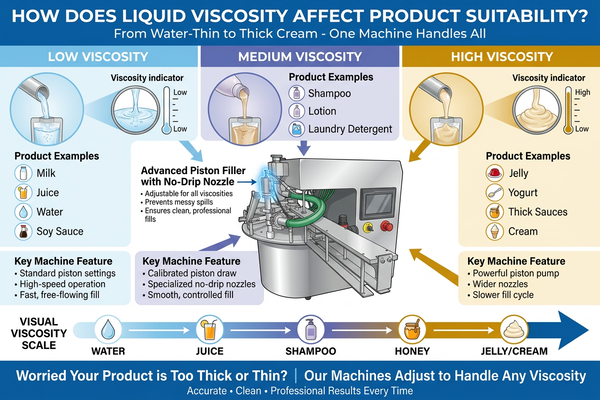
The term "viscosity3" just means how thick or resistant to flow a liquid is. Water has a low viscosity, while honey has a high viscosity.4 Our rotary desktop machines are engineered to manage this diversity. For low-viscosity products, the machine can be set for a fast, free-flowing fill. For medium to high-viscosity products, the power of the piston pump5 ensures that even thick creams and sauces are dispensed smoothly and accurately. We also equip our machines with specialized no-drip nozzles6. This prevents messy spills and ensures each pouch looks clean and professional. We can customize the filling system based on your specific products.
Here is a simple breakdown:
| Viscosity Level | Product Examples | Key Machine Feature |
|---|---|---|
| Low | Milk, Juice, Water, Soy Sauce | Standard piston settings, high-speed operation. |
| Medium | Shampoo, Lotion, Laundry Detergent | Calibrated piston draw, specialized no-drip nozzles. |
| High | Jelly, Yogurt, Thick Sauces, Cream | Powerful piston pump, wider nozzles, slower fill cycle. |
Which Industries Benefit Most From This Machine?
Are you wondering if this compact machine can truly meet the demands of your specific industry? You need a solution that is not just versatile, but also compliant and efficient.
The food and beverage7 and the daily chemical/personal care industries8 are the primary beneficiaries. This machine's hygienic design, accuracy, and compact size make it ideal for producing items like fruit jellies, yogurts, lotions, and liquid soaps in stand-up pouches.
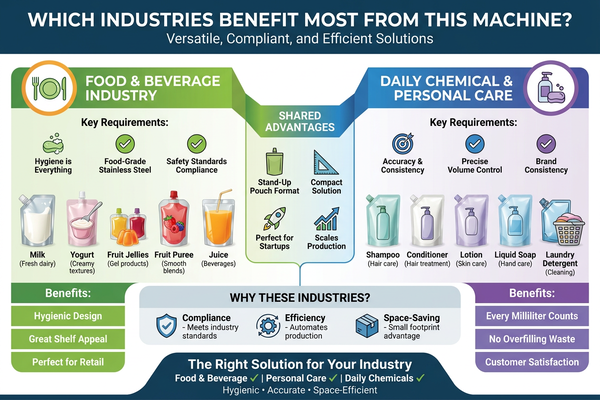
In our experience at RITO, we see these machines thrive in very specific environments. For food and beverage companies, hygiene is everything. Our machines can be built with food-grade stainless steel9 to meet safety standards, making them perfect for packaging products like milk, yogurt, and fruit puree. The stand-up pouch format10 is also fantastic for retail, offering great shelf appeal.
For the daily chemical and personal care sector, accuracy and consistency are key. Whether you're filling shampoo, conditioner, or laundry detergent, every milliliter counts. Overfilling wastes product and money, while underfilling disappoints customers. Our piston fillers provide precise volume control, ensuring brand consistency. The machine's small footprint11 is also a huge advantage for startups or businesses with limited factory space, allowing them to automate and scale production without needing a massive facility.
What Pouch and Cap Combinations Are Compatible?
You've chosen your liquid product, but now you worry about the packaging. Will the machine work with your uniquely shaped pouch or the specific cap you want to use?
These machines are designed for flexibility. They are most compatible with pre-made stand-up pouches, especially spouted pouches, and can handle a variety of standard screw caps. We can also customize the machine to fit your specific pouch sizes and cap designs.
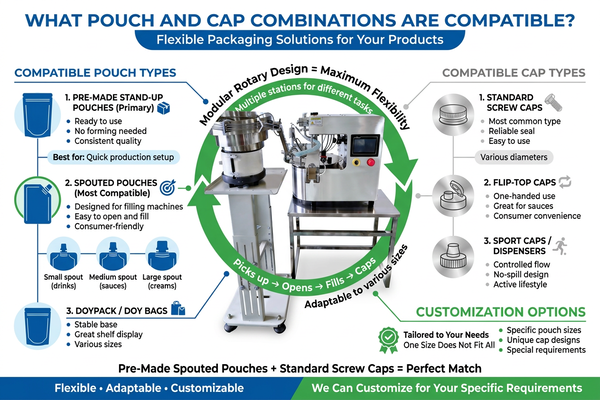
The "rotary" part of the machine's name refers to its operation. It has several stations arranged in a circle. Each station performs a specific task: one picks up a pouch, another opens it, the next one fills it, and another seals the cap on. This modular process makes it adaptable. While it's designed for standard pre-made spouted pouches, we understand that one size does not fit all.
As a manufacturer with a strong R&D team, we thrive on customization. Perhaps your pouch has a unique shape for branding, or you use a special cap to stand out. In many cases, we can adjust the pouch grippers, the capping head, and other components to match your exact packaging specifications. This ability to tailor the machine is crucial. It ensures that you don't have to compromise your packaging vision for the sake of automation. You get the efficiency of a machine built for the pouch you want to use, not the other way around.
Conclusion
This versatile rotary desktop machine is an ideal packaging solution for a wide range of liquid products in the food and daily chemical industries, handling various viscosities and pouch types.
"Filling Cbd Gummies Into Containers With Primocombi Spindexer ...", https://my.environment.uw.edu/about-environment-shared-services/?id=c_filling-cbd-gummies-into-containers-with-primocombi-spindexer-rotary-indexing-conveyor. Descriptions of rotary packaging and filling machines explain that rotary systems index containers or packages through multiple stations arranged around a rotating platform, supporting the article's explanation of sequential pouch handling, filling, and capping. Evidence role: mechanism; source type: education. Supports: A rotary pouch filling and capping machine operates through multiple stations arranged around a rotating mechanism.. Scope note: This supports the general architecture of rotary machinery and may not describe every station or configuration of the specific desktop model. ↩
"Laminar Flow - HyperPhysics", http://hyperphysics.phy-astr.gsu.edu/hbase/pfric.html. Standard fluid mechanics references define viscosity as resistance to flow, providing context for why filling equipment must be selected or adjusted according to liquid thickness. Evidence role: definition; source type: education. Supports: A rotary desktop stand-up pouch filling and capping machine can be used for products with different viscosities.. Scope note: This supports the physical concept behind the claim, not the performance of a specific pouch-filling machine. ↩
"Viscosity - Wikipedia", https://en.wikipedia.org/wiki/Viscosity. The cited source defines viscosity as a measure of a fluid's resistance to deformation or flow, supporting the article's explanation of why liquids such as water and honey behave differently during filling. Evidence role: definition; source type: encyclopedia. Supports: Viscosity means how thick or resistant to flow a liquid is.. Scope note: The source defines the property generally and does not evaluate packaging machinery. ↩
"Through thick and thin: Learning about viscosity", https://sfa.cems.umn.edu/through-thick-and-thin-learning-about-viscosity. Reference tables of dynamic viscosity show water at room temperature has a much lower viscosity than honey, supporting the comparison used to illustrate low- and high-viscosity liquids. Evidence role: statistic; source type: education. Supports: Water is a low-viscosity liquid compared with honey, which is high viscosity.. Scope note: Exact values vary with temperature and honey composition, so the source supports the general comparison rather than a fixed measurement. ↩
"[PDF] positive displacement reciprocating pump fundamentals - OAKTrust", https://oaktrust.library.tamu.edu/bitstream/handle/1969.1/163923/06-tackett.pdf. Technical descriptions of piston or reciprocating positive-displacement pumps explain that a piston displaces a set volume of fluid per stroke, supporting their use where controlled dosing is required. Evidence role: mechanism; source type: education. Supports: A piston pump can support controlled dispensing of liquid or semi-liquid products.. Scope note: This supports the dosing mechanism generally and does not prove the accuracy of the specific machine described in the article. ↩
"Liquid Filling Nozzles & Dispensers - Volumetric Technologies", https://volumetrictechnologies.com/dispensing-nozzles. Packaging and filling equipment references describe anti-drip or shut-off filling nozzles as devices used to reduce product dripping after dosing, supporting the article's claim that such nozzles help keep packages cleaner. Evidence role: mechanism; source type: other. Supports: No-drip nozzles can reduce spills or dripping during liquid filling.. Scope note: The source would support the general nozzle function, not the effectiveness of any named manufacturer's nozzle design. ↩
"[PDF] Impact of Pouch Dimensions on Relationship Between Burst ...", https://open.clemson.edu/cgi/viewcontent.cgi?article=3962&context=all_theses. Food packaging literature identifies pouches and flexible packaging as widely used formats in food and beverage applications because they can package liquids, semi-liquids, and shelf-ready products. Evidence role: general_support; source type: paper. Supports: Food and beverage companies are a major use case for stand-up pouch filling machinery.. Scope note: This supports the relevance of pouch packaging to the sector generally, not that one desktop rotary machine is ideal for every food or beverage producer. ↩
"Home & Personal Care Packaging Materials - Dow", https://www.dow.com/en-us/market/mkt-packaging/sub-pkg-flexible-packaging/app-pkg-flexible-pkg-home-personal-care.html. Packaging references for cosmetics and household products describe flexible pouches and spouted pouches as packaging formats used for products such as shampoos, lotions, soaps, and detergents. Evidence role: general_support; source type: paper. Supports: Daily chemical and personal care products are common applications for pouch filling and capping equipment.. Scope note: The evidence would contextualize industry use of pouch packaging, not directly verify this machine's suitability for all personal-care or household-chemical products. ↩
"Regulatory Status of Components of a Food Contact Material - FDA", https://www.fda.gov/food/packaging-food-contact-substances-fcs/determining-regulatory-status-components-food-contact-material. Food equipment hygiene guidance identifies stainless steel as a common food-contact construction material because it is durable, corrosion-resistant, and cleanable when properly specified. Evidence role: expert_consensus; source type: government. Supports: Food-grade stainless steel construction can help packaging equipment meet food safety and hygiene requirements.. Scope note: The source supports stainless steel as a suitable food-contact material generally; compliance still depends on grade, surface finish, design, and local regulations. ↩
"Stand-up pouch - Wikipedia", https://en.wikipedia.org/wiki/Stand-up_pouch. Packaging research and industry-neutral references describe stand-up pouches as flexible packages designed to stand upright on shelves, supporting the claim that the format can improve shelf presentation. Evidence role: definition; source type: paper. Supports: Stand-up pouches are designed for upright retail display and shelf presentation.. Scope note: This supports the shelf-display function of the format, not a quantified increase in sales or consumer preference. ↩
"[PDF] Process Plant Layout Optimization: Equipment Allocation", https://research.monash.edu/files/444967651/252931868_oa.pdf. Manufacturing and process-design literature treats equipment footprint as an important constraint in facility layout and production planning, supporting the claim that compact machinery can benefit space-limited operations. Evidence role: general_support; source type: education. Supports: A smaller equipment footprint can benefit startups or facilities with limited production space.. Scope note: The source would support the general facility-planning principle, not the exact footprint or scalability of the machine discussed. ↩