

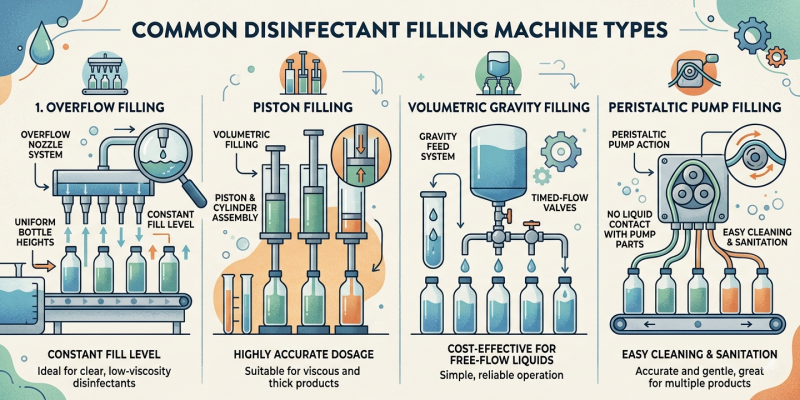
Struggling with filling corrosive disinfectants1? Using the wrong machine can destroy it, forcing costly replacements. The solution is an anti-corrosion filling machine designed for these harsh products.
For filling disinfectants, you should use an anti-corrosion filling machine. Disinfectants are often corrosive2, so a specialized machine built with resistant materials like PVC or high-grade stainless steel will last longer3. This saves you money and provides reliable performance. RITO4 is an expert in this area.
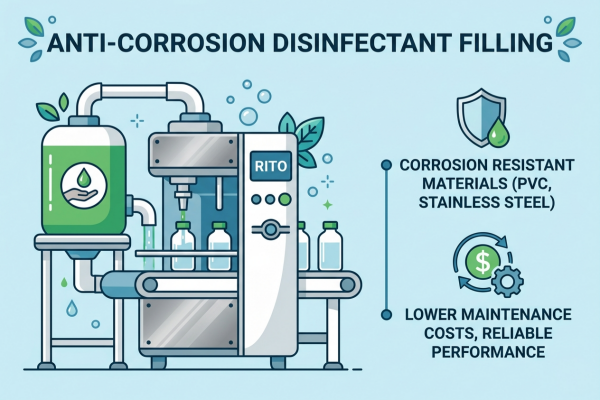
Choosing the right equipment is one of the most important decisions you'll make for your production line. When dealing with products like disinfectants, this choice becomes even more critical. It's not just about filling bottles; it's about protecting your investment, ensuring safety, and maintaining consistent output. Let's explore why a specialized machine is not just a good idea, but a necessity.
Why do you need a special filling machine for disinfectants?
Are you finding that your filling equipment breaks down too often? The constant repairs and production halts from filling disinfectants with a standard machine can be a huge drain on resources.
You need a special machine because disinfectants contain corrosive chemicals like bleach, alcohol, or acids5. These ingredients can quickly damage the metal and plastic parts of a standard filler. This leads to leaks, product contamination, and complete machine failure6, costing you time and money.
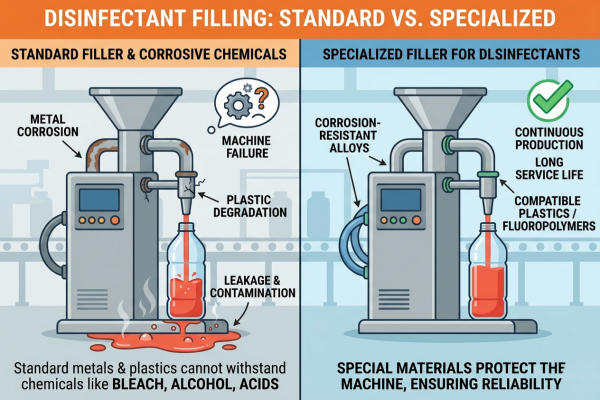
When we talk about disinfectants, we're dealing with chemically aggressive liquids. I remember a client who decided to use their existing water-filling line for a new alcohol-based sanitizer. They thought it would be fine, but within a few weeks, the problems started. The seals began to swell and crack, the filling nozzles started dripping, and eventually, the pump failed. The alcohol had literally eaten away at the machine's internal components. This is a common story. The issue is that standard filling machines are often built with materials like 304 stainless steel and standard plastics, which are perfect for gentle products but not for corrosive ones.
Common Corrosive Agents in Disinfectants
| Disinfectant Type | Active Ingredient | Effect on Standard Machines |
|---|---|---|
| Bleach-Based | Sodium Hypochlorite7 | Causes rapid oxidation (rust) and pitting in standard stainless steel. |
| Alcohol-Based | Isopropyl Alcohol, Ethanol8 | Can cause certain plastics and rubber seals to swell, harden, or dissolve over time. |
| Peroxide-Based | Hydrogen Peroxide9 | Is a strong oxidizer that can corrode metals and degrade incompatible plastics. |
| Acid-Based | Citric Acid, Peracetic Acid10 | Can aggressively attack most metals that aren't specifically graded for acid resistance. |
Using the wrong machine doesn't just lead to costly repairs. It can also cause inaccurate fill volumes, product contamination, and safety hazards for your operators. That's why investing in a machine designed for the job is crucial.
What are the key features of an anti-corrosion filling machine?
So, you know you need an anti-corrosion machine. But when you look at different options, they might all seem the same on the surface. How do you know which one is truly built to last?
The key features of an anti-corrosion filling machine are the materials used for all contact parts, such as 316L stainless steel, PVC, or titanium. These machines also have protected electronics and use special seals, like Teflon or Viton, that won't degrade when exposed to harsh chemicals.
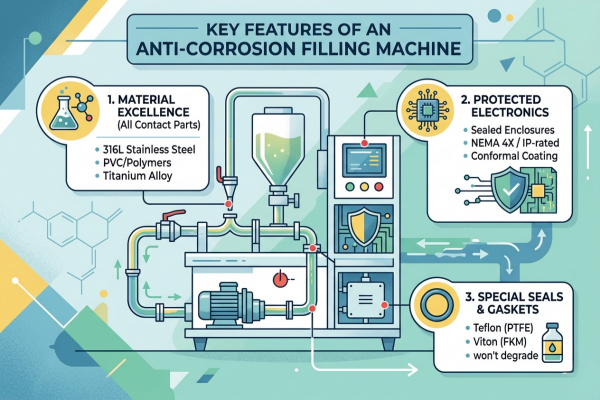
When we at RITO design a machine for disinfectants, we don't just upgrade a few parts; we engineer the entire system for corrosion resistance. It's a ground-up approach that focuses on longevity and reliability. The most important factor is material choice. For everything that touches the product—the tank, pipes, pump, and filling nozzles—we select materials based on the specific chemical you're filling.
Material Selection is Crucial
The first question we always ask a client is, "What exactly is in your product?" The answer determines our material choice. For bleach-based products, a plastic-based system using PVC or CPVC is often the best choice because even high-grade stainless steel can be affected by chlorine over time. For alcohol or solvent-based products, 316L stainless steel is an excellent choice. It contains molybdenum, which significantly increases its resistance to corrosion compared to the more common 304 stainless steel.11 For extremely aggressive acids, we might even use titanium components.
Design and Construction Matter
Beyond materials, the machine's overall design is critical. The fumes from disinfectants can be just as corrosive as the liquid itself. That's why we build our machines with enclosed cabinets for the motors, sensors, and electronics, protecting them from the corrosive atmosphere. We also pay close attention to the seals and gaskets. Using a standard rubber seal is a recipe for disaster. We use materials like Viton or Teflon (PTFE) that maintain their integrity and prevent leaks even after long-term exposure to harsh chemicals. Every detail is designed to prevent failure and extend the machine's life.
How does choosing the right machine save money and time?
A specialized anti-corrosion machine has a higher price tag upfront. This can make it tempting to choose a cheaper, standard option and hope for the best. But is that really the smarter financial decision?
Choosing the right machine saves money by drastically reducing repair costs and eliminating the need for frequent replacements. It saves time by preventing unexpected downtime, ensuring your production line runs smoothly and efficiently. The long-term value far outweighs the initial higher cost.
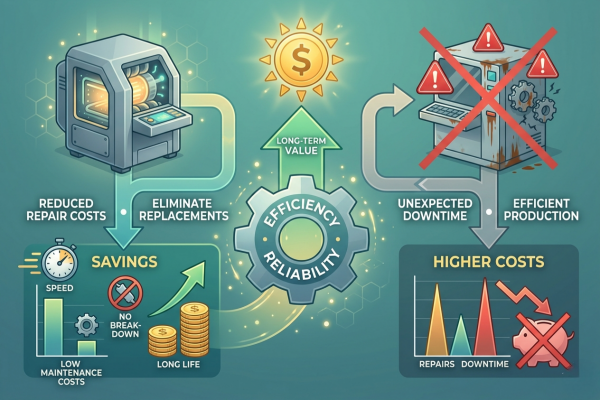
Let’s be direct about the costs. A standard filling machine might seem cheaper today, but it becomes incredibly expensive over time when used for disinfectants. You'll be constantly buying replacement parts, paying for service calls, and losing production hours. I've seen companies have to buy a new "cheap" machine every single year. An anti-corrosion machine from a professional manufacturer like RITO is an investment, not an expense. It's built to last for years with only routine maintenance.
Calculating the Total Cost of Ownership
Think about the total cost, not just the purchase price. A machine that is down for repairs isn't making you money; it's costing you money in lost output and labor.
| Cost Factor | Standard Filler (for Disinfectant) | RITO Anti-Corrosion Filler |
|---|---|---|
| Initial Purchase Price | Lower | Higher |
| Repair Costs (Year 1) | High & Frequent | Minimal to None |
| Production Downtime | Significant | Negligible |
| Machine Lifespan | 6-18 months | 5-10+ years |
| Product Waste (from leaks) | Moderate | Minimal |
| Total Cost over 3 Years | Very High | Lower |
The Value of Reliability
The peace of mind that comes with a reliable machine is priceless. When you can trust your equipment, you can focus on growing your business, not on fixing problems. You can confidently promise delivery dates to your customers and take on larger orders. A reliable machine from a trusted partner like RITO means you can schedule your production and know it will get done. It's the foundation of a stable and profitable operation.
Conclusion
For filling corrosive disinfectants, an anti-corrosion machine isn't an option; it's a necessity. It protects your investment, ensures production reliability, and saves you significant money and time in the long run.
"Calcium Hypochlorite/Sodium Hypochlorite | ToxFAQs™ | ATSDR", https://wwwn.cdc.gov/tsp/ToxFAQs/ToxFAQsDetails.aspx?faqid=928&toxid=192. Authoritative chemical-safety or materials-compatibility sources document that common disinfectant active ingredients such as sodium hypochlorite, hydrogen peroxide, and peracetic acid can corrode metals or degrade incompatible materials, supporting the characterization of these products as corrosive in equipment-contact applications. Evidence role: mechanism; source type: government. Supports: Some disinfectants are corrosive to standard filling-machine materials, so filling them requires corrosion-resistant equipment.. Scope note: The degree of corrosion depends on concentration, temperature, exposure time, and the specific equipment material. ↩
"Chemical Disinfectants | Infection Control - CDC", https://www.cdc.gov/infection-control/hcp/disinfection-sterilization/chemical-disinfectants.html. Chemical-safety and public-health references classify several common disinfectant actives, including hypochlorites, peroxides, and acids, as corrosive or oxidizing substances, supporting the claim that corrosion risk is common in disinfectant handling. Evidence role: general_support; source type: government. Supports: Many disinfectants contain ingredients that can be corrosive to equipment materials.. Scope note: This supports common disinfectant categories rather than proving every disinfectant formulation is corrosive. ↩
"[PDF] Chemical Resistance and Chemical Applications for CPVC Pipe and ...", https://www.nrc.gov/docs/ML1820/ML18207A604.pdf. Corrosion-engineering references describe how material compatibility, including use of polymers such as PVC and corrosion-resistant stainless steels, affects service life in contact with aggressive chemicals. Evidence role: mechanism; source type: research. Supports: Filling equipment made with chemically compatible materials is expected to last longer when handling corrosive disinfectants.. Scope note: Material life depends on chemical concentration, temperature, exposure time, and cleaning procedures, so the evidence is contextual rather than a fixed lifespan guarantee. ↩
"Anti-Corrosive Filling Machines: Making Liquid Filling Safer and ...", https://www.ritopackmachinery.com/info/anti-corrosive-filling-machines-making-liquid-102858745.html. A source documenting RITO’s production of anti-corrosion filling equipment for corrosive disinfectant or chemical liquids would substantiate the article’s identification of RITO as a relevant specialist supplier in this field. Evidence role: general_support; source type: other. Supports: RITO is an expert or specialist supplier in anti-corrosion filling machines for disinfectants.. Scope note: This would support RITO’s relevance or product capability, but not the subjective claim that it is an “expert” unless the source provides independent evidence of recognized expertise, certifications, patents, or documented case studies. ↩
"Chemical Disinfectants | Infection Control - CDC", https://www.cdc.gov/infection-control/hcp/disinfection-sterilization/chemical-disinfectants.html. Public-health and chemical-safety sources identify bleach solutions, alcohols, and acidic compounds among widely used disinfectant chemistries and describe relevant hazards such as corrosivity, flammability, and material incompatibility. Evidence role: definition; source type: government. Supports: Disinfectants may contain chemically aggressive ingredients such as bleach, alcohols, and acids.. Scope note: Alcohols are not generally corrosive in the same way as strong acids or hypochlorites, so the source should distinguish corrosivity from other compatibility hazards. ↩
"Equipment Leaks | US EPA", https://www.epa.gov/natural-gas-star-program/equipment-leaks. Engineering maintenance and corrosion references explain that corrosion and seal degradation can cause leakage, contamination pathways, and equipment failure in fluid-handling systems. Evidence role: mechanism; source type: education. Supports: Material corrosion and seal degradation in filling systems can lead to leaks, contamination risk, and equipment failure.. Scope note: The evidence would support plausible failure modes generally, not prove that every standard filler will fail completely. ↩
"[PDF] Protein Adsorption and Layer Formation at the Stainless Steel", https://tsapps.nist.gov/publication/get_pdf.cfm?pub_id=924050. Chemical-safety and corrosion references identify sodium hypochlorite as a strong oxidizing chlorinated compound that can promote corrosion and pitting in susceptible stainless steels. Evidence role: mechanism; source type: government. Supports: Sodium hypochlorite in bleach-based disinfectants can corrode or pit standard stainless-steel components.. Scope note: Corrosion severity depends on hypochlorite concentration, pH, chloride level, temperature, and stainless-steel grade. ↩
"[PDF] Compatibility Study for Plastic, Elastomeric, and Metallic Fueling ...", https://info.ornl.gov/sites/publications/files/Pub44488.pdf. Polymer and elastomer compatibility references report that alcohols can swell, harden, or otherwise degrade some rubber and plastic materials, supporting the need to verify seal and plastic compatibility. Evidence role: mechanism; source type: research. Supports: Alcohol-based disinfectants can degrade certain plastics and rubber seals over time.. Scope note: Many plastics and elastomers are compatible with ethanol or isopropanol, so the claim applies to certain materials rather than all plastics and seals. ↩
"Medical Management Guidelines for Hydrogen Peroxide - CDC", https://wwwn.cdc.gov/TSP/MMG/MMGDetails.aspx?mmgid=304&toxid=55. Chemical-safety references classify hydrogen peroxide as an oxidizer and corrosion literature documents that oxidizing agents can attack susceptible metals and incompatible polymers. Evidence role: mechanism; source type: government. Supports: Hydrogen peroxide is an oxidizer that can corrode susceptible metals and degrade incompatible plastics.. Scope note: Commercially used concentrations vary widely, and dilute hydrogen peroxide may be compatible with selected materials. ↩
"Evaluation of AISI Type 304 stainless steel as a suitable surface ...", https://pmc.ncbi.nlm.nih.gov/articles/PMC5655606/. Safety and materials references describe peracetic acid as a corrosive oxidizing acid and note that equipment materials must be selected for compatibility with acidic oxidizers. Evidence role: mechanism; source type: government. Supports: Peracetic-acid disinfectants can aggressively attack incompatible metals.. Scope note: The claim is stronger for peracetic acid than for weak organic acids such as citric acid; concentration and exposure conditions are important. ↩
"SAE 316L stainless steel - Wikipedia", https://en.wikipedia.org/wiki/SAE_316L_stainless_steel. Metallurgical references state that 316/316L stainless steel contains molybdenum and generally has greater resistance to pitting and crevice corrosion than 304 stainless steel, especially in chloride-containing environments. Evidence role: expert_consensus; source type: encyclopedia. Supports: 316L stainless steel contains molybdenum and has greater corrosion resistance than 304 stainless steel in many service environments.. Scope note: 316L is not universally resistant to all disinfectants, particularly high-chloride or hypochlorite solutions under unfavorable conditions. ↩