

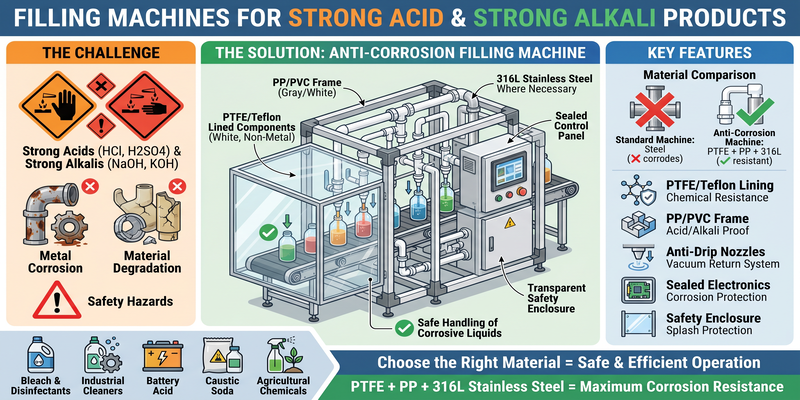
Handling corrosive liquids1 is a major headache. The wrong equipment fails quickly, costs a fortune to replace, and creates huge safety risks. You need a machine built to withstand them.
An anti-corrosion filling machine2 is the best choice. It uses special non-metallic materials like PP and Teflon3 to resist harsh chemicals. This ensures high accuracy, prevents contamination, and dramatically extends the machine's lifespan.
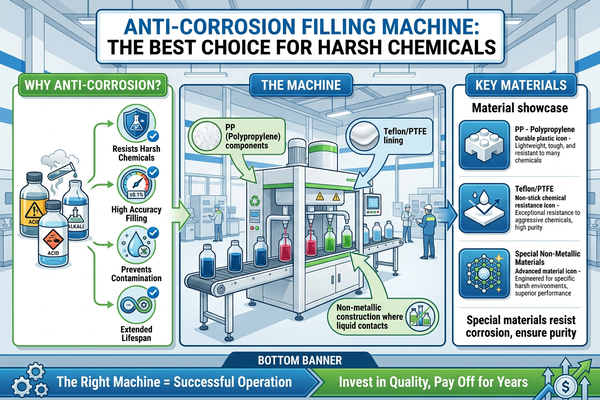
You now know that an anti-corrosion machine4 is the answer. But this is just the beginning of the story. The real difference between a successful operation and a constant series of problems lies in the details of that machine. Let's look deeper into what makes these machines so special and what you should look for when choosing one. Understanding these key features will help you make a smart investment that pays off for years.
Why are special materials essential for corrosive liquid filling machines5?
Choosing the wrong material for your filling machine is a costly mistake. It will corrode, fail, and contaminate your product, hurting your investment and your reputation.
Special materials like PP (Polypropylene) and Teflon are essential because they are chemically inert6. They do not react with strong acids or alkalis. This prevents machine breakdown, product contamination, and ensures long-term operational safety.
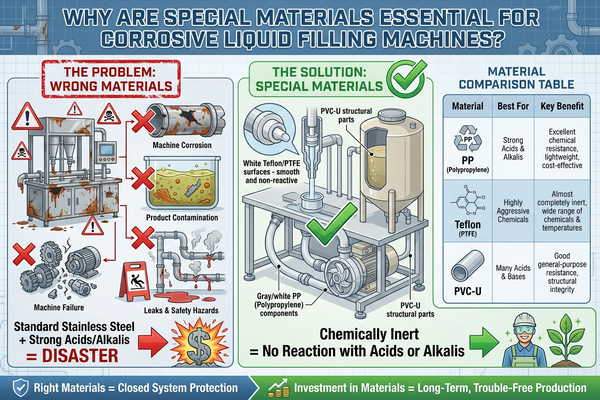
When I first started in this industry, I saw many companies try to save money by using standard stainless steel7 machines for everything. For many products, that works fine. But for strong acids like sulfuric acid or strong bases like sodium hydroxide, it's a recipe for disaster. The problem is that even high-grade stainless steel will eventually corrode when in constant contact with these aggressive chemicals. This leads to leaks, machine failure, and worst of all, metal ions leaching into the product, which can be a huge issue, especially in the chemical or agricultural industries.
The Anti-Corrosion Material Advantage
This is where specialized materials become non-negotiable. We build our anti-corrosion machines using materials chosen for their chemical resistance.
| Material | Best For | Key Benefit |
|---|---|---|
| PP (Polypropylene)8 | Strong Acids & Alkalis | Excellent chemical resistance, lightweight, and cost-effective. |
| Teflon (PTFE)9 | Highly Aggressive Chemicals | Almost completely inert, handles a very wide range of chemicals and temperatures. |
| PVC-U10 | Many Acids & Bases | Good general-purpose resistance and structural integrity. |
By using these materials for all parts that touch the liquid—the nozzle, the tubing, the pump, and the tank—we create a closed system that is completely protected. This not only guarantees the purity of your product but also dramatically extends the lifespan of the machine. An investment in the right materials is an investment in long-term, trouble-free production.
Can an anti-corrosion machine still be highly accurate?
You might worry that a special anti-corrosion machine has to sacrifice filling precision. Inaccurate fills mean wasted product, inconsistent quality, and lost profits with every single bottle.
Yes, an anti-corrosion machine can be extremely accurate. At RITO11, our models achieve a precision of ±0.3%. This is possible through advanced filling technologies and controls that are completely isolated from the corrosive environment.
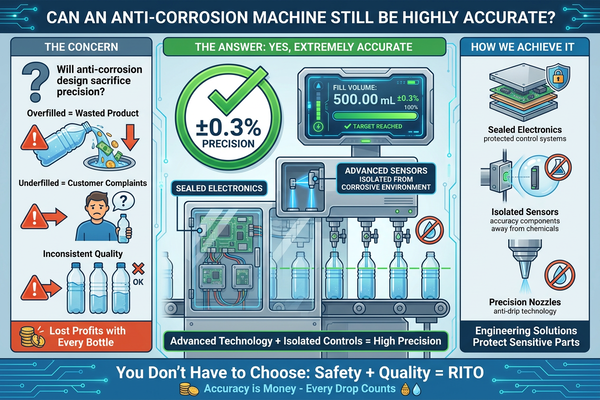
Accuracy is money. It's as simple as that. Every drop of overfilled product is profit down the drain. Every underfilled bottle is a potential customer complaint. So, when we designed our anti-corrosion fillers, we knew that maintaining high precision was just as important as resisting chemicals. We couldn't ask our clients to choose between safety and quality. They needed both. That's why we focused on engineering solutions that protect the sensitive parts of the machine that control accuracy.
How We Maintain Precision
The secret is in the design. We don't just swap out metal parts for plastic ones. We build the system intelligently.
- Servo-Driven Control12: The high-precision servo motors that drive the filling mechanism are located outside the "wet zone." They provide precise, repeatable motion without ever being exposed to corrosive fumes or splashes.
- Resistant Piston Design: The pistons themselves are crafted from materials like ceramic or Teflon. They move smoothly and accurately within the cylinder, delivering the exact same volume time after time, without degrading.
- Non-Contact Filling: For some applications, we use technologies like peristaltic pumps13. Here, the liquid only ever touches a disposable, resistant tube. The pump mechanism squeezes the tube from the outside, providing a very accurate dose without any contact between the product and the machine's core components.
With a precision of ±0.3%, a 1000ml fill will consistently be between 997ml and 1003ml. This level of control minimizes waste and ensures every package meets your quality standards.
What makes a manufacturer a true expert in anti-corrosion solutions?
Buying just a filling machine might not solve your whole production line problem. Mismatched equipment can cause bottlenecks, compatibility issues, and new points of potential corrosion down the line.
A true expert looks beyond the filler. For example, if you need a capping machine, we make sure any parts that might get splashed are also made from corrosion-resistant materials. This complete approach guarantees reliability.
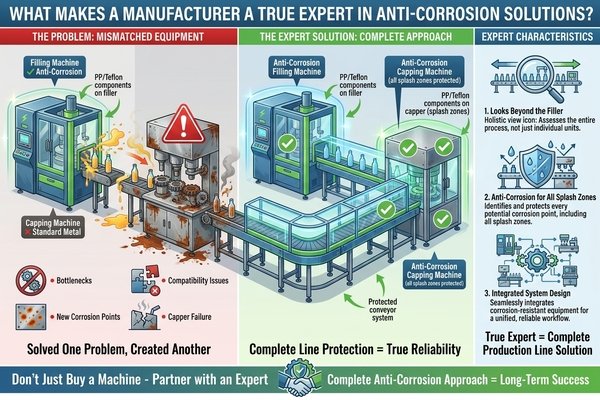
I remember a client who bought a fantastic anti-corrosion filling machine. However, they connected it to a standard capping machine. Within a few months, the capper started failing. Why? Because small splashes and fumes from the filler were corroding the metal parts of the capper. They solved one problem but created another one right next to it. This is a classic example of why you need to think about the entire production line, not just one machine.
The Value of an Integrated System
A true partner and expert in corrosive liquids understands this. They won't just sell you a box. They provide a complete solution.
- Holistic Design: When we talk to a client about filling strong acids, our first question isn't just about the filler. We ask, "What happens next?" We look at the capping, labeling, and conveying systems.
- Customized Capping: For a capping machine on a corrosive line, we identify all the parts that could be exposed to the liquid. We then replace standard steel parts, like the chuck or guide rails, with components made from PP, Teflon, or coated metals. This prevents the capper from becoming the weak link in the chain.
- Seamless Integration: An expert ensures all the machines communicate properly. The filler, capper, and labeler work together as a single, efficient unit. This prevents bottlenecks and ensures smooth, continuous operation.
Working with a manufacturer who provides a full, corrosion-resistant line means you have one point of contact and a unified design philosophy. It's the most reliable way to build a production line that is safe, efficient, and built to last.
Conclusion
For corrosive products, choose an anti-corrosion filler with the right materials for accuracy and longevity. Most importantly, partner with an expert who can provide a complete, reliable solution for your entire line.
"1910.1200 - Hazard Communication. | Occupational Safety ... - OSHA", http://www.osha.gov/laws-regs/regulations/standardnumber/1910/1910.1200. A governmental or institutional chemical-safety source can substantiate that corrosive liquids can attack materials, damage equipment or containers, and create significant handling hazards, making material compatibility and corrosion-resistant equipment necessary. Evidence role: general_support; source type: government. Supports: Handling corrosive liquids requires equipment built from compatible, corrosion-resistant materials because unsuitable equipment can corrode, fail, and create safety risks.. Scope note: This supports the general need for compatible, corrosion-resistant handling equipment; it may not validate any specific filling-machine design or performance claim. ↩
"[PDF] Materials Compatability", https://scs.illinois.edu/system/files/inline-files/MaterialsCompatability.pdf. Materials-selection references documenting the broad chemical resistance of polypropylene and PTFE to acids and alkalis support the claim that wetted components made from these polymers are appropriate for equipment handling corrosive liquids. Evidence role: mechanism; source type: education. Supports: An anti-corrosion filling machine is the best choice for handling corrosive liquids because it uses non-metallic materials like PP and Teflon to resist harsh chemicals, helping prevent contamination and extend machine lifespan.. Scope note: The evidence supports the material-resistance rationale, but the phrase “best choice” depends on the specific chemical, concentration, temperature, production requirements, and machine design. ↩
"[PDF] Materials Compatability", https://scs.illinois.edu/system/files/inline-files/MaterialsCompatability.pdf. Chemical-resistance references from engineering or institutional sources describe polypropylene and PTFE as polymers commonly selected for resistance to many acids, bases, and solvents, supporting their use in corrosion-resistant wetted components. Evidence role: definition; source type: institution. Supports: Polypropylene and PTFE are suitable non-metallic materials for resisting many harsh chemicals in filling equipment.. Scope note: Resistance depends on the specific chemical, concentration, temperature, and exposure time. ↩
"[PDF] Peristaltic pump", https://ptacts.uspto.gov/ptacts/public-informations/petitions/1530821/download-documents?artifactId=nzaOFjndm5pZTwy0gr9UuiaLKstYj7p_i_bhWG0IVDUqei4julU7GLk. Independent evidence on corrosion-resistant wetted materials and precision liquid-metering mechanisms can substantiate that filling equipment designed for corrosive liquids may still deliver accurate, repeatable fills. Evidence role: mechanism; source type: research. Supports: An anti-corrosion machine can be extremely accurate.. Scope note: A neutral source may support the general technical feasibility of accurate corrosive-liquid filling, but it is unlikely to verify the article’s vendor-specific ±0.3% accuracy claim without manufacturer test data. ↩
"[PDF] Materials Compatability", https://scs.illinois.edu/system/files/inline-files/MaterialsCompatability.pdf. Materials-compatibility evidence documenting the resistance of polypropylene and PTFE to acids and alkalis supports the claim that corrosive-liquid filling equipment requires chemically resistant wetted materials to reduce corrosion, contamination, and failure risk. Evidence role: general_support; source type: research. Supports: Corrosive liquid filling machines require special chemically resistant materials such as polypropylene and PTFE for wetted parts because these materials resist strong acids and alkalis, helping prevent corrosion-related machine breakdown and product contamination.. Scope note: Such sources establish material compatibility in general; performance in a specific filling machine also depends on concentration, temperature, exposure time, mechanical design, and maintenance conditions. ↩
"Polytetrafluoroethylene - Wikipedia", https://en.wikipedia.org/wiki/Polytetrafluoroethylene. Polymer chemistry references describe PTFE as highly chemically inert and polypropylene as resistant to many acids and alkalis, supporting the article’s characterization of these materials as low-reactivity choices for corrosive service. Evidence role: mechanism; source type: education. Supports: Special materials such as PP and PTFE are used because they have low chemical reactivity with many corrosive liquids.. Scope note: The term “chemically inert” is more directly applicable to PTFE than to polypropylene, whose resistance varies by reagent and conditions. ↩
"CORROSION FATIGUE OF TYPE 304 STAINLESS STEEL IN H>2 ...", https://experts.umn.edu/en/publications/corrosion-fatigue-of-type-304-stainless-steel-in-hsub2subsosub4su/. A corrosion-engineering source should substantiate that stainless steels, including common high-grade alloys, are not universally resistant to concentrated strong acids or alkalis and may corrode under sustained exposure depending on concentration, temperature, and alloy composition. Evidence role: mechanism; source type: institution. Supports: Even high-grade stainless steel can eventually corrode when kept in constant contact with aggressive chemicals such as strong sulfuric acid or sodium hydroxide.. Scope note: Corrosion resistance varies significantly by stainless-steel grade, chemical concentration, temperature, aeration, and exposure conditions; the source should not imply all stainless steels fail under all acid or alkali service conditions. ↩
"[PDF] CHEMICAL COMPATIBILITY CHART", https://www.wisconsin.edu/ehs/download/Fisher-Scientific-Chemical-Compatibility-Chart.pdf. Materials data from neutral engineering or institutional references list polypropylene as resistant to many acids and alkalis, supporting its use as a cost-effective polymer for corrosive chemical-contact parts. Evidence role: general_support; source type: institution. Supports: Polypropylene is useful for many strong-acid and alkali applications because of its chemical resistance.. Scope note: Polypropylene is not compatible with every chemical and may be limited by oxidizers, hydrocarbons, or elevated temperature. ↩
"Polytetrafluoroethylene - Wikipedia", https://en.wikipedia.org/wiki/Polytetrafluoroethylene. Reference sources characterize PTFE as a fluoropolymer with exceptionally broad chemical resistance and useful high-temperature stability, supporting its selection for highly aggressive chemical service. Evidence role: definition; source type: encyclopedia. Supports: PTFE is suitable for highly aggressive chemicals because it is broadly inert and temperature resistant.. Scope note: PTFE compatibility still has exceptions, such as some molten alkali metals and highly reactive fluorinating agents. ↩
"Chemical Resistance and Chemical Applications for CPVC ...", https://www.nrc.gov/docs/ML1820/ML18207A604.pdf. Engineering materials references identify unplasticized PVC as having good resistance to many acids, alkalis, and salts, supporting its use as a general-purpose corrosion-resistant plastic in chemical systems. Evidence role: general_support; source type: institution. Supports: PVC-U provides general-purpose resistance to many acids and bases in corrosive-liquid applications.. Scope note: PVC-U performance is limited by temperature and by incompatibility with some solvents and oxidizing chemicals. ↩
"Corrosion Resistant Corrosive Liquid Filler - E-PAK Machinery, Inc.", https://www.epakmachinery.com/media/corrosive-liquid-filler. A RITO technical datasheet or product specification stating that its anti-corrosion filling models achieve ±0.3% filling precision would substantiate the article’s specific performance claim. Evidence role: statistic; source type: other. Supports: At RITO, our models achieve a precision of ±0.3%.. Scope note: This would support the manufacturer-specific specification only; independent verification would require third-party testing or certification. ↩
"Closed Loop Stepper vs. Servo: Choosing the Right Motor", https://www.pmdcorp.com/quickbytes/closed-loop-stepper-vs-servo-how-to-choose-the-right-motor-control-approach. Industrial motion-control literature describes servo systems as closed-loop drives capable of accurate, repeatable position or motion control, supporting their use for precise dosing mechanisms when isolated from corrosive exposure. Evidence role: mechanism; source type: education. Supports: Servo-driven mechanisms can provide precise, repeatable motion for filling applications while allowing sensitive components to be separated from the wet zone.. Scope note: The source would support the servo-control principle, not the stated precision of any specific filling machine. ↩
"Peristaltic pump - Wikipedia", https://en.wikipedia.org/wiki/Peristaltic_pump. Pump references describe peristaltic pumps as moving fluid through flexible tubing so that the pumped liquid contacts only the tube interior, supporting their use for isolating corrosive fluids from pump components and reducing contamination risk. Evidence role: mechanism; source type: education. Supports: Peristaltic pumps can fill corrosive liquids while keeping the liquid isolated inside compatible tubing.. Scope note: Dosing accuracy depends on tubing material, pump design, calibration, pressure, and wear, so the source would not alone prove a specific accuracy value. ↩