

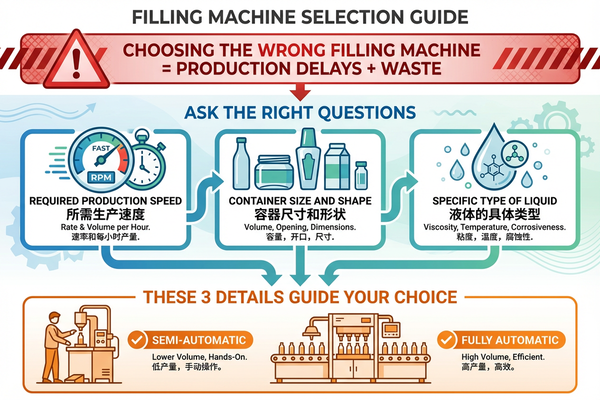
Choosing the wrong filling machine is a costly mistake that leads to production delays and waste. But asking the right questions upfront ensures you get the perfect machine.
The most important factors to consider are your required production speed1, the size and shape of your containers, and the specific type of liquid you are filling. These three details will guide you to the right semi-automatic or fully automatic machine2 for your needs.
Getting these three basics right is the foundation of a smart purchase. Over my 20+ years in this industry, I've helped countless clients navigate this process. It can feel overwhelming, but it doesn't have to be. Let's break down exactly what you need to know to make the best choice for your business.
How Does Production Speed Affect Your Machine Choice?
You're unsure whether to invest in a fast, expensive machine or a slower, cheaper one. A wrong choice can bottleneck your growth or drain your capital unnecessarily.
For low-volume or startup production, a semi-automatic machine3 offers great value and flexibility. For high-volume, continuous production, a fully automatic machine2 is essential to meet demand, reduce labor costs, and ensure consistent output. The choice depends entirely on your current and future goals.
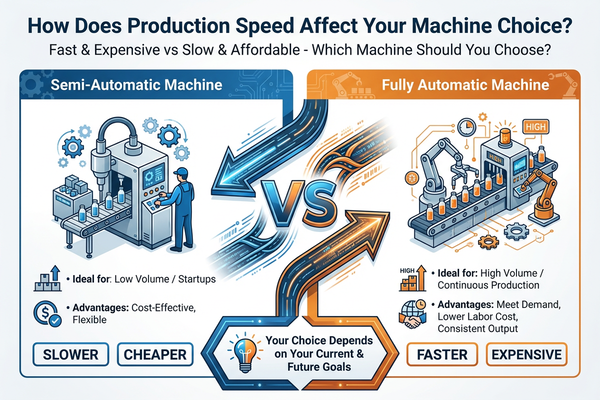
The first question we always ask a new client at RITO4 is, "How many bottles do you need to fill per minute or per hour?" Your answer immediately points us in one of two directions: semi-automatic or fully automatic. These aren't just labels; they represent completely different operational philosophies and investment levels. Understanding this difference is the key to matching a machine to your business reality, not just your current needs.
Semi-Automatic: The Flexible Starter
A semi-automatic machine3 is the perfect entry point. I've seen so many successful businesses start here. These machines require an operator to place the bottles, start the fill cycle, and then remove the filled bottles. While this sounds labor-intensive, it's incredibly cost-effective for small batches, seasonal products, or market testing. The initial investment is much lower, and their simplicity means you can easily switch between different products or bottle sizes without extensive downtime. It's the ideal solution for a business that values flexibility over raw speed.
Fully Automatic: The Growth Engine
When your orders start to outpace your ability to fill them, it's time to consider a fully automatic line. These machines handle everything from feeding empty bottles to filling, capping, and labeling them without any operator intervention. It's a significant investment, but the return is massive. You drastically reduce labor costs, eliminate human error, and achieve a consistent, high-speed output that can run 24/7. This is the choice for established businesses looking to scale up production and maximize efficiency.
Making the Right Speed Decision
Here is a simple breakdown to help you visualize the difference:
| Feature | Semi-Automatic Filler | Fully Automatic Filler |
|---|---|---|
| Speed | Lower (e.g., 5-20 BPM) | Higher (e.g., 20-200+ BPM) |
| Initial Cost | Lower | Higher |
| Labor Needs | Requires operator for each cycle | Minimal operator supervision |
| Best For | Startups, small batches, R&D | Large-scale production, established lines |
| Flexibility | High, easy to change over | Lower, optimized for specific tasks |
At RITO4, we help you look at your 3-to-5-year plan. Buying a machine that only solves today's problem can be a mistake. We'll help you find a solution that supports your growth.
Does Your Bottle Size and Shape Really Matter?
You have various bottle sizes but aren't sure which machine can handle them. Using the wrong equipment can lead to messy spills, inaccurate fills, and even damaged containers.
Yes, your container's size and shape are crucial. Small bottles, for instance, are often best handled by an integrated filling and capping machine (a monoblock) to save space and streamline the process. This ensures a smoother, more efficient, and compact operation from start to finish.
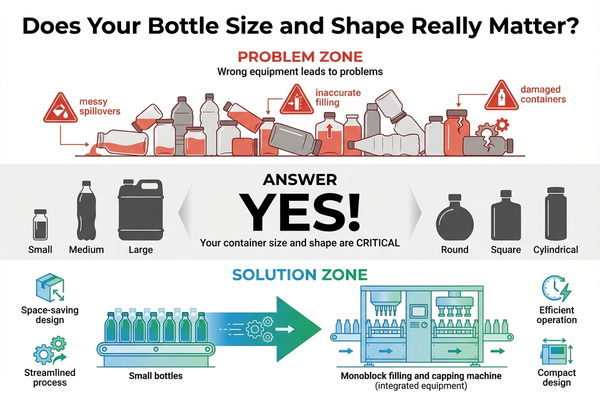
After speed, the next thing we look at is your container. It’s not just about the volume it holds; the height, diameter, and opening size all influence the type of filling machine that will work best. A machine designed for tall, thin wine bottles will struggle with short, wide jars. I remember a client who tried to use a standard filler for a uniquely shaped cosmetic bottle; the constant jamming and spilling cost them more in lost product than a proper machine would have. Let's look at how to avoid that.
Small Containers: The Case for Monoblock Machines
If you're filling small bottles (typically under 250ml) for products like essential oils, nail polish, or vials, a monoblock machine5 is often the best solution. These machines combine filling and capping onto a single, compact frame. This integration saves a huge amount of valuable floor space in your facility. More importantly, it creates a seamless process. The bottle is filled and immediately capped, which reduces the risk of contamination and improves overall efficiency. For anyone working with smaller containers, especially in the cosmetics or pharmaceutical industries, a monoblock is a game-changer.
Large Containers and Unique Shapes
When you move to larger containers like gallons, jugs, or pails, the mechanics change. You need a more robust system. The shape also becomes a major factor. Unstable or oddly shaped bottles might require special pucks or holders to move them securely through the filling line. At RITO4, we've designed custom solutions for all sorts of containers. We can equip a machine with adjustable guide rails and specialized filling nozzles6 to handle a wide range of shapes and sizes on one production line7, which is a huge benefit for contract packers8 or companies with diverse product lines.
Planning for Container Variety
If you plan to fill multiple bottle sizes, you need a machine designed for flexibility. This is where "change parts9" come in. These are components like star wheels, guides, and nozzles that can be quickly swapped out to accommodate a different container. A well-designed machine allows for a "tool-free" or quick changeover, meaning your team can switch from filling a 100ml bottle to a 1-liter bottle in minutes, not hours. This minimizes downtime and keeps your production line7 running efficiently, no matter what you're packaging that day.
Why Is Your Liquid's Type the Most Critical Factor?
You might think any filling machine can handle your liquid. But using the wrong one can contaminate your product, violate regulations, or even destroy the machine itself.
Identifying your liquid's properties is essential for choosing a safe, compliant, and durable machine. The product you are filling is the single most important detail in this entire process. It dictates everything from the materials we use to build the machine to the filling technology10 we recommend.
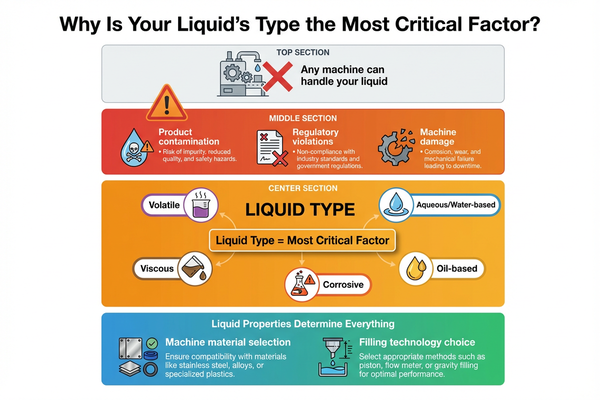
Your product is the hero of your business, and the filling machine is its most important partner. You wouldn't put a delicate food product in contact with industrial-grade materials, and you wouldn't try to pump a corrosive acid through a standard stainless steel pump. This is where professional guidance is not just helpful—it's necessary. A mismatch here can lead to disaster, from product recalls to complete equipment failure. At RITO4, we are experts in this area. We analyze your product's characteristics to build the perfect machine for it.
Food, Beverage, and Pharma Applications
If your product is something people will eat, drink, or use on their bodies, hygiene is the top priority. These applications demand machines built with food-grade materials11, typically 316L stainless steel, which has superior corrosion resistance compared to the standard 304 stainless steel. The machine must also be designed for easy cleaning. This often means "Clean-in-Place" (CIP) systems, tri-clamp fittings that are easy to disassemble, and surfaces with no cracks or crevices where bacteria can hide. It’s all about meeting Good Manufacturing Practices (GMP12) to ensure your product is safe and pure.
Corrosive and Industrial Chemicals
On the other end of the spectrum are aggressive, corrosive liquids13 like acids, bleach, or certain cleaners. Putting these liquids through a standard stainless steel machine would be a disaster; the machine would corrode and fail in a short time. For these applications, we build machines from anti-corrosive materials. This could mean using plastics like PVC or HDPE, or for extremely aggressive chemicals, even specialized metals like titanium. Furthermore, if the product is flammable, the machine must be equipped with explosion-proof motors14 and electronics to ensure a safe working environment.
Viscosity: From Water to Paste
| Finally, we consider your liquid's thickness, or viscosity15. This determines the filling technology10. | Liquid Type | Key Consideration | Recommended Machine Material/Type |
|---|---|---|---|
| Beverages, Sauces | Hygiene, Sanitary standards (GMP12) | Food-grade 316L Stainless Steel, Overflow or Piston Filler | |
| Cosmetics (Creams) | Viscosity, Accuracy, No-drip | Piston Filler, Servo-driven Pump Filler | |
| Acids, Bleach | Corrosion Resistance | PVC, Titanium, or other anti-corrosive plastics | |
| Oils, Solvents | Flammability, Explosion-proof | Explosion-proof motors and electronics (ATEX rated) |
A thin, watery liquid like juice is perfect for an overflow filler, which fills each bottle to the same level for a great cosmetic appearance on the shelf. But a thick liquid like honey or a cream would just make a mess. For that, you need a piston filler16, which acts like a syringe to accurately push a specific volume of product into the container.
Conclusion
Choosing the right liquid filler comes down to speed, container size, and your product type. Get these right, and you'll build a reliable and efficient production line7.
Understanding production speed is crucial for selecting a filling machine that meets your operational needs and growth plans. ↩
Discover how fully automatic machines can enhance efficiency and reduce labor costs for high-volume production. ↩
Explore how semi-automatic machines offer flexibility and cost-effectiveness for startups and small production runs. ↩
Explore RITO's expertise in filling machines to ensure you make an informed choice for your production needs. ↩
Find out how monoblock machines streamline the filling and capping process for small containers, enhancing efficiency. ↩
Explore the various filling nozzles and their applications to ensure optimal performance for your products. ↩
Learn strategies for enhancing efficiency and reliability in your filling production line. ↩
Understand the unique requirements of contract packers when selecting filling machines for diverse product lines. ↩
Understand how change parts facilitate quick adjustments for different bottle sizes, minimizing downtime in production. ↩
Explore various filling technologies to find the best match for your product's characteristics and requirements. ↩
Learn about the importance of food-grade materials in ensuring hygiene and safety for food and beverage applications. ↩
Explore the significance of GMP in ensuring product safety and quality in food and pharmaceutical filling processes. ↩
Discover the best practices for selecting machines that can safely handle aggressive and corrosive liquids. ↩
Learn about the importance of explosion-proof motors for safely handling flammable liquids in production. ↩
Understand how the thickness of your liquid influences the type of filling technology needed for accurate dispensing. ↩
Discover how piston fillers provide accuracy for thick liquids, ensuring precise filling without mess. ↩