

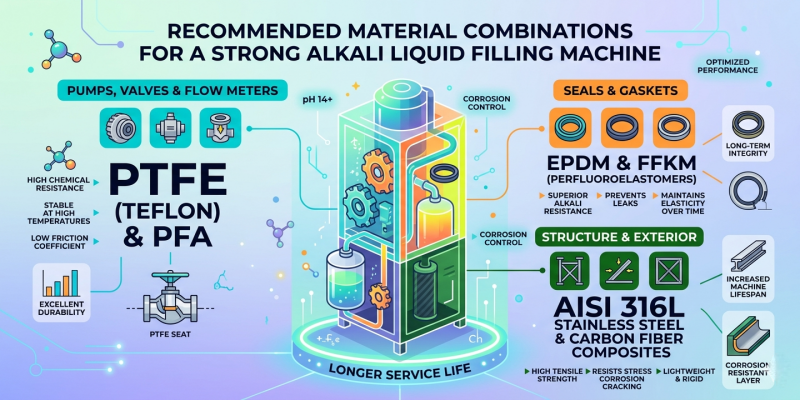
Struggling with equipment that breaks down from corrosive liquids? It’s a costly problem when strong alkalis eat away at your filling machine, causing constant downtime and maintenance headaches.
For a strong alkali liquid filling machine, the best material combination is a Polypropylene (PP) body, with Polyvinyl Chloride (PVC) for all liquid-contact parts like tubing and nozzles, and a PVC piston1. This setup provides excellent corrosion resistance, ensuring a long service life and reliable performance.
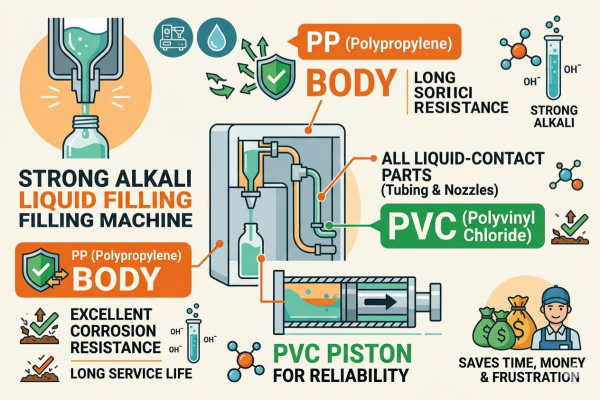
Now you know the secret formula: PP and PVC. But the real value comes from understanding why this specific combination works so well. Each material plays a distinct role, and getting it right is the difference between a machine that lasts for a decade and one that fails in a year. Let’s dive deeper into how these materials come together to create a truly robust and reliable filling system. Making the right choice here will save you a lot of time, money, and frustration down the road.
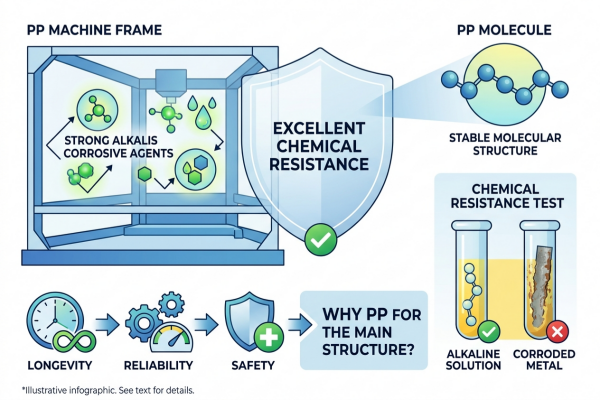
Why is Polypropylene (PP) the Top Choice for the Machine's Main Structure?
Choosing the wrong material for your machine's frame is a recipe for disaster. Corrosion can weaken the structure, turning your expensive equipment into a ticking time bomb of unreliability and safety hazards.
Polypropylene (PP) is the ideal choice for the machine's main structure because of its outstanding chemical resistance2. It stands up to strong alkalis without degrading3, protecting the machine's integrity and guaranteeing a long, stable operational life. It’s a smart, durable, and cost-effective foundation.
I remember visiting a plant years ago that was using a standard metal-framed machine for a caustic soda solution. The air itself felt corrosive, and the machine's legs were literally rusting away. It was a powerful lesson in material science. That's why we rely on Polypropylene for the main body and frame of our strong alkali fillers.
Chemical Inertness
PP is a thermoplastic polymer4 that is famous for its resistance to a wide range of chemicals, including the strong alkalis that are so destructive to metals. Unlike stainless steel, which can still suffer from pitting or stress corrosion cracking when exposed to certain concentrations of sodium hydroxide or potassium hydroxide5, PP remains completely unaffected. It doesn't react, it doesn't rust, and it doesn't leach6. This chemical inertness is the primary reason it forms the backbone of a durable alkali filling machine, ensuring the structural integrity is never compromised by the very product it's designed to handle.
Physical Durability and Cost-Effectiveness
Beyond its chemical properties, PP offers a great balance of physical strength and low cost. It has a good stiffness-to-weight ratio7, meaning it can be used to build a strong, rigid frame without being excessively heavy. It also has decent impact resistance8, which is important in a busy production environment. When you compare the costs, the choice becomes even clearer.
| Material | Alkali Resistance | Cost | Weight |
|---|---|---|---|
| Polypropylene (PP) | Excellent | Low | Low |
| Stainless Steel 304 | Poor | Medium | High |
| Stainless Steel 316L | Fair to Good | High | High |
As you can see, for this specific application, PP provides the best performance at the most reasonable cost, making it the superior choice for the machine's non-contact structural components.
How Do PVC Components Enhance the Filling Machine's Performance and Safety?
Your machine's frame can be perfect, but it's the parts that touch the liquid that face the biggest battle. The wrong material for tubes, seals, or nozzles leads to leaks, contamination, and inaccurate fills.
Polyvinyl Chloride (PVC) is used for all "wetted" parts, including tubing, nozzles, and the piston head. Its smooth surface and high resistance to alkali corrosion prevent product contamination and ensure consistent, accurate filling volumes, which is critical for safety and quality.
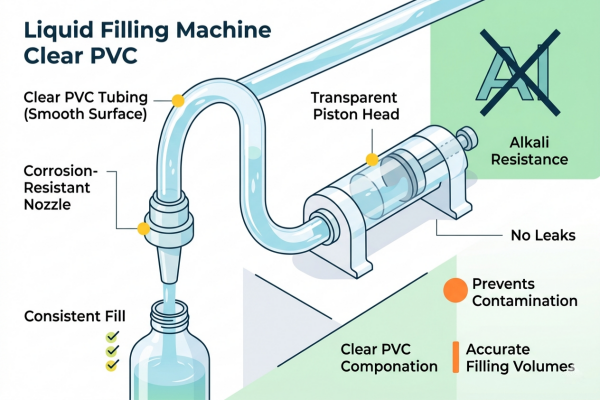
When we design a machine, we think about every single surface the liquid will touch. This is what we call the "liquid path." For strong alkalis, this path must be completely inert. Using PVC for these critical components is a non-negotiable part of our design philosophy. It's the only way to guarantee both the purity of the product and the longevity of the machine itself.
Direct Contact Resistance
The primary job of the liquid contact parts is to survive constant exposure to the corrosive product. PVC excels here. It is highly resistant to a broad spectrum of chemicals, and especially strong alkalis.9 This means the material won't swell, soften, or break down over time. This consistent stability is crucial. A material that degrades can shed particles into your product, leading to contamination. PVC's proven resistance ensures that the product being filled remains pure from the tank to the final container, which is absolutely essential in industries like chemical manufacturing or industrial cleaning supplies.
Maintaining Filling Accuracy and Safety
Performance isn't just about survival; it's also about precision. PVC can be manufactured with a very smooth internal surface. This is more important than it sounds. A smooth surface reduces friction and prevents product residue from sticking to the walls of the tubing or the nozzle.10 This ensures a clean, consistent flow and makes the machine much easier to clean between batches. More importantly, it helps maintain volumetric accuracy. When residue builds up, it can alter the internal diameter of the tubes, leading to inaccurate fills. By using smooth PVC components, we ensure that every fill is as precise as the last, from the first bottle of the day to the thousandth. This reliability is key to reducing product waste and ensuring quality control.
What is the Role of the Steel Barrel Driver in a Non-Metallic System?
You might be thinking, "Wait, you just said to avoid metal, but now you're talking about steel?" It does sound like a contradiction. A machine built entirely from plastic might not have the power needed for industrial work.
The steel barrel driver is a non-contact mechanical part. It provides the power and precision needed to move the piston, but it never touches the alkali liquid. This design gives you the strength of steel and the chemical resistance of the PVC piston.
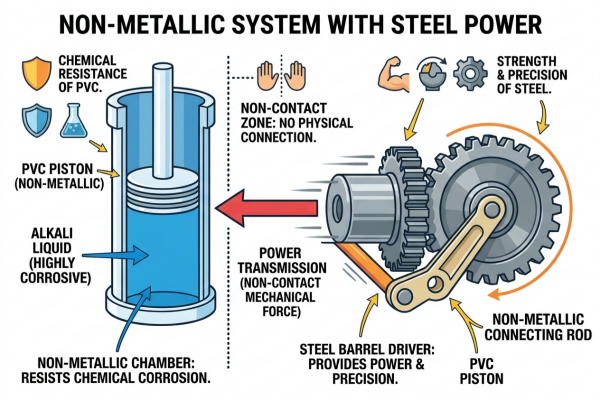
Think of it like this: the engine in your car is made of metal for strength and power, but it's completely separate from the gasoline in the fuel lines. We apply the same principle here. We use the right material for the right job. The steel driver provides the muscle, while the plastic parts handle the corrosive liquid. It’s a hybrid design that gives you the best of both worlds.
The Power Behind the Piston
To achieve fast, accurate, and repeatable fills, the piston needs to be driven with significant force and precision. This is especially true for thicker, more viscous liquids. A robust steel barrel, typically powered by a pneumatic cylinder or a servo motor, provides the raw strength and rigidity needed for this task. It won't flex, warp, or wear down under the high-cycle demands of a production line. An all-plastic drive system would simply not have the long-term durability or the precision required for industrial-grade performance. The steel driver is the powerhouse that ensures the machine can run reliably for millions of cycles without a drop in performance.
Isolating Mechanics from Chemicals
The brilliance of this design lies in its separation of functions. The steel driver is purely a mechanical component. It is completely isolated from the liquid path by the PVC piston head and a series of high-performance seals. The driver pushes the back of the piston, and the piston pushes the liquid. There is never any contact between the steel and the strong alkali. This clever engineering allows us to leverage the mechanical advantages of steel—its strength, durability, and precision—without ever exposing it to the corrosive environment it's not suited for. This isolation is the key to creating a machine that is both powerful and incredibly durable in the face of harsh chemicals.
Conclusion
To build a strong alkali filling machine that lasts, you need a smart combination of materials. A Polypropylene frame, PVC for all contact parts, and an isolated steel driver gives you long-term reliability.
"[PDF] Chemical Resistance Chart", https://biotech.gsu.edu/core_facility/Documents/pdfs/glove_chemical_resistant_chart.pdf. A materials compatibility source should show that polypropylene and PVC are generally rated as resistant to concentrated alkaline solutions, supporting their selection for alkaline-liquid handling components. Evidence role: general_support; source type: institution. Supports: The best material combination for a strong alkali liquid filling machine is a PP body with PVC liquid-contact parts and a PVC piston.. Scope note: This would support the chemical-compatibility rationale, but it would not by itself prove that this exact machine configuration is optimal for every alkali concentration, temperature, or duty cycle. ↩
"Polypropylene - Wikipedia", https://en.wikipedia.org/wiki/Polypropylene. A polymer reference should document polypropylene’s broad resistance to many acids, bases, and solvents, including alkaline environments. Evidence role: definition; source type: encyclopedia. Supports: Polypropylene has outstanding chemical resistance relevant to alkaline service.. Scope note: General chemical-resistance references may not cover every concentration, temperature, or mechanical-stress condition relevant to filling equipment. ↩
"[PDF] Study of Sound Absorption Coefficients and Characterization of Rice ...", https://bioresources.cnr.ncsu.edu/wp-content/uploads/2016/06/BioRes_10_2_3378_Jayamani_HRB_Sound_Abs_Coeff_-Rice_Straw_PP_Composites.pdf. A chemical compatibility table should indicate that polypropylene is compatible with strong bases such as sodium hydroxide and potassium hydroxide under specified conditions. Evidence role: general_support; source type: institution. Supports: Polypropylene can withstand strong alkalis without significant degradation under compatible service conditions.. Scope note: Compatibility ratings are condition-dependent and should be checked against the exact alkali, concentration, temperature, and exposure duration. ↩
"Polypropylene", https://en.wikipedia.org/wiki/Polypropylene. An encyclopedia or polymer-science source should define polypropylene as a thermoplastic polymer produced by polymerizing propylene. Evidence role: definition; source type: encyclopedia. Supports: Polypropylene is a thermoplastic polymer.. ↩
"[PDF] Stress Corrosion Cracking of Duplex Stainless Steels in Caustic ...", https://repository.gatech.edu/bitstreams/44cf9295-c7e4-4b43-815b-4cbe4534508c/download. A corrosion reference should document that stainless steels may experience localized corrosion or caustic stress-corrosion cracking in hot or concentrated caustic environments. Evidence role: mechanism; source type: paper. Supports: Stainless steel can suffer pitting or stress corrosion cracking in certain sodium hydroxide or potassium hydroxide environments.. Scope note: The risk varies substantially with stainless grade, caustic concentration, temperature, oxygen content, and applied stress. ↩
"Plastic Products Leach Chemicals That Induce In Vitro Toxicity ...", https://pmc.ncbi.nlm.nih.gov/articles/PMC8427741/. A polymer compatibility or toxicology source should support that polypropylene is generally chemically inert and corrosion-free in many alkaline environments. Evidence role: general_support; source type: research. Supports: Polypropylene is generally inert and non-rusting in alkaline service and is not expected to contaminate the liquid under appropriate conditions.. Scope note: The statement is absolute; leaching and extractables can depend on additives, formulation, temperature, and regulatory grade of the polypropylene. ↩
"Experimental Study of Mechanical Properties of Polypropylene ...", https://pmc.ncbi.nlm.nih.gov/articles/PMC8911984/. A materials-property database or polymer handbook should provide polypropylene’s density and mechanical modulus, supporting the characterization of PP as a lightweight structural polymer with useful stiffness. Evidence role: statistic; source type: institution. Supports: Polypropylene has a useful stiffness-to-weight balance for lightweight structural components.. Scope note: Material properties vary by grade, filler content, processing method, and service temperature. ↩
"Research and application of polypropylene: a review - PMC", https://pmc.ncbi.nlm.nih.gov/articles/PMC10761633/. A polymer-materials source should list polypropylene impact-strength properties and describe its common use where toughness and light weight are needed. Evidence role: statistic; source type: institution. Supports: Polypropylene has moderate impact resistance suitable for many industrial plastic components.. Scope note: Impact resistance depends heavily on PP grade, copolymer type, fillers, temperature, and notch sensitivity. ↩
"[PDF] Chemical Resistance and Chemical Applications for CPVC Pipe and ...", https://www.nrc.gov/docs/ML1820/ML18207A604.pdf. A PVC chemical-resistance reference should indicate that rigid PVC is generally resistant to many bases, including sodium hydroxide and potassium hydroxide, under specified service conditions. Evidence role: general_support; source type: institution. Supports: PVC is highly resistant to many chemicals, including strong alkalis, when used under compatible conditions.. Scope note: PVC compatibility depends on formulation, plasticizer content, concentration, temperature, pressure, and exposure time. ↩
"Does Surface Roughness Necessarily Increase the Fouling ...", https://pubmed.ncbi.nlm.nih.gov/36719958/. A fluid-mechanics or surface-engineering source should explain that smoother internal pipe surfaces reduce wall friction and can reduce sites for deposition compared with rougher surfaces. Evidence role: mechanism; source type: education. Supports: Smooth internal surfaces can reduce friction and help limit residue accumulation in tubing or nozzles.. Scope note: This supports the general mechanism, but actual residue buildup also depends on liquid chemistry, viscosity, flow velocity, temperature, and cleaning procedures. ↩