

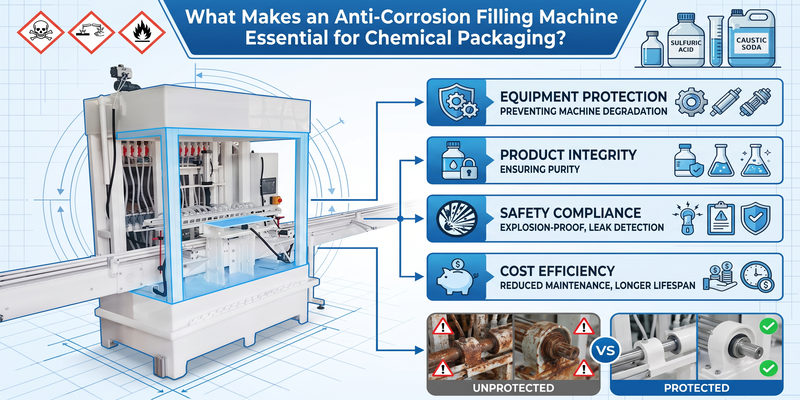
Handling corrosive chemicals is tough. They eat away at your equipment, causing costly damage and downtime. An anti-corrosion filling machine1 is the only safe and durable solution for your business.
An anti-corrosion filling machine is essential because standard machines can't handle corrosive chemicals. These specialized fillers use materials like stainless steel, titanium, and PE, preventing damage, ensuring safety, and extending the machine's life, which protects your investment.
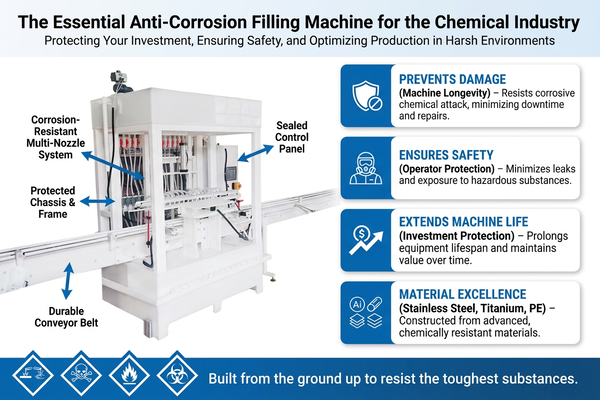
I've seen firsthand what happens when the wrong machine meets a harsh chemical. The breakdown is quick, messy, and expensive. But why exactly are these machines so different? It's more than just a special coating; it's about building the entire machine from the ground up to resist the toughest substances. Let's break down the core components and materials that make them so robust and necessary for anyone in the chemical industry.
How Do Anti-Corrosion Materials Protect Your Filling Machine?
You worry about your machine's longevity. Aggressive chemicals constantly threaten to corrode parts, leading to failure. The right materials are your first and best line of defense against this.
Anti-corrosion materials create a protective barrier against chemical reactions. Materials like 316L stainless steel, titanium alloys, and plastics like PTFE and PE2 are non-reactive with acids and alkalis, preventing rust and degradation of machine parts.
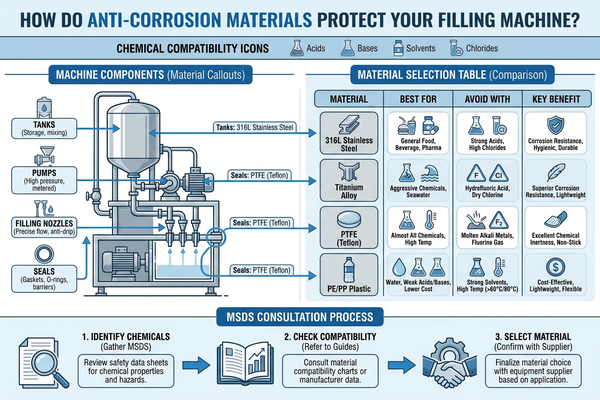
Choosing the right material is the most critical decision in designing an anti-corrosion filling machine. At RITO3, we don't believe in a one-size-fits-all approach. The ideal material depends entirely on the chemical you are packaging. It's not just about whether it's an acid or an alkali; concentration and temperature also play a huge role4. For example, a material that resists a weak acid might fail completely when exposed to a high concentration of the same acid. We always consult our client's Material Safety Data Sheet (MSDS) to make an expert recommendation. The parts that come into direct contact with the product, like the nozzles, pumps, tanks, and seals, are the most vulnerable. Using the wrong material here can lead to leaks, product contamination, and catastrophic system failure.
Here’s a simple breakdown of common materials we use:
| Material | Best For | Avoid With | Key Benefit |
|---|---|---|---|
| 316L Stainless Steel5 | Mild acids, oils, solvents | Strong acids (like hydrochloric) | Good general resistance, cost-effective |
| Titanium Alloy6 | Strong oxidizing acids, chlorides | High-temperature reducing acids | Exceptional strength and resistance |
| PTFE (Teflon)7 | Most acids and bases | Not applicable (highly inert) | Extremely non-reactive, great for seals |
| PE / PP Plastic8 | Strong acids and alkalis | Organic solvents | Lightweight and highly resistant to many chemicals |
This selection process is a science we've perfected over many years to ensure our machines stand the test of time.
What Key Features Should You Look for in an Anti-Corrosion Filler?
Choosing a new machine is overwhelming. You know you need anti-corrosion materials, but what other features matter? Picking a machine without the right supporting features means you're still at risk.
Beyond materials, look for features like sealed electronics to protect from fumes, easy-to-clean designs to prevent residue buildup, and precise filling mechanisms. A robust frame and non-metallic contact parts in critical areas are also vital for longevity.
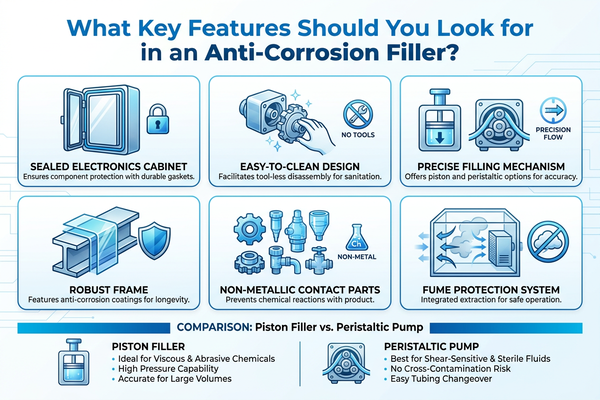
A truly effective anti-corrosion machine9 is about more than just the materials that touch the liquid. Corrosive fumes can be just as damaging as direct contact, slowly eating away at sensitive components. That's why we at RITO pay close attention to the entire machine ecosystem. Our electrical cabinets are fully sealed with gaskets to protect the PLC and other electronics from any corrosive atmosphere in your facility. The machine's main frame is also treated with special anti-corrosion coatings to prevent rust and degradation over time.
We also think about the filling technology itself. While a piston filler offers incredible accuracy, a peristaltic pump filler might be a better choice for extremely aggressive chemicals. With a peristaltic pump, the liquid only ever touches a disposable, chemically-resistant tube, meaning the core mechanics of the machine are never exposed. Another crucial feature is the ease of cleaning. We design our machines for quick, tool-less disassembly. This is vital because leftover chemical residue can continue to corrode parts even when the machine is idle. A simple and fast cleaning process ensures the machine's longevity and prevents cross-contamination between different product batches. These "hidden" details are what separate a good machine from a great one.
How Does an Anti-Corrosion Machine Improve Workplace Safety and ROI?
Chemical spills10 are a nightmare. They endanger your staff, damage your facility, and can lead to huge fines. A faulty, corroded machine dramatically increases this risk, threatening both your people and your profits.
Anti-corrosion machines drastically reduce the risk of leaks and spills caused by equipment failure. This protects workers from hazardous chemicals and prevents costly product loss. Their durability means fewer replacements and less downtime, directly boosting your return on investment (ROI).
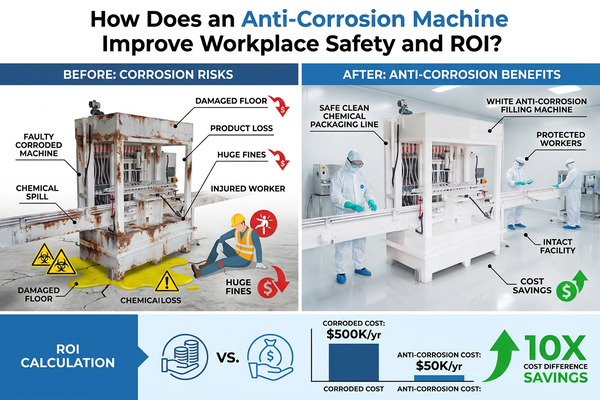
The return on investment for a proper anti-corrosion machine goes far beyond the initial purchase price. I remember a new client who came to us after a major incident. Their standard filling machine, which wasn't designed for chemicals, failed while packaging an acidic cleaning agent. The resulting spill not only ruined an entire pallet of product but also damaged the concrete floor and unfortunately put an employee on medical leave. They thought they were saving money with a cheaper machine, but the true cost of that one incident was ten times the price difference.
By investing in a proper anti-corrosion line from RITO, they immediately improved their situation. Here's how the ROI breaks down:
- Safety: The number one benefit. A machine built to resist corrosion is far less likely to leak or fail catastrophically. This protects your team from exposure to hazardous substances and helps you comply with workplace safety regulations like OSHA.
- Reduced Downtime: Machines that corrode need constant repairs and part replacements. An anti-corrosion filler runs reliably for longer, meaning more production uptime and less money spent on maintenance.
- No Product Loss: Spills and leaks mean wasted product. A reliable machine ensures every drop of your valuable chemical product gets into the final container.
- Longer Equipment Lifespan: These machines are built to last in harsh environments. You won't have to replace your entire filling line every few years, providing a much better long-term value.
The ROI isn't just in dollars saved; it's in the peace of mind that comes from running a safe, compliant, and efficient operation.
Conclusion
An anti-corrosion filling machine is not a luxury for chemical packaging; it's a fundamental requirement for safety, efficiency, and long-term profitability. Your team and your business are worth the investment.
"NIOSH Pocket Guide to Chemical Hazards - CDC", https://www.cdc.gov/niosh/npg/default.html. Authoritative guidance on handling corrosive chemicals notes that equipment and containers must be chemically compatible and corrosion-resistant to prevent degradation, leaks, and hazardous releases. Evidence role: general_support; source type: government. Supports: Standard filling machines are unsuitable for corrosive chemicals; an anti-corrosion filling machine should use chemically compatible, corrosion-resistant materials to prevent equipment damage, leaks, and safety risks.. Scope note: The evidence supports the material-compatibility and safety rationale for corrosion-resistant filling equipment, but may not address a specific commercial filling-machine model. ↩
"[PDF] CHEMICAL COMPATIBILITY CHART", https://www.wisconsin.edu/ehs/download/Fisher-Scientific-Chemical-Compatibility-Chart.pdf. A neutral chemical-compatibility reference documenting the acid and alkali resistance of PTFE and polyethylene would support the use of these polymers for corrosion-resistant wetted parts in chemical filling equipment. Evidence role: general_support; source type: institution. Supports: PTFE and PE are plastics used in anti-corrosion filling machines because they resist chemical attack from many acids and alkalis, helping prevent degradation of machine parts.. Scope note: Polyethylene compatibility varies by grade, chemical concentration, temperature, and exposure duration; the evidence should not imply universal resistance to all acids, alkalis, or solvents. ↩
"[PDF] Material Compatibility Evaluation for DWPF Nitric- Glycolic Acid - SRS", https://digital.library.unt.edu/ark:/67531/metadc842228/m2/1/high_res_d/1084446.pdf. Corrosion-engineering literature establishes that material compatibility is specific to the chemical environment and is strongly affected by factors such as chemical species, concentration, temperature, and exposure conditions, supporting the need to select wetted filling-machine components according to the product’s SDS and compatibility data. Evidence role: expert_consensus; source type: paper. Supports: The ideal material for an anti-corrosion filling machine depends on the chemical being packaged, including its concentration and temperature, and should be selected using compatibility information such as the product’s MSDS/SDS.. Scope note: This supports the general materials-selection principle, not any specific performance claim about RITO machines. ↩
"Effects of Different Ions and Temperature on Corrosion Behavior of ...", https://pmc.ncbi.nlm.nih.gov/articles/PMC7345544/. A corrosion-engineering source should show that corrosion rate and material compatibility vary with solution concentration and temperature; this directly supports the article’s qualification that chemical identity alone is insufficient for selecting construction materials. Evidence role: mechanism; source type: education. Supports: Chemical concentration and temperature are major variables in determining whether a material will resist corrosion.. ↩
"Stainless steel - Wikipedia", https://en.wikipedia.org/wiki/Stainless_steel. A neutral metallurgy or corrosion reference should state that 316L stainless steel has good general corrosion resistance, including improved resistance from molybdenum, but can be vulnerable to certain aggressive acids and chloride environments; this supports the table’s broad positioning rather than every listed application. Evidence role: definition; source type: encyclopedia. Supports: 316L stainless steel is a corrosion-resistant material often used in chemical service but is not universally resistant to strong acids.. Scope note: The source may not classify all ‘mild acids, oils, solvents’ as suitable; detailed compatibility still requires chemical-specific data. ↩
"Corrosion Resistance of Titanium", https://www.nrc.gov/docs/ML9932/ML993210187.pdf. A corrosion reference should document titanium’s resistance in many oxidizing and chloride-containing environments and its limitations in reducing acids at elevated temperatures; this supports the table’s material guidance at a general level. Evidence role: definition; source type: research. Supports: Titanium alloys can offer strong corrosion resistance in oxidizing acid and chloride environments but may be unsuitable for high-temperature reducing acids.. Scope note: Titanium performance depends strongly on alloy grade, acid chemistry, aeration, concentration, and temperature. ↩
"Polytetrafluoroethylene - Wikipedia", https://en.wikipedia.org/wiki/Polytetrafluoroethylene. A polymer-chemistry or materials reference should show that PTFE is chemically inert and resistant to a broad range of acids and bases, supporting its use for seals and wetted components; this does not mean PTFE is appropriate for all temperatures, pressures, or mechanical loads. Evidence role: definition; source type: encyclopedia. Supports: PTFE is highly chemically inert and broadly resistant to acids and bases, making it useful for seals in corrosive service.. Scope note: Compatibility may be constrained by service temperature, mechanical wear, permeability, or specific reactive chemicals. ↩
"[PDF] CHEMICAL COMPATIBILITY CHART", https://www.wisconsin.edu/ehs/download/Fisher-Scientific-Chemical-Compatibility-Chart.pdf. A polymer compatibility reference should support that polyethylene and polypropylene are resistant to many acids and alkalis while certain organic solvents can cause swelling, stress cracking, or degradation; this supports the table’s broad guidance but not any specific chemical formulation. Evidence role: definition; source type: research. Supports: PE and PP plastics resist many acids and alkalis but may be unsuitable for some organic solvents.. Scope note: Actual compatibility depends on polymer grade, solvent type, concentration, temperature, and exposure time. ↩
"How to Handle Chemical Spills - Penn State Extension", https://extension.psu.edu/how-to-handle-chemical-spills/. Independent corrosion-safety guidance documents that corrosion degrades process equipment, can cause leaks or failures when handling hazardous chemicals, and is mitigated through chemically compatible, corrosion-resistant materials and controls. Evidence role: general_support; source type: institution. Supports: A proper anti-corrosion machine for chemical filling reduces the likelihood of leaks, spills, equipment failure, downtime, and related safety or cost impacts.. Scope note: Such sources generally support the safety and reliability rationale, but may not quantify ROI for a specific filling-machine model or operating environment. ↩
"NIOSH Pocket Guide to Chemical Hazards - CDC", https://www.cdc.gov/niosh/npg/default.html. Government occupational-safety and environmental guidance documents on hazardous chemical spill response describe worker exposure risks, required containment/cleanup procedures, and potential enforcement penalties for noncompliance. Evidence role: general_support; source type: government. Supports: Chemical spills endanger staff, can damage facilities, and may lead to regulatory fines.. Scope note: Specific fines and facility-damage consequences depend on the chemical involved, spill volume, jurisdiction, and applicable regulations. ↩