

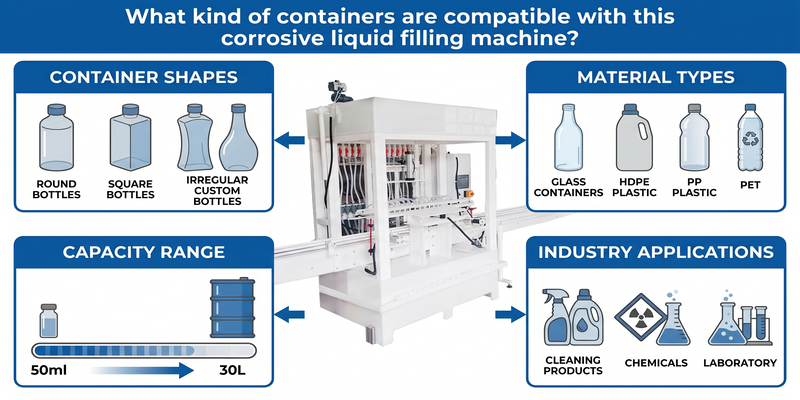
Handling corrosive liquids is a huge risk.1 You worry about damaging your containers or, even worse, the filling machine itself, leading to costly spills and production delays.
Our corrosive liquid filling machine is highly versatile. It is designed to handle a wide range of container shapes, including round, square, and custom irregular bottles. It is also compatible with both glass and plastic materials, all while ensuring safety when filling corrosive liquids.
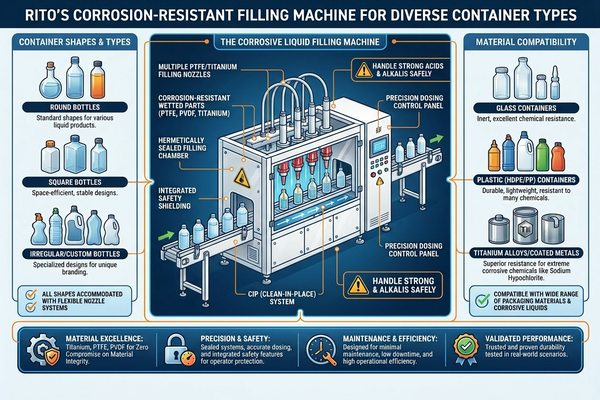
It's a relief to know that one machine can handle so much variety. This flexibility opens up a lot of possibilities for packaging and product lines. But you might be wondering about the specifics. How does the machine adapt to such different materials and shapes without causing problems? Let's dive into the details and see how it works.
Can it really handle both plastic and glass containers safely?
You might worry that a machine strong enough for glass could crush plastic bottles. Or, a machine gentle enough for plastic might not be secure enough for heavy glass containers.
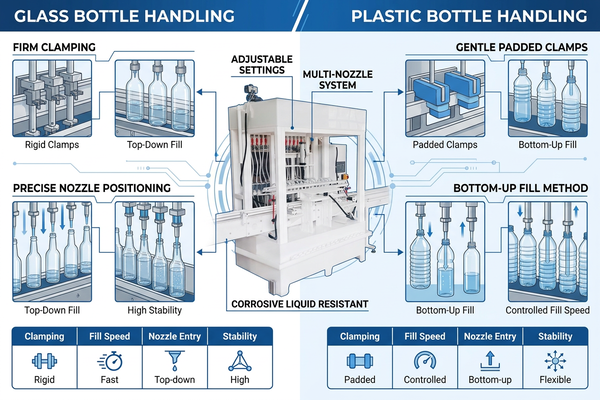
Yes, it handles both safely. The machine has adjustable settings for container gripping, filling pressure, and speed2. This allows it to process sturdy glass bottles and flexible plastic ones without causing any damage, ensuring a secure and efficient fill every time.
When I first started in this industry, I saw many companies struggling with this exact problem. They would buy separate lines for glass and plastic, which took up so much space and budget. Our goal was to create a single, robust solution. The key is in the machine's adaptability.
Adjusting for Glass Containers
Glass is rigid and heavy, so the primary concern is stability and preventing breakage.3 Our machine uses a heavy-duty conveyor belt with firm, adjustable guide rails that keep the glass bottles perfectly aligned. The clamping mechanism that holds the bottle during filling applies a solid, secure grip without putting stress on the glass itself. The machine's frame is also built from reinforced steel to absorb vibrations, which is critical when you're moving heavy glass containers at high speeds. This ensures the bottles don't knock against each other or the filling nozzles, preventing chips and cracks.
Adapting to Plastic Containers
Plastic containers, like PET or HDPE, are much lighter but can be easily dented or deformed.4 For these, the machine uses a gentler touch. The gripper pressure is reduced, and we can even use soft, padded clamps to hold the bottle securely without marking it. The filling nozzles can also be programmed for a "bottom-up" fill, where the nozzle lowers into the bottle and retracts as it fills. This prevents foaming and splashing5, especially with thinner liquids, and avoids putting pressure on the container's neck.
| Feature | Glass Container Considerations | Plastic Container Considerations |
|---|---|---|
| Clamping | Firm, secure grip to prevent any movement. | Gentle, controlled pressure to avoid dents or deformation. |
| Fill Speed | Can often be higher due to the container's rigidity. | May need a controlled speed to prevent foaming or splashing. |
| Nozzle Entry | Precise positioning is key to avoid chipping the bottle opening. | Soft or non-contact filling is preferred to protect the container. |
| Stability | Relies on a robust frame and firm guide rails. | Relies on smooth transport and gentle handling mechanisms. |
Do special or irregular bottle shapes cause filling problems?
Your unique bottle design helps your product stand out, but you're worried it will jam a standard filling line. This could lead to production stalls, wasted product, and major frustration.
No, they don't cause problems. Our machine uses adjustable guide rails and precision sensors to handle all kinds of shapes. For very unique bottles, we use custom-made "pucks" that hold the bottle securely6, ensuring a perfect, centered fill every time without jamming.
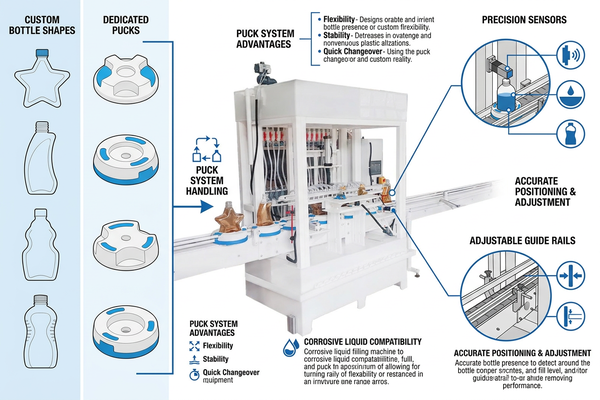
I remember a client who came to us with a fantastic star-shaped bottle for a new cleaning product. They thought they would have to fill every bottle by hand. They were convinced no automated system could handle it. We showed them how a simple puck system would solve their problem.
Handling Round and Square Bottles
Round and square bottles are the easiest to work with. The machine's guide rails can be adjusted in minutes with a simple hand-crank to fit the exact width of the container. For round bottles, a star wheel is often used to feed them into the filling station with perfect spacing7. This is a simple, mechanical system that is incredibly reliable and fast. It's the bread and butter of liquid filling, and our machine masters it with ease.
Mastering Irregular and Custom Shapes
This is where the real magic happens. For bottles that aren't round or square, we use something called a "puck." A puck is basically a custom holder, shaped like a standard round or square bottle on the outside, but with a perfect cavity for your unique bottle on the inside. You place your irregular bottle into the puck, and the machine handles it as if it were a simple, standard container. This is how we helped that client with the star-shaped bottle. We designed a puck that held it securely, and they were able to run thousands of bottles per day automatically. This system gives you complete design freedom for your packaging without sacrificing production efficiency.
What makes the machine itself resistant to corrosive liquids?
You've invested in a filling machine, but you're constantly worried that the product you're filling is slowly destroying it from the inside out. This is a common fear.
The secret is in the materials we use. All the parts that come into contact with your liquid are made from high-grade, corrosion-resistant materials like 316L stainless steel, titanium, or specialized polymers.8 This prevents the machine from degrading and keeps your product pure.
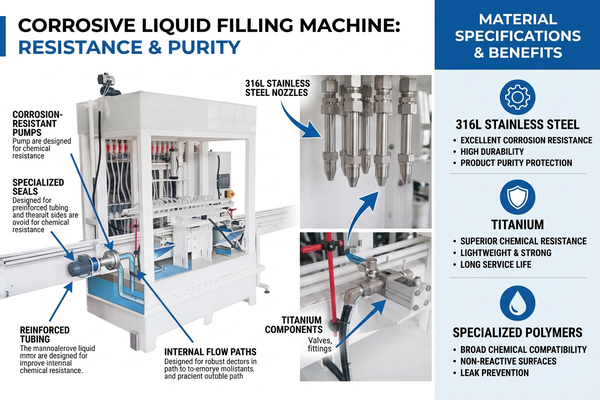
A machine is only as strong as its weakest part. When you're dealing with acids, bleach, or strong alkalis, using the wrong material can lead to disaster. It can cause machine failure, but more importantly, it can contaminate your product, which is a risk no one can afford to take. That's why we are so serious about material selection.
The Importance of Wetted Parts
"Wetted parts"9 is the term we use for every component that the liquid touches. This includes the storage tank, pumps, tubing, and the filling nozzles themselves. For a standard liquid, a material like 304 stainless steel might be fine. But for corrosive products, that's not nearly enough. Strong acids or chloride-based liquids (like bleach) can eat through 304 stainless steel10 in a surprisingly short amount of time. That's why we start with 316L stainless steel as our baseline for corrosive applications.
Choosing the Right Material for the Job
We don't believe in a one-size-fits-all solution. We analyze your product's chemical properties to select the perfect material. For many products, 316L stainless steel, which has added molybdenum for extra corrosion resistance11, is sufficient. But for extremely aggressive chemicals, we go further. For products containing high concentrations of chloride, like certain industrial cleaners or bleach, we recommend using titanium for the wetted parts. Titanium is practically immune to this type of corrosion.12 For seals and gaskets, which need to be flexible, we use materials like PTFE (Teflon) because it is chemically inert to almost everything.
| Corrosive Liquid Type | Recommended Material | Why it Works |
|---|---|---|
| Strong Acids | Titanium, Hastelloy | Resists rapid corrosion from low pH chemicals. |
| Bleach (Chlorides) | Titanium, PE, PVC | Resists the strong oxidizing and pitting effects of chlorides. |
| Solvents | 316L Stainless Steel, PTFE | Offers broad chemical compatibility and prevents product contamination. |
| Alkaline Cleaners | 316L Stainless Steel | Provides excellent resistance to corrosion from high pH solutions. |
Conclusion
This machine offers incredible flexibility for container shapes and materials. Its robust, corrosion-resistant construction ensures it can handle your products safely and reliably, making it a versatile and long-lasting solution.
"1910.120 App C - Compliance Guidelines | Occupational Safety and ...", http://www.osha.gov/laws-regs/regulations/standardnumber/1910/1910.120AppC. Government occupational-safety guidance identifies corrosive liquids as substances capable of causing severe tissue damage and requiring controlled handling, storage, and spill-response procedures, supporting the claim that they present significant safety hazards. Evidence role: expert_consensus; source type: government. Supports: Handling corrosive liquids presents significant safety and operational risks.. Scope note: This supports the general hazard of corrosive-liquid handling, not the specific probability or cost of machine damage in this article. ↩
"The Journey of Liquid Products through Advanced Filling Equipment", https://www.accutekpackaging.com/the-journey-of-liquid-products-through-advanced-filling-equipment/. Packaging-engineering references describe container handling force, fill pressure, and line speed as adjustable process variables used to accommodate different container materials and shapes during automated liquid filling. Evidence role: mechanism; source type: education. Supports: Adjusting gripping force, filling pressure, and speed helps filling equipment handle both glass and plastic containers safely.. Scope note: This would support the engineering principle, but it would not independently verify the settings or performance of the specific machine described. ↩
"Packaging Glasses: From Containers to Encapsulation Composition ...", https://pmc.ncbi.nlm.nih.gov/articles/PMC12897758/. Materials-science sources characterize glass as rigid and brittle, with density generally higher than common packaging plastics, supporting the need to control stability and impact during automated handling. Evidence role: mechanism; source type: education. Supports: Glass containers require stable handling because glass is rigid, relatively heavy, and prone to brittle fracture.. Scope note: The source would support the material-property rationale, not the exact design requirements of this filling machine. ↩
"Comparison and Optimization: Research on the Structure of the PET ...", https://pmc.ncbi.nlm.nih.gov/articles/PMC9371001/. Polymer and packaging-material references report that PET and HDPE have lower densities and lower stiffness than glass, supporting the need for gentler mechanical handling to avoid deformation. Evidence role: mechanism; source type: education. Supports: PET and HDPE containers are lighter than glass and can deform under handling pressure.. Scope note: Actual deformation risk depends on wall thickness, bottle geometry, temperature, and applied force. ↩
"Filling Foamy Products - The Bottom Up Fill Solution", https://www.liquidpackagingsolution.com/news/filling-foamy-products---the-bottom-up-fill-solution. Filling-process references describe bottom-up or subsurface filling as a technique that reduces splashing, air entrainment, and foam formation by keeping the discharge point below or close to the liquid surface. Evidence role: mechanism; source type: education. Supports: Bottom-up filling can reduce foaming and splashing during liquid filling.. Scope note: The degree of foam reduction depends on liquid viscosity, surfactants, fill speed, nozzle design, and container geometry. ↩
"Pros and Cons of a Puck-Line for Bottle Packaging - Posimat", https://www.posimat.com/en/blog/pros-and-cons-of-a-puck-line-for-bottle-packaging-a-realistic-view-for-packaging-automation. Packaging-line references describe bottle or container pucks as fixtures that carry unstable, non-round, or custom-shaped containers through conveyors and filling stations while maintaining orientation and spacing. Evidence role: mechanism; source type: institution. Supports: Custom pucks can secure irregularly shaped bottles during automated filling.. Scope note: This supports the general use of pucks for irregular containers, not the performance of a particular custom puck design. ↩
"Filling Machine Options - Indexing Systems", https://www.liquidpackagingsolution.com/news/filling-machine-options---indexing-systems. Packaging-machinery descriptions identify star wheels as rotating indexing components used to meter, space, and position bottles or containers in filling, capping, and labeling operations. Evidence role: definition; source type: education. Supports: Star wheels are commonly used to space and index bottles into filling stations.. Scope note: The citation would support the general function of star wheels, while “perfect spacing” remains an idealized phrasing dependent on equipment setup and tolerances. ↩
"(PDF) Corrosion-materials-selection - Academia.edu", https://www.academia.edu/16531357/Corrosion_materials_selection. Corrosion-engineering and chemical-compatibility references identify 316L stainless steel, titanium, and selected fluoropolymers or engineering plastics as common wetted-material options for corrosive chemical service. Evidence role: general_support; source type: research. Supports: Wetted components for corrosive liquid equipment are commonly made from corrosion-resistant metals and polymers such as 316L stainless steel, titanium, and specialized plastics.. Scope note: This supports the appropriateness of these material classes for corrosive service in general, but it does not verify the actual bill of materials of the machine described. ↩
"Wetting - Wikipedia", https://en.wikipedia.org/wiki/Wetting. Engineering terminology sources define wetted parts as the components of equipment that come into direct contact with the process fluid, such as internal surfaces, seals, tubing, pumps, and nozzles. Evidence role: definition; source type: encyclopedia. Supports: “Wetted parts” means equipment components that directly contact the liquid being processed.. ↩
"Corrosion Behavior of Sensitized AISI 304 Stainless Steel in Acid ...", https://pmc.ncbi.nlm.nih.gov/articles/PMC9740934/. Corrosion references report that 304 stainless steel is vulnerable to pitting and crevice corrosion in chloride-containing environments and can be unsuitable for some strong acids, supporting the warning that these liquids can rapidly degrade 304 stainless under adverse conditions. Evidence role: mechanism; source type: research. Supports: Strong acids and chloride-containing liquids can corrode 304 stainless steel.. Scope note: Corrosion rate depends strongly on concentration, temperature, pH, oxygen, exposure time, and cleaning conditions; the phrase “eat through” is colloquial and condition-dependent. ↩
"[PDF] Effect of Molybdenum Additions on the Microstructures and ... - OSTI", https://www.osti.gov/servlets/purl/1439854. Materials references describe 316L stainless steel as a low-carbon austenitic stainless steel containing molybdenum, which improves resistance to pitting and crevice corrosion compared with 304 stainless steel, especially in chloride environments. Evidence role: mechanism; source type: encyclopedia. Supports: 316L stainless steel contains molybdenum that improves corrosion resistance.. Scope note: 316L is more resistant than 304 in many environments but is not universally resistant to all corrosive liquids or all chloride concentrations. ↩
"[PDF] Corrosion Resistance of Titanium", https://www.nrc.gov/docs/ML9932/ML993210187.pdf. Corrosion literature describes titanium as having excellent resistance to many chloride-containing and oxidizing environments because of its stable passive oxide film, supporting its use for selected chloride-rich corrosive liquids. Evidence role: mechanism; source type: research. Supports: Titanium has exceptional resistance to many chloride-related corrosion mechanisms and is often selected for chloride-rich corrosive service.. Scope note: “Practically immune” is stronger than most technical sources; titanium can corrode under certain reducing acids, high-temperature chlorides, or fluoride-containing conditions. ↩