

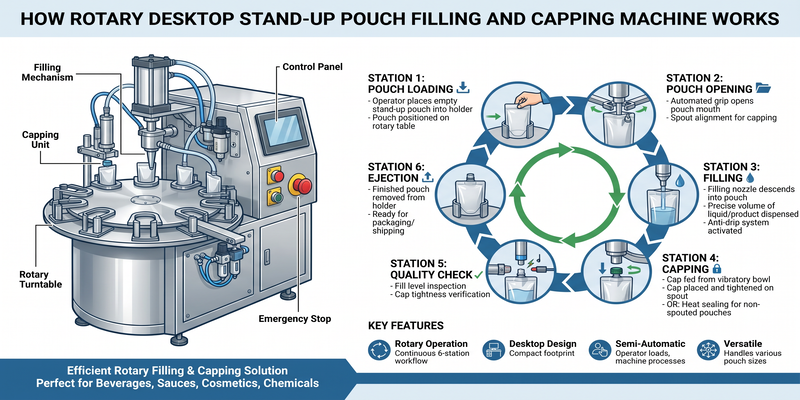
Struggling with slow, messy pouch filling? Manual processes are costing you time and product. There's a better, more efficient way to package liquids in stand-up pouches1.
A rotary desktop stand-up pouch2 filling and capping machine is a compact, semi-automatic system3. One person loads pouches, and the machine automatically fills them with precise amounts of liquid and then tightens the caps, streamlining your entire packaging process from start to finish.
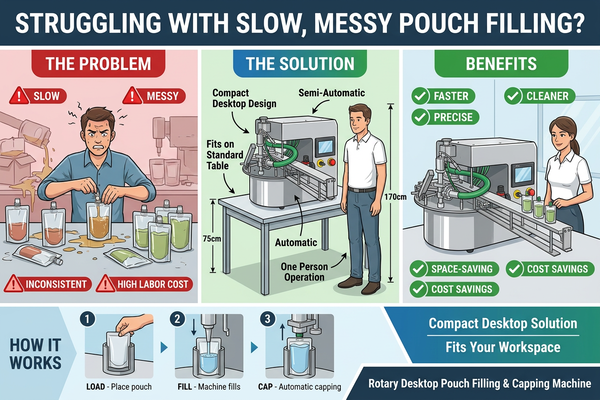
This sounds great, but how does it actually fit into a real workflow? Let's break down the process and see what makes this machine a game-changer for so many businesses, including mine. It's a simple but powerful tool that can really transform a production line.
How Does The Machine's Workflow Actually Operate?
Confused about how a semi-automatic machine works? You worry it might be complex. But this machine simplifies the process into a few easy steps for one operator.
It's a simple, five-step rotary process4. An operator hangs a pouch, the machine fills it, a cap is placed (manually or automatically), it's automatically tightened, and then the finished pouch is discharged. This cycle repeats continuously for efficient production.
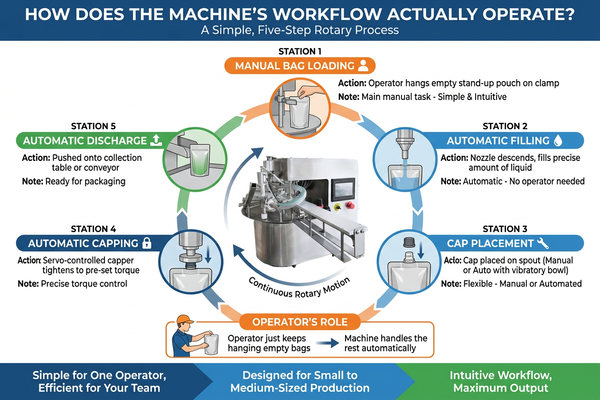
The beauty of this machine is its simplicity and continuous motion. I've worked with clients who were initially intimidated, but they quickly saw how intuitive the workflow is. It’s designed around a single operator, making it incredibly efficient for small to medium-sized teams. The rotary table moves from one station to the next in a smooth, circular path. Let's look at each station in the cycle.
- Manual Bag Loading: The process starts with the operator. They simply take an empty stand-up pouch and hang it on a clamp at the first station. This is the main manual task in the entire process.
- Automatic Filling: Once the pouch is in place, the rotary table moves it to the filling station. Here, a nozzle descends and fills the pouch with a precise amount of liquid.
- Cap Placement: The table rotates again. At this station, a cap needs to be placed on the pouch's spout. This can be done manually by the operator or automated with a vibrating bowl feeder that sorts and places the caps for you.
- Automatic Capping: Next, the pouch moves to the capping station. A servo-controlled capper descends, grips the cap, and tightens it to a pre-set torque5.
- Automatic Discharge: In the final step, the perfectly filled and sealed pouch is automatically pushed off the machine and onto a collection table or a conveyor belt.
The operator just needs to keep hanging empty bags, and the machine handles the rest.
What Kind Of Performance And Capacity Can I Expect?
Worried a desktop machine can't keep up? You need speed and flexibility but fear small machines are too limited. This compact unit delivers surprising performance and versatility.
This machine handles a wide range of volumes, from 50g to 3000g6. Its speed is impressive, reaching 15 to 35 bags per minute depending on the fill volume. For example, it can package 1000g pouches at about 20-25 bags per minute.
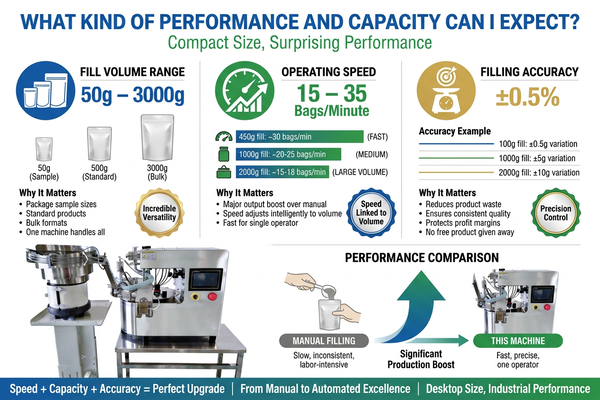
When my clients are looking to scale up, performance is their biggest question. They need to know if the investment will actually increase their output. The answer with this machine is a definite yes. The key is understanding the relationship between fill volume, speed, and accuracy. The machine is fast, but the speed naturally adjusts based on how much product it needs to dispense. It takes longer to pump 2000g of liquid than it does 450g. For example, you can expect around 30 bags per minute for a 450g fill, but for a large 2000g fill, the speed will be closer to 15-18 bags per minute. This is still remarkably fast for a single operator.
Then there's the accuracy, which is critical for cost control. This machine boasts an accuracy of ±0.5%. Let’s break that down. For a 100g fill, the variation is only plus or minus 0.5g. For a large 1000g (1kg) pouch, you're only looking at a variation of ±5g. This precision means you aren't giving away free product or short-changing customers.
| Feature | Specification | Why It Matters for Your Business |
|---|---|---|
| Fill Volume Range | 50g – 3000g | Offers incredible flexibility to package sample sizes, standard products, and bulk formats with one machine. |
| Operating Speed | 15 – 35 Bags/Minute | Provides a major output boost over manual methods, with speed intelligently linked to the volume being filled. |
| Filling Accuracy | ±0.5% | Reduces product waste, ensures consistent quality, and protects your profit margins on every single pouch. |
This combination of speed, capacity, and accuracy makes it the perfect step up from manual or tabletop methods.
What Key Technical Features Make This Machine So Efficient?
Technical jargon can be intimidating. You see terms like "servo" and "gear pump" and worry about complexity. Let's break down what these powerful components actually do for you.
The machine's efficiency comes from its core components. A servo magnetic gear pump ensures precise, self-priming filling. Meanwhile, a servo claw capper7 provides consistent, adjustable torque for perfect seals every time, preventing leaks and product damage.
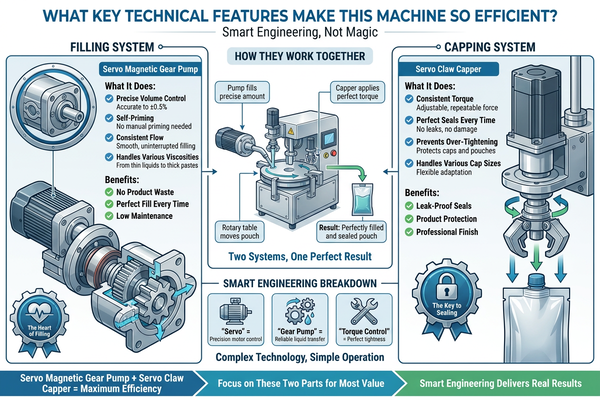
The "magic" of this machine isn't magic at all; it's just smart engineering. I always tell my clients to focus on two main parts that deliver most of the value: the filling system8 and the capping system9.
The Heart of the Machine: The Servo Magnetic Gear Pump10
This is what guarantees your filling accuracy. The "servo" part means the motor is digitally controlled. It receives precise electronic commands, so it knows exactly how much to turn, ensuring the same amount of liquid is dispensed every single time. The "magnetic gear pump" design is brilliant for food and cosmetic applications. It uses magnets to connect the motor to the pump, so there are no physical seals that can wear out, break down, and contaminate your product. It’s also self-priming, which means it can pull liquid directly from your main tank without any extra setup.
The Perfect Seal: The Servo11 Claw Capper
Leaky pouches are a nightmare. They create a mess, waste product, and ruin customer trust. The servo claw capper solves this problem. Just like the filling pump, it uses a servo motor for digital precision, but this time it controls the twisting force, or "torque." I've seen so many people struggle with manual capping; it's either too loose or so tight that the cap strips. With this machine, you just type the exact torque value you need into the screen. A mechanical claw then grips the cap and tightens it perfectly every time. This adjustable torque is a game-changer for quality control.
These two core technologies, combined with the efficient rotary design, are what allow a single operator to achieve the output of a much larger team.
Conclusion
This desktop rotary machine is a powerful solution for businesses needing efficient, accurate, and versatile pouch filling and capping without a huge footprint or major capital investment.
"Retort pouch - Wikipedia", https://en.wikipedia.org/wiki/Retort_pouch. A neutral source defining stand-up pouches as a form of flexible packaging, including spouted or reclosable variants used for liquids and semi-liquids, would support the statement that liquids can be packaged in stand-up pouches. Evidence role: definition; source type: encyclopedia. Supports: Liquids can be packaged in stand-up pouches.. Scope note: This support establishes the suitability and common use of stand-up pouches for liquid packaging, but it does not verify the performance or efficiency claims of the specific filling and capping machine described in the article. ↩
"Stand-up pouch - Wikipedia", https://en.wikipedia.org/wiki/Stand-up_pouch. The source defines a stand-up pouch as a flexible package designed to stand upright, typically using a bottom gusset, supporting the article’s use of the term for the pouch format handled by the filling and capping machine. Evidence role: definition; source type: encyclopedia. Supports: A rotary desktop stand-up pouch filling and capping machine is designed to package liquids in stand-up pouches.. Scope note: This evidence would define the packaging format but would not verify the performance or specifications of the specific machine described. ↩
"Electro-Pneumatic Portable Packaging Machine - Academia.edu", https://www.academia.edu/102020168/Electro_Pneumatic_Portable_Packaging_Machine. A packaging engineering or automation reference should define semi-automatic packaging equipment as machinery that combines operator-fed handling with automated machine operations, supporting the article’s classification of the desktop pouch filler. Evidence role: definition; source type: education. Supports: A rotary desktop stand-up pouch filling and capping machine is a compact, semi-automatic system.. Scope note: This would support the category description, not the specifications of any particular model. ↩
"Rotary Indexing Table: What Is It? - Motion Control Tips", https://www.motioncontroltips.com/rotary-indexing-table/. A packaging systems reference on rotary indexing machines should explain that rotary equipment advances containers through sequential stations, supporting the article’s description of a multi-station rotary workflow. Evidence role: mechanism; source type: education. Supports: The machine operates as a five-step rotary process in which pouches move through loading, filling, cap placement, capping, and discharge stations.. Scope note: The source would support the general rotary-indexing principle, while the exact five-station configuration may vary by machine design. ↩
"Closure Torque - Qorpak", https://shop.qorpak.com/resources/closure-torque/. A packaging or metrology source on closure application torque should support that capping equipment can be set to apply a specified torque to closures during sealing. Evidence role: mechanism; source type: institution. Supports: A servo-controlled capper tightens caps to a pre-set torque.. Scope note: The source would support the concept of torque-controlled capping, not prove that every capper maintains the same torque accuracy. ↩
"Apakah Itu Rotary Desktop Stand-Mesin Pengisian Dan Penutup ...", https://my.ritopackmachinery.com/info/what-is-a-rotary-desktop-stand-up-pouch-fillin-17812199109092352.html. A technical datasheet or operating manual for the rotary desktop stand-up pouch filling and capping machine should state the rated filling-volume range as 50–3000 g, supporting the article’s capacity specification. Evidence role: statistic; source type: other. Supports: This machine handles a wide range of volumes, from 50g to 3000g.. Scope note: This is a model-specific performance claim; neutral institutional sources may discuss pouch-filling equipment generally but are unlikely to verify this exact 50–3000 g range without a manufacturer datasheet or manual. ↩
"[PDF] Parker O-Ring Handbook", https://nfc.arizona.edu/sites/default/files/2022-02/parker_o-ring_handbook.pdf. The source explains that controlled cap-application torque is necessary for reliable closure seal integrity, supporting the claim that a servo-controlled claw capper can apply repeatable, adjustable tightening to reduce leakage and closure damage. Evidence role: mechanism; source type: research. Supports: A servo claw capper provides consistent, adjustable torque for reliable seals, helping prevent leaks and product damage.. Scope note: Support should be framed generally for torque-controlled capping systems unless the source specifically discusses claw-style servo cappers. ↩
"Mr. John Purcell, Roper Pump: ―Gear Pumps‖ Mr. Jim Brennan ...", https://www.academia.edu/12187212/Mr_John_Purcell_Roper_Pump_Gear_Pumps_Mr_Jim_Brennan_IMO_Pump_Multiple_Screw_Pumps_Mr_Kent_Whitmire_Roper_Pump_Progressing_Cavity_Pumps_Mr_Herbert_Werner_Fluid_Metering_Inc_Metering_Pumps. Technical literature on servo-driven positive-displacement pumps and magnetically coupled gear pumps explains that controlled pump rotation enables repeatable volumetric dosing, while magnetic coupling removes dynamic shaft seals and can reduce leakage or contamination risks. Evidence role: mechanism; source type: paper. Supports: The machine’s filling system uses a servo magnetic gear pump to deliver precise, repeatable liquid fills, with a seal-less magnetic drive design that helps reduce leakage or contamination risk.. Scope note: This supports the operating principle of the filling system, but it does not verify the performance specifications of the specific machine model unless paired with model-specific test data. ↩
"49 CFR Part 173 -- Shippers—General Requirements for Shipments ...", https://www.ecfr.gov/current/title-49/subtitle-B/chapter-I/subchapter-C/part-173. A packaging-engineering source on closure application torque would support that controlled capping systems apply repeatable, adjustable torque to closures, improving seal consistency and reducing risks such as leakage or closure damage. Evidence role: mechanism; source type: paper. Supports: A servo-controlled capping system improves pouch packaging efficiency by applying consistent, adjustable torque to tighten caps, helping create reliable seals and reduce leaks or cap or product damage.. Scope note: This support would establish the general engineering principle of torque-controlled capping, not the performance of this specific machine model unless the source tests that model directly. ↩
"[PDF] P&S Metering Article - Liquiflo pumps", https://www.liquiflo.com/v2/files/pdf/lit/brochures/Metering_Brochure.pdf. A technical paper or institutional engineering reference describing magnetically coupled gear/metering pumps can substantiate that magnetic coupling avoids dynamic shaft seals and that servo-controlled metering enables repeatable, precise liquid dosing. Evidence role: mechanism; source type: paper. Supports: A servo magnetic gear pump provides digitally controlled, precise liquid dispensing, can support self-priming filling, and uses magnetic coupling without conventional physical shaft seals to reduce wear and contamination risk.. Scope note: The source should support the general pump mechanism and dosing-control principles; it may not verify the performance of this specific packaging-machine model. ↩
"What Is a Servo Motor? Tech Explained - BU Blogs", https://blogs.bu.edu/jpark3/article-332/. A technical reference on servomotors explains that servo systems use feedback control to command and regulate motor position, speed, or torque, supporting the statement that a servo-driven pump can dispense repeatable amounts through precise motor control. Evidence role: mechanism; source type: education. Supports: The “servo” part means the motor is digitally controlled and can receive precise commands so it turns accurately and dispenses the same amount of liquid each time.. Scope note: This supports the general control principle of servo motors, not the specific performance of the described pouch-filling machine. ↩