

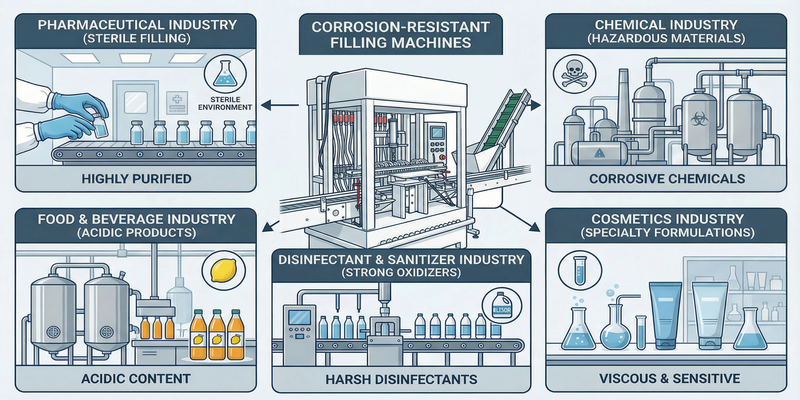
Handling corrosive liquids1 can damage your equipment and ruin your product. This leads to costly downtime and safety risks. Specialized anti-corrosion fillers2 are the only reliable solution for your business.
Industries like chemical manufacturing, agriculture, and daily chemicals absolutely require corrosion-resistant filling machines3. These machines are built with materials like PTFE4, PVDF5, and titanium6 to safely handle acids, alkalis, bleach, and solvents without degrading, ensuring both equipment longevity7 and product purity.
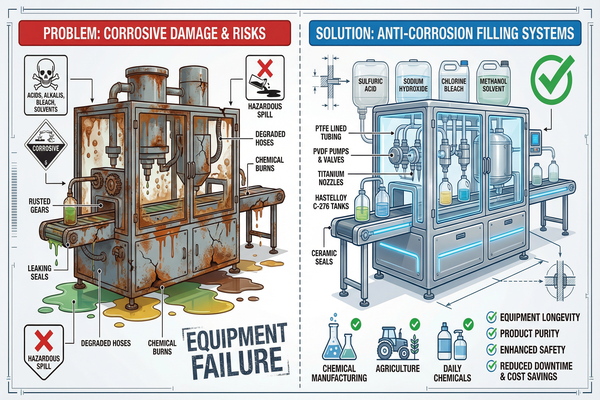
Choosing the right filling machine is one of the most critical decisions for your production line, especially when dealing with aggressive liquids. Using a standard machine for a corrosive product is a recipe for disaster, leading to leaks, contamination, and frequent, expensive repairs. But many people don't realize just how many common products are considered "corrosive" in an industrial setting. Let's explore the specific industries that depend on these specialized machines and see why they are so essential.
Why is the Chemical Industry a Prime User of Anti-Corrosion Fillers?
The chemical industry8 works with highly aggressive substances daily. Standard metal fillers corrode quickly, causing leaks, contamination, and dangerous situations. Anti-corrosion fillers are specifically designed to handle these harsh chemicals.
The chemical industry8 uses anti-corrosion fillers2 to safely package strong acids, bases, solvents, and chemical reagents. These machines use inert materials like PTFE4 and PVDF5 on all contact parts to prevent chemical reactions, guarantee operator safety, and maintain the integrity of the final product.
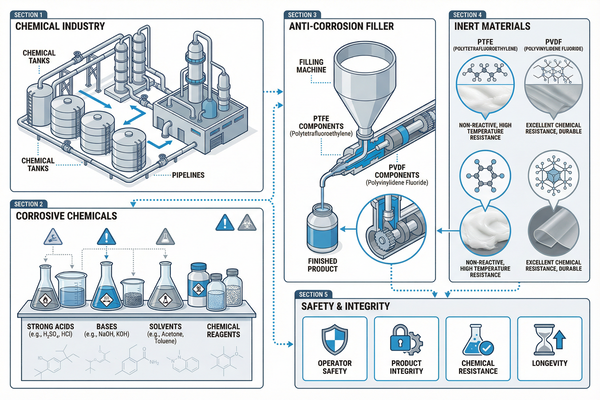
In my 20 years of experience, I've seen firsthand how destructive even seemingly minor chemicals can be to the wrong equipment. The chemical industry8 is the most obvious user of anti-corrosion technology because the liquids they handle are often extremely potent. We're talking about substances that can dissolve metal in hours.
Understanding the Materials
The key is in the materials used for the machine's "wet parts" – any component that touches the liquid. A standard machine might use 304 stainless steel, which is great for food products but not for strong acids. We at RITO9 build our anti-corrosion machines with a focus on complete inertness. This means using materials that do not react with the product.
Here’s a quick breakdown of common materials:
| Material | Used For | Key Benefit |
|---|---|---|
| PVC/CPVC | Mild acids, salts, alkalis | Cost-effective and good general resistance. |
| PTFE4 (Teflon) | Strong acids, bases, solvents | Extremely non-reactive and has a low-friction surface. |
| PVDF5 | Halogens (like chlorine), strong acids | Excellent chemical resistance and high mechanical strength. |
| Titanium | Oxidizing chemicals, chlorides | Superior strength-to-weight ratio and exceptional corrosion resistance. |
| Hastelloy | High-concentration acids, high temperatures | A high-performance alloy for the most extreme conditions. |
Common Chemical Applications
Our machines are used to fill a wide range of industrial chemicals. This includes sulfuric acid for batteries, hydrochloric acid10 for cleaning, sodium hydroxide for manufacturing processes, and various solvents used in labs. For these applications, accuracy is not enough. The machine must guarantee that no metallic ions leach into the product and that no hazardous leaks occur. This is a matter of safety, quality control, and regulatory compliance.
Do Daily Chemical Products Also Need Corrosion-Resistant Machines?
You might think household cleaners are harmless. But many contain corrosive agents like bleach or strong detergents that will degrade standard filling equipment over time, causing constant problems.
Yes, the daily chemical industry8 heavily relies on these machines. Products like toilet cleaners, disinfectants, and drain unblockers contain ingredients like sodium hypochlorite11 or acidic agents that require corrosion-resistant fillers to prevent equipment failure and ensure a long operational life.
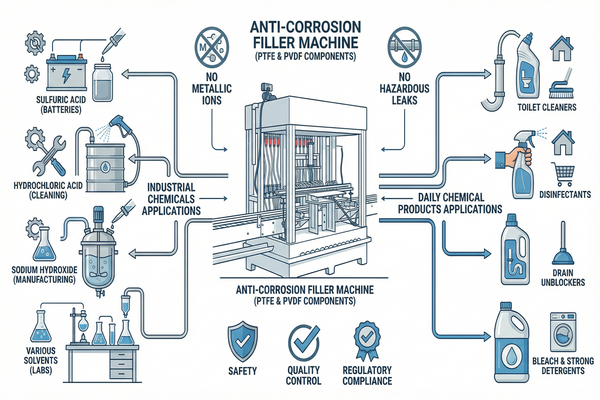
This is an area that often surprises our new customers. They see a bottle of cleaner on a supermarket shelf and assume it's not very aggressive. But when you are filling thousands of bottles an hour, day after day, even a mildly corrosive substance will cause significant wear and tear on a standard machine. The seals will degrade, the nozzles will clog, and the pump mechanisms will fail.
The Hidden Corrosives in Your Home
Many everyday products contain active ingredients that are corrosive by nature. It's what makes them effective. We have engineered solutions specifically for this market because we understand the long-term impact of these chemicals.
Here are some examples of daily chemical products12 and their corrosive components:
| Product Category | Common Corrosive Ingredients | Why It Matters for Filling |
|---|---|---|
| Bleach-Based Cleaners | Sodium Hypochlorite | Highly oxidative, will attack most metals and elastomers. |
| Toilet Bowl Cleaners | Hydrochloric Acid, Sulfamic Acid | Strongly acidic, requiring plastic or high-grade alloy contact parts. |
| Drain Openers | Sodium Hydroxide (Lye) | Highly alkaline and caustic, can cause severe damage to pumps and seals. |
| Glass Cleaners | Ammonia | A basic compound that can be corrosive to certain metals like copper and zinc. |
| Disinfecting Wipes | Quaternary Ammonium Compounds | Can be corrosive to less-resistant plastics and metals over time. |
The RITO9 Solution for Daily Chemicals
For our clients in the daily chemical sector, we often recommend machines built with a combination of PVC and PTFE4. This provides excellent resistance at a cost-effective price point. We also focus on designing machines that are easy to clean, because product changeovers are very common in this industry. A machine that is quick to flush and prepare for the next product, whether it's a window cleaner or a thick bleach gel, saves immense time and money. It's about building a robust machine that can handle the full range of products, not just one.
What About the Agricultural and Pharmaceutical Sectors?
Agrochemicals and medicines require absolute purity and safety. Contamination from a corroded machine part can ruin an entire batch, leading to huge financial losses and serious regulatory problems.
Absolutely. The agricultural sector13 needs them for filling corrosive pesticides14, herbicides, and liquid fertilizers15. The pharmaceutical industry16 requires them for sterile, acidic, or alkaline drug solutions where preventing any metal ion contamination is critical for patient safety and product efficacy.
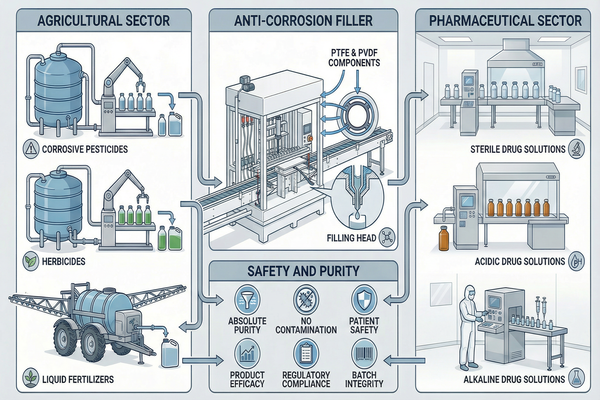
These two industries present unique challenges, but the core need for non-reactive equipment is the same. In my experience, the cost of failure in these sectors is far higher than in many others. A contaminated batch of medicine or an ineffective pesticide doesn't just mean lost profit; it can have public health and environmental consequences.
Agricultural Demands: Durability and Resistance
The agrochemical industry8 handles a huge variety of liquids, from nutrient solutions to potent pesticides14. These products are often formulated to be aggressive.
- Pesticides & Herbicides: These can be solvent-based or acid-based and are designed to be chemically active. Our machines for this sector often use PVDF5 and Hastelloy components to withstand these chemicals.
- Liquid Fertilizers: Many fertilizers are salt-based and can be highly corrosive, similar to seawater. They cause pitting and rapid corrosion in standard stainless steel.
- Environment: The filling often happens in environments that are not as clean as a pharmaceutical lab. The machines need to be robust, durable, and easy to maintain.
Pharmaceutical Needs: Purity and Precision
In the pharmaceutical world, the top priority is preventing contamination. The standard is not just "corrosion-resistant" but "non-leaching17 and non-reactive."
- Good Manufacturing Practice (GMP)18: All equipment must comply with strict GMP standards. This means using materials like 316L stainless steel, PEEK, or ceramics for contact parts, which are known for their high purity.
- Sterility: Many products are filled in a sterile environment19. The filling machine itself must be designed for easy sterilization, either through steam (autoclaving) or chemical agents.
- No Metal Ions: Even a few parts per billion of metallic ions leached from a machine can deactivate an active pharmaceutical ingredient (API) or cause side effects in patients. That's why we build our pharmaceutical-grade fillers to be completely inert.
| Sector | Primary Concern | Common Liquids | Recommended Materials |
|---|---|---|---|
| Agriculture | Durability, Chemical Resistance | Pesticides, Herbicides, Fertilizers | PVC, PVDF5, Titanium |
| Pharmaceutical | Purity, Sterility, Precision | Saline solutions, Acidic APIs, Buffers | 316L SS, PEEK, Ceramic, PTFE4 |
Conclusion
From heavy chemicals to household cleaners, many industries need corrosion-resistant fillers. Choosing the right machine prevents costly damage, ensures safety, and protects your product's quality, making it a vital investment.
Understanding the risks of corrosive liquids can help you implement better safety measures in your operations. ↩
Explore how anti-corrosion fillers can enhance equipment longevity and product safety in your production line. ↩
Learn why these machines are crucial for maintaining product integrity and preventing costly downtime. ↩
Discover the unique properties of PTFE and its applications in various industries for enhanced safety. ↩
Find out how PVDF can improve the performance and durability of equipment in harsh environments. ↩
Explore the benefits of titanium in manufacturing and how it can withstand extreme conditions. ↩
Explore strategies to enhance equipment longevity and reduce maintenance costs in your operations. ↩
Gain insights into the specific challenges and solutions for the chemical industry in handling aggressive substances. ↩
Explore RITO's innovative solutions for corrosion-resistant filling machines, crucial for safety and efficiency in chemical handling. ↩
Explore essential safety measures to take when working with hydrochloric acid to prevent accidents. ↩
Understand the corrosive nature of sodium hypochlorite and its implications for equipment maintenance. ↩
Learn about the corrosive ingredients in everyday products and how they affect equipment longevity. ↩
Discover the importance of corrosion-resistant machines in agriculture for handling potent chemicals. ↩
Learn about the safety concerns associated with pesticides and how to mitigate risks in production. ↩
Explore the unique challenges posed by liquid fertilizers and how to address them effectively. ↩
Learn about the strict standards for equipment in pharmaceuticals to ensure product safety and efficacy. ↩
Understand the importance of non-leaching materials in preventing contamination in sensitive applications. ↩
Understand the significance of GMP in ensuring quality and safety in manufacturing processes. ↩
Discover best practices for maintaining sterility in pharmaceutical environments to ensure product integrity. ↩