

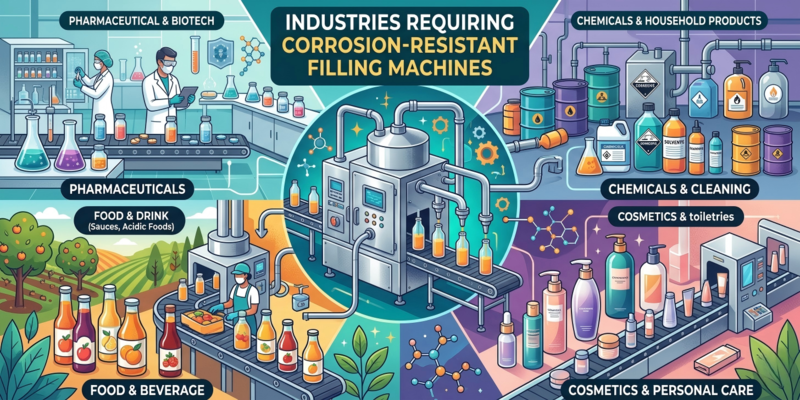
Handling corrosive liquids is a serious risk. Using the wrong equipment can lead to costly damage, production halts, and safety hazards.1 A specialized machine is the only safe solution.
The main industries that need corrosion-resistant filling machines are the chemical, household cleaning, and agricultural sectors. These industries handle substances like acids, alkalis, bleach, and pesticides that would quickly destroy standard equipment, making specialized, durable machines essential for safety and operational continuity.
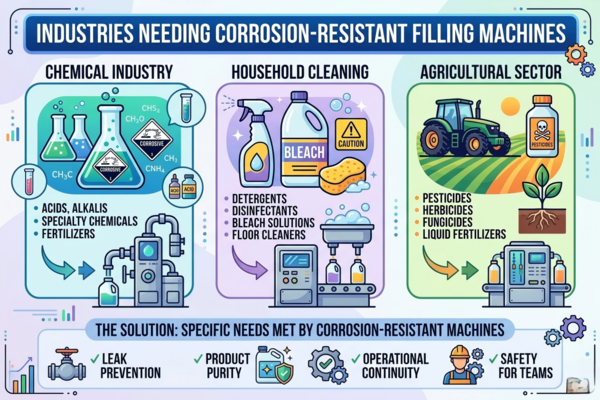
It's clear that for certain products, a standard filling machine just won't work. The risk of corrosion is too high, leading to leaks, product contamination, and dangerous situations for your team.
But which industries are most affected, and what specific products are we talking about? Let's dive deeper into the specific needs of each sector. Understanding this will help you make the right choice for your production line.
Why is the Chemical Industry the Biggest User of These Machines?
Producing chemicals means working with aggressive liquids that can eat through normal metals2. Imagine a machine failing and causing a dangerous chemical spill. The costs for cleanup and safety are enormous.
The chemical industry needs corrosion-resistant fillers because it handles a wide range of aggressive materials.3 This includes strong acids, alkalis, and solvents. Standard machines would fail quickly, causing leaks and unsafe conditions. Specialized equipment is not just an option; it's a necessity.
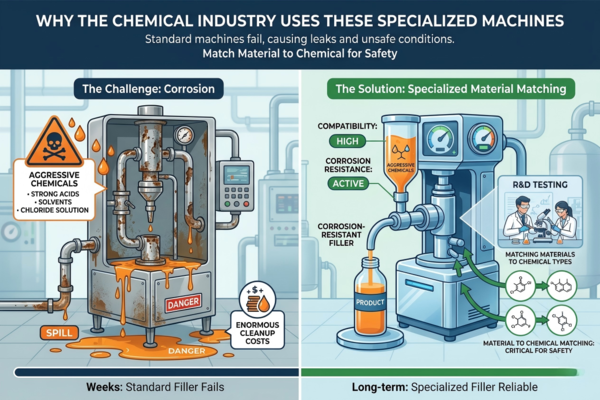
When we talk about the chemical industry, the range of corrosive liquids is vast. We're dealing with everything from bulk industrial chemicals to highly pure laboratory reagents. A client of mine once tried to use a standard stainless steel filler for a chloride-based solution. Within weeks, they saw pitting and corrosion that threatened to contaminate their entire batch. This is a common story. The key is to match the machine's material to the chemical it will handle4. This is why our R&D team spends so much time testing materials.
Material Selection is Critical
Choosing the right material is the most important decision. A wrong choice can lead to equipment failure and safety risks.
| Material | Resistant To... | Common Application |
|---|---|---|
| 316L Stainless Steel5 | Mild acids, alkalis, oils | Food additives, gentle cleaners, some industrial fluids |
| PVC / CPVC6 | Strong acids (like hydrochloric), bleach | Bleach packaging, acid-based cleaning solutions |
| PP (Polypropylene) | A broad range of acids and bases | Laboratory reagents, general chemical packaging |
| PTFE (Teflon)7 | Nearly all aggressive solvents and acids | High-purity chemicals, pharmaceutical ingredients |
| Titanium | Strong oxidizing agents, chloride solutions | Seawater applications, specific industrial chemicals |
For example, you would never use a standard steel filler for bleach. The sodium hypochlorite in bleach is extremely corrosive to most metals.8 Instead, a machine made with PVC or another resistant polymer is the correct choice. We help our customers analyze their product’s Safety Data Sheet (SDS) to ensure we build their machine from the perfect material.
Are They Necessary for Everyday Household Cleaning Products?
You might think household cleaners are mild, but many contain corrosive ingredients. A slow, unnoticed leak can ruin product batches and damage your filling machine over time. Using the right filler protects your product and equipment.
Yes, they are often necessary for household products. Many cleaners, like toilet bowl cleaners, drain openers, and disinfectants, contain bleach or strong acids.9 These ingredients will corrode standard filling equipment, so you need specialized machines to ensure reliable and safe production.
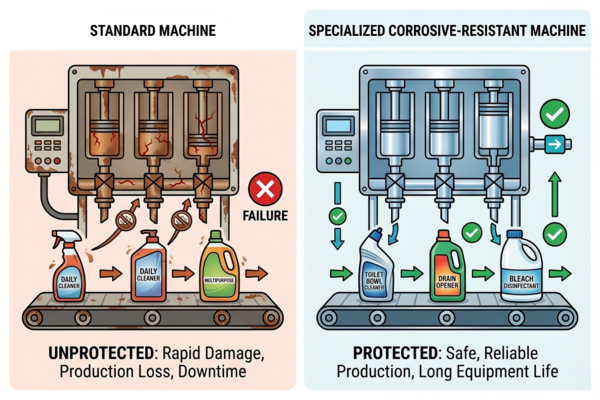
The term "daily chemicals" can be misleading. While these products are used every day, some of them are chemically aggressive. The biggest culprits are products containing bleach (sodium hypochlorite) and strong acids. I visited a facility once where the fumes alone from their cleaning product caused visible rust on equipment across the room. The filling machine, which was in direct contact, was failing constantly. They thought they could save money with a standard machine, but the constant repairs and downtime cost them far more in the long run.
Common Corrosive Ingredients in Cleaners
It's important to know what's inside the bottle. Even a small percentage of a corrosive ingredient can cause big problems over thousands of filling cycles.
-
Bleach-Based Products: Bleach is a powerful oxidizer. It attacks and breaks down stainless steel, even high-grade versions, over time. For any product containing bleach, we recommend machines with contact parts made from plastics like PVC or PP. This completely removes the risk of metallic corrosion.
-
Acid-Based Products: Think of toilet bowl cleaners or descalers. They often use hydrochloric acid or phosphoric acid to dissolve mineral deposits. These acids require machines built with acid-resistant polymers to prevent the filling nozzles and internal pathways from being eaten away.
-
Alkaline Products: On the other end of the pH scale, you have strong alkaline products like oven cleaners or drain openers, which often use sodium hydroxide10. While many metals resist alkali better than acid, high concentrations still demand careful material selection to prevent any issues.
What About the Agriculture and Food Industries?
Even natural products can be surprisingly corrosive. You might not think about corrosion when bottling vinegar or pesticides, but the wrong machine can cause metallic contamination and equipment failure.
Absolutely. The agriculture industry uses corrosive pesticides, herbicides, and liquid fertilizers.11 In the food industry, products with high acidity like vinegar, citrus juices, and certain sauces can also corrode standard machinery12. This requires food-grade, corrosion-resistant materials like 316L stainless steel.
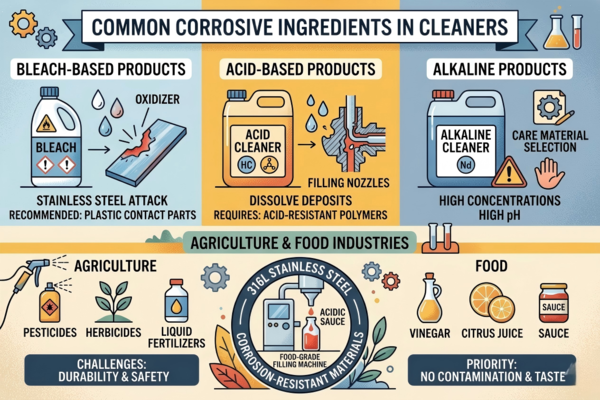
These two industries present unique challenges. In agriculture, the main concern is durability and safety when handling potent chemicals. In the food industry, the top priority is preventing contamination and preserving the product's taste and quality.
Different Industries, Different Priorities
While both need corrosion resistance, their primary goals are different.
| Industry | Corrosive Product Example | Primary Concern |
|---|---|---|
| Agriculture | Liquid Fertilizers, Pesticides | Machine durability, operator safety, preventing leaks |
| Food & Beverage | Vinegar, Citrus Juice, Tomato Sauce | Product purity, preventing metallic taste, hygiene |
In agriculture, the chemicals are often complex and designed to be reactive. A filling machine must be robust enough to handle these liquids day in and day out without breaking down. A leak in a pesticide line is a serious safety and environmental hazard. Therefore, heavy-duty construction and highly resistant materials are non-negotiable.
In the food industry, the issue is more subtle. Vinegar (acetic acid) or lemon juice (citric acid) may not dissolve a machine overnight, but they can cause micro-corrosion. This can release tiny amounts of metal into the product, creating a metallic taste and failing quality control checks. This is why food-grade 316L stainless steel is the minimum standard for acidic food products. It provides excellent resistance to corrosion while also being easy to clean and sanitize, ensuring the final product is pure, safe, and tastes exactly as it should.
Conclusion
Corrosion-resistant fillers are crucial for the chemical, household cleaning, agriculture, and food industries. Choosing the right machine protects your investment, ensures product quality, and guarantees a safe working environment.
"1910.119 - Process safety management of highly hazardous ... - OSHA", http://www.osha.gov/laws-regs/regulations/standardnumber/1910/1910.119. Process-safety and corrosion-control literature documents that incompatible materials of construction can cause corrosion, leaks, equipment failure, and hazardous releases in chemical handling systems. Evidence role: general_support; source type: institution. Supports: Using the wrong equipment can lead to costly damage, production halts, and safety hazards.. Scope note: This supports the general risk pathway rather than quantifying costs or downtime for filling machines specifically. ↩
"Corrosion Fundamentals - NASA", https://public.ksc.nasa.gov/corrosion/corrosion-fundamentals/. Corrosion science references describe how acids, alkalis, oxidizers, chlorides, and solvents can chemically or electrochemically degrade common metals used in industrial equipment. Evidence role: mechanism; source type: education. Supports: Producing chemicals means working with aggressive liquids that can eat through normal metals.. Scope note: The severity depends on concentration, temperature, exposure time, alloy, and operating conditions. ↩
"Request to provide list of corrosive materials and ... - OSHA", http://www.osha.gov/laws-regs/standardinterpretations/2008-04-14-0. Chemical engineering and occupational-safety sources identify acids, bases, solvents, and oxidizers as common chemical-industry substances requiring compatible materials of construction to prevent corrosion and release hazards. Evidence role: expert_consensus; source type: government. Supports: The chemical industry needs corrosion-resistant fillers because it handles a wide range of aggressive materials.. Scope note: This provides sector-level context and does not establish that every chemical filling application requires corrosion-resistant equipment. ↩
"NIOSH Pocket Guide to Chemical Hazards - CDC", https://www.cdc.gov/niosh/npg/default.html. Guidance on chemical compatibility and materials of construction states that equipment materials should be selected according to the specific chemical handled, including concentration, temperature, and exposure conditions. Evidence role: expert_consensus; source type: institution. Supports: The key is to match the machine's material to the chemical it will handle.. Scope note: Compatibility charts and SDS data are screening tools; final selection may require testing under actual process conditions. ↩
"Susceptibility of 316L Stainless Steel Structures to Corrosion ... - PMC", https://pmc.ncbi.nlm.nih.gov/articles/PMC10672112/. Materials references characterize 316L stainless steel as a molybdenum-bearing austenitic stainless steel with improved corrosion resistance in many mildly corrosive environments compared with standard stainless steels. Evidence role: definition; source type: education. Supports: 316L stainless steel is suitable for mild acids, alkalis, oils, and some food or industrial fluids.. Scope note: Resistance is not universal; chlorides, strong acids, temperature, and concentration can cause pitting or other corrosion. ↩
"[PDF] Chemical Resistance and Chemical Applications for CPVC Pipe and ...", https://www.nrc.gov/docs/ML1820/ML18207A604.pdf. Chemical-resistance data for PVC and CPVC commonly show compatibility with selected mineral acids and sodium hypochlorite solutions, supporting their use in some acid and bleach handling systems. Evidence role: expert_consensus; source type: institution. Supports: PVC and CPVC can be appropriate materials for strong acids such as hydrochloric acid and for bleach applications.. Scope note: Compatibility varies by resin grade, concentration, temperature, pressure, and exposure duration. ↩
"Teflon PTFE Chemical Compatibility Reference Chart - CP Lab Safety", https://www.calpaclab.com/teflon-ptfe-compatibility/?srsltid=AfmBOoqgl7clLFy1Y8s1OY_5Y8IDrdzGWgkqRpEm-Aon3BKe_EClIzVJ. Materials-science references describe PTFE as highly chemically inert and resistant to many acids and organic solvents, which explains its use in severe chemical-service applications. Evidence role: definition; source type: research. Supports: PTFE is resistant to nearly all aggressive solvents and acids and is used for high-purity chemicals and pharmaceutical ingredients.. Scope note: PTFE is not compatible with all substances under all conditions, particularly some molten alkali metals and highly reactive fluorinating agents. ↩
"Cleaning and Disinfecting with Bleach - CDC", https://www.cdc.gov/hygiene/about/cleaning-and-disinfecting-with-bleach.html. Corrosion studies and safety data for sodium hypochlorite report that hypochlorite solutions are oxidizing and can corrode many metals, including stainless steels under certain conditions. Evidence role: mechanism; source type: paper. Supports: The sodium hypochlorite in bleach is extremely corrosive to most metals.. Scope note: The corrosion rate depends on hypochlorite concentration, pH, temperature, chloride content, and alloy composition. ↩
"Search Products that Meet the Safer Choice Standard", https://www.epa.gov/saferchoice/products. Public health and poison-control sources identify household cleaning products such as toilet-bowl cleaners, drain openers, and disinfectants as products that may contain corrosive acids, alkalis, or hypochlorite bleach. Evidence role: general_support; source type: government. Supports: Many cleaners, like toilet bowl cleaners, drain openers, and disinfectants, contain bleach or strong acids.. Scope note: Formulations vary by product and jurisdiction, so the statement is best supported as a common category-level observation rather than a universal rule. ↩
"Sodium hydroxide poisoning: MedlinePlus Medical Encyclopedia", https://medlineplus.gov/ency/article/002487.htm. Toxicology and consumer-safety references describe sodium hydroxide as a strongly caustic alkali commonly found in some oven cleaners and drain openers. Evidence role: definition; source type: government. Supports: Strong alkaline products like oven cleaners or drain openers often use sodium hydroxide.. Scope note: Not all oven cleaners or drain openers use sodium hydroxide, and concentrations differ substantially across formulations. ↩
"Pesticide Storage and Security - Penn State Extension", https://extension.psu.edu/pesticide-storage-and-security/. Agricultural safety and extension sources note that some pesticide formulations and liquid fertilizers can be corrosive and require compatible storage, handling, and application equipment. Evidence role: general_support; source type: education. Supports: The agriculture industry uses corrosive pesticides, herbicides, and liquid fertilizers.. Scope note: Corrosivity varies widely by active ingredient, formulation, fertilizer chemistry, concentration, and equipment material. ↩
"Comparative Gravimetric Studies on Carbon Steel Corrosion ... - PMC", https://pmc.ncbi.nlm.nih.gov/articles/PMC8400660/. Food-processing and materials literature recognizes acetic, citric, and other food acids as corrosive under certain conditions and emphasizes selecting food-contact materials that resist corrosion and metal release. Evidence role: mechanism; source type: paper. Supports: Products with high acidity like vinegar, citrus juices, and certain sauces can also corrode standard machinery.. Scope note: The claim is condition-dependent; acidity alone does not determine corrosion without considering alloy type, chloride content, temperature, cleaning chemicals, and exposure time. ↩