

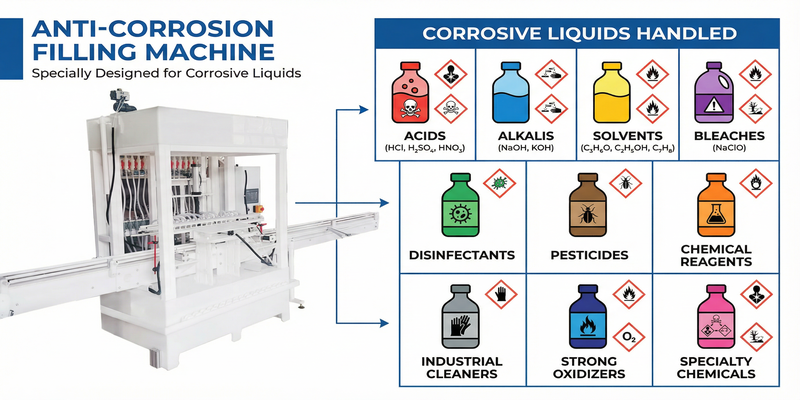
Handling corrosive liquids damages standard machines. This leads to costly downtime and safety risks. Our anti-corrosion fillers1 are built to solve this problem, ensuring safe and reliable operation.
An anti-corrosion filling machine2 is designed to handle harsh chemicals. This includes strong acids3, powerful alkalis, organic solvents, and high-concentration reagents like industrial cleaners. It uses specialized, chemically-resistant materials to prevent damage and ensure longevity, making your production process4 safer and more efficient.
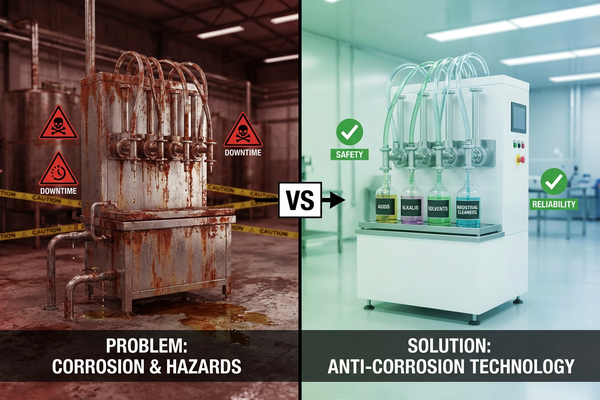
Choosing the wrong equipment for these aggressive liquids isn't just an inconvenience; it's a recipe for disaster. I've seen it happen. But understanding what these machines are truly capable of is the first step toward a safer, more efficient production line. So, let’s break down the specific types of liquids our machines can handle.
Can it handle strong acids3 like sulfuric and hydrochloric acid?
Strong acids can destroy metal parts in minutes. This can cause dangerous leaks and production halts. Our machines use acid-resistant materials5 to keep your line running safely.
Yes, it can. Our anti-corrosion filling machine2s are specifically engineered to handle strong acids3 like sulfuric, hydrochloric, phosphoric, and even hydrofluoric acid. We use materials like PVDF, PTFE, and special alloys that do not react with or degrade from acid exposure, ensuring precision and safety.
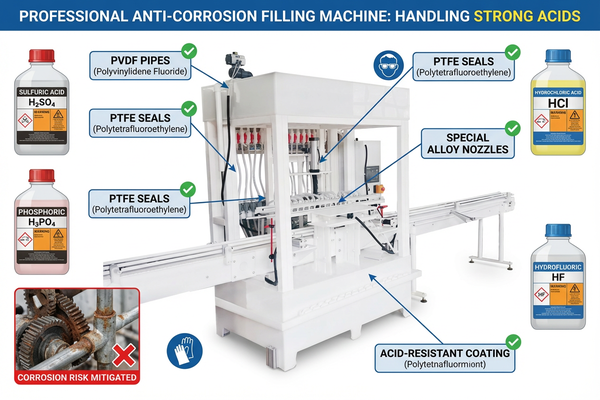
The secret to handling aggressive acids is all about material science. Standard stainless steel, which works for many products, simply can't withstand highly acidic environments. That’s why we build our machines using non-metallic polymers or high-grade alloys. I remember a client in the battery industry who was struggling with sulfuric acid6 spills. Their old equipment was failing constantly. We provided them with a filling machine2 that had a fluid path made entirely of PVDF (Polyvinylidene fluoride). This material is incredibly resistant to acid. The change completely eliminated their downtime from equipment failure. It's not just about the material, but also the design. We ensure every part that touches the liquid, from the nozzle to the tubing and seals, is made from the right stuff.
| Common Acid | Recommended Material for Fluid Path | Key Industries |
|---|---|---|
| Sulfuric Acid (H₂SO₄) | PVDF, PTFE | Battery Manufacturing, Fertilizers |
| Hydrochloric Acid (HCl) | PVC, Titanium | Steel Pickling, Chemical Synthesis |
| Phosphoric Acid (H₃PO₄) | Polypropylene (PP), PVDF | Food Additives, Rust Removal |
| Hydrofluoric Acid (HF) | PTFE, PFA | Glass Etching, Electronics |
What about strong alkaline solutions like sodium hydroxide7?
Strong alkalis are just as destructive as acids. They corrode metals and degrade common seals, causing leaks. Our machines are built with alkali-resistant components8 to prevent this.
Absolutely. Our anti-corrosion fillers1 are designed to safely manage strong alkaline solutions, including sodium hydroxide7 (caustic soda) and potassium hydroxide. The key is using materials like polypropylene (PP) and special EPDM or Kalrez seals that resist the chemical attack9 from these high-pH liquids.
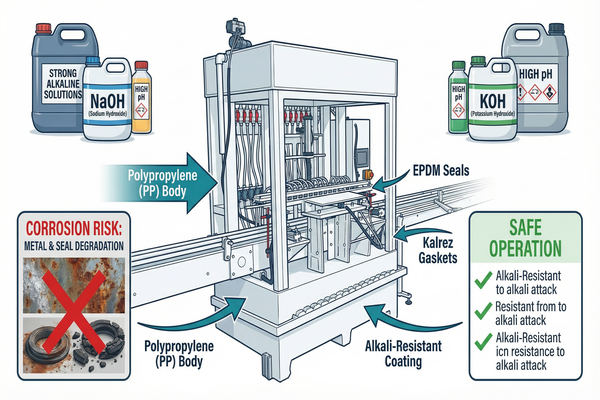
People often focus on acids, but strong bases can be even trickier. Sodium hydroxide, for example, is notorious for attacking certain metals and causing stress-corrosion cracking. It also degrades many standard rubber seals. When we design a machine for a client in the soap or detergent industry, we pay close attention to the seals. A small leak from a failed seal can become a major safety hazard. We choose sealing materials like EPDM (Ethylene Propylene Diene Monomer) because it offers excellent resistance to alkalis. For extremely aggressive applications, we might use something like Kalrez. The entire system is built to be robust, so you can fill your products consistently without worrying about the machine breaking down from chemical exposure. It’s about building a complete, resistant system, not just one or two special parts.
| Alkaline Solution | Recommended Material for Seals | Key Industries |
|---|---|---|
| Sodium Hydroxide (NaOH) | EPDM, PTFE | Soap & Detergent, Paper Production |
| Potassium Hydroxide (KOH) | EPDM, Kalrez | Biodiesel, Battery Manufacturing |
| Calcium Hydroxide (Slaked Lime) | EPDM, Buna-N | Water Treatment, Food Processing |
| Ammonia (NH₃) | EPDM, Neoprene | Cleaners, Fertilizers |
Are organic solvents like acetone and ethanol compatible?
Organic solvents can dissolve plastic parts and cause seals to swell. This leads to inaccurate fills and leaks. Our machines use solvent-proof materials10 to ensure total compatibility.
Yes, they are. We engineer our anti-corrosion filling machine2s to handle a wide range of organic solvents, including ethanol, acetone, toluene, and isopropyl alcohol. We achieve this by using solvent-resistant polymers and specialized elastomers like Viton for seals, which prevents swelling, dissolving, or degradation.
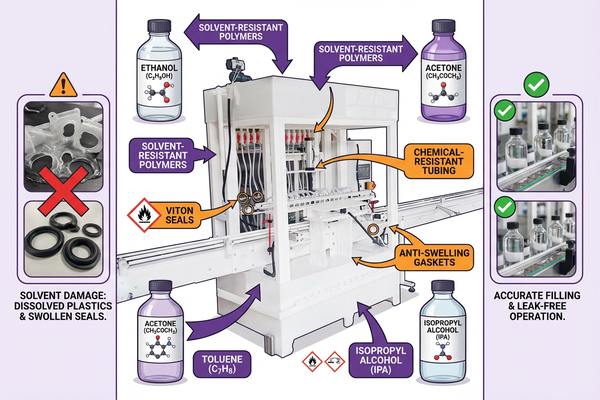
The challenge with organic solvents is different from acids or alkalis. Instead of a chemical reaction that corrodes metal, solvents can physically dissolve or swell plastic and rubber components. A seal that swells up can completely jam a piston or valve. I once worked with a cosmetics company filling a nail polish remover, which is mostly acetone. Their original filler used standard seals that swelled after just a few hours, causing inaccurate volumes and messy leaks. We built them a machine with a PTFE fluid path and Viton seals. Viton is a fluoroelastomer that holds up exceptionally well against aggressive solvents like acetone. The problem was solved immediately. It’s crucial to match every component to the specific solvent being used, because what works for ethanol might not work for toluene. This is where our 11+ years of experience really helps our customers.
| Organic Solvent | Recommended Material for Seals | Key Industries |
|---|---|---|
| Acetone | Viton, Kalrez | Cosmetics, Industrial Cleaning |
| Ethanol / Isopropyl Alcohol | EPDM, Viton | Pharmaceuticals, Disinfectants |
| Toluene / Xylene | PTFE, Viton | Paints & Coatings, Adhesives |
| Methanol | EPDM, Kalrez | Fuel Additives, Chemical Feedstock |
How does the machine perform with high-concentration chemical reagents11?
Complex chemical reagents are highly reactive. They can quickly destroy standard filling equipment from the inside out. Our machines are built to handle these aggressive industrial chemicals.
Our anti-corrosion filling machine2s excel with high-concentration chemical reagents11. This includes industrial disinfectants12 like bleach, plating solutions, and lab reagents. We build them with robust, non-reactive materials13 like PVC, Titanium, or PVDF to ensure they withstand high chemical activity without any degradation.
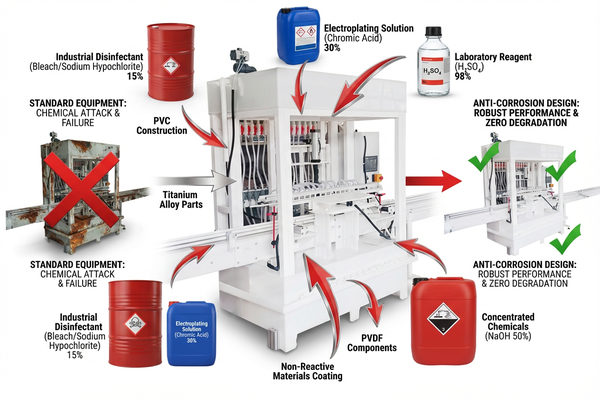
High-concentration reagents are some of the toughest products to handle. Often, they are a mixture of different chemicals, and this "cocktail" can be far more aggressive than any single ingredient. For example, sodium hypochlorite (bleach) is a strong oxidizer that corrodes even some grades of stainless steel. For a bleach filling line, we would never use standard metal parts. Instead, we would recommend a machine constructed from PVC, or for maximum durability, Titanium. I had a client in the water treatment business who needed to dose a complex mix of chemicals. We asked for their Safety Data Sheet (SDS) for the product. Based on that, we designed a custom machine with a fully non-metallic fluid path and specialized seals14 to guarantee long-term compatibility. This level of customization is essential because there is no one-size-fits-all solution for these powerful industrial chemicals.
| Chemical Reagent | Recommended Construction Material | Key Features |
|---|---|---|
| Sodium Hypochlorite (Bleach) | PVC, Titanium, PVDF | Oxidation Resistance, Non-metallic path |
| Plating Solutions (e.g., Nickel) | PVDF, Polypropylene | High Purity, No metal leaching |
| Strong Disinfectants | Kynar, PTFE | Broad Chemical Compatibility |
| Laboratory Reagents | Glass, PFA | High Purity, Easy to clean |
Conclusion
In short, our anti-corrosion filling machine2s are built to safely and reliably handle a wide range of aggressive liquids, from acids and alkalis to solvents and complex chemical reagents.
Explore how anti-corrosion fillers can enhance safety and efficiency in handling aggressive liquids. ↩
Learn about essential features that make filling machines suitable for corrosive substances. ↩
Understand the impact of strong acids on machinery and how to mitigate risks. ↩
Discover strategies to enhance production efficiency while managing corrosive liquids. ↩
Find out which materials are most effective in resisting acid damage. ↩
Discover materials that can withstand sulfuric acid to ensure equipment longevity. ↩
Learn about the dangers of sodium hydroxide and how to safely manage it. ↩
Explore the components that ensure safe handling of strong alkaline solutions. ↩
Learn about chemical attacks and their effects on industrial materials. ↩
Discover the best materials to use for machines handling organic solvents. ↩
Learn about the risks associated with high-concentration chemical reagents. ↩
Explore best practices for safely managing industrial disinfectants. ↩
Find out which non-reactive materials are essential for chemical processing. ↩
Explore the different types of seals that provide protection in corrosive environments. ↩