

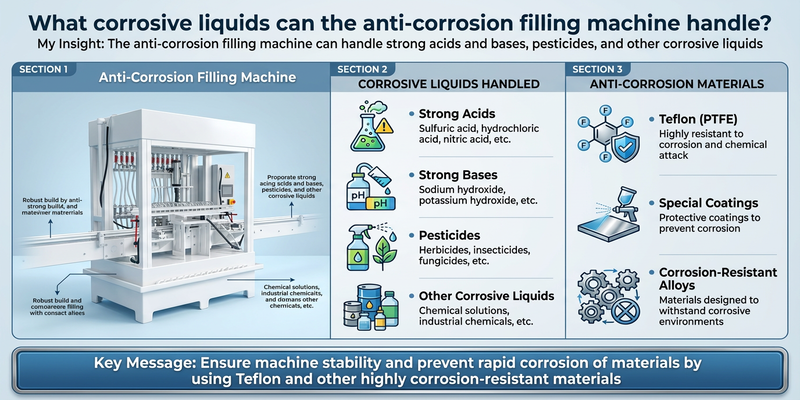
Handling aggressive chemicals1 can destroy your equipment. This leads to expensive repairs and dangerous leaks. Our specialized machines are built to withstand these harsh substances, protecting your investment and your team.
An anti-corrosion filling machine2 is designed to handle a wide range of aggressive substances. This includes strong acids3, strong bases, bleach, pesticides, and various industrial chemicals. The key is using materials like Teflon (PTFE)4 and specialized plastics that do not react with or degrade from these liquids.
When we talk about filling machines, most people think of standard stainless steel. That works great for food, drinks, and cosmetics. But when you introduce highly corrosive liquids, the game changes completely. Standard metals will pit, rust, and fail very quickly. This is not just a maintenance issue; it's a major safety hazard. That’s why we had to develop a different kind of machine. It's about more than just filling a bottle; it's about doing it safely and reliably for years, even with the most challenging liquids. Let's explore what makes these machines so special.
Why are special materials necessary for these machines?
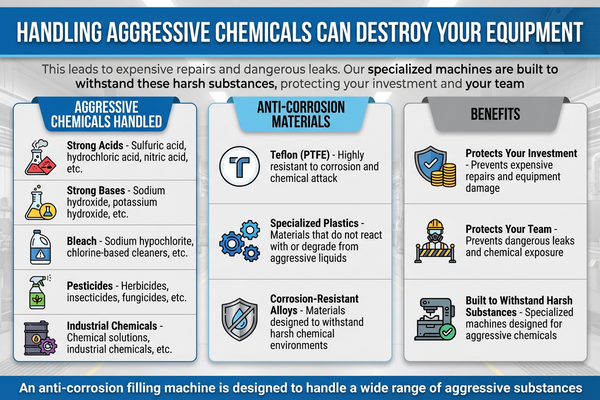
Your standard filling machine will quickly fail with corrosive liquids. This causes production to stop and costs you money. You need a machine built from materials that can resist chemical attacks.
We build our anti-corrosion filling machine2s with materials specifically chosen for their chemical resistance5. This ensures the machine has a long service life and operates safely, preventing leaks and protecting your product's purity. Materials like Teflon are essential for this demanding job.
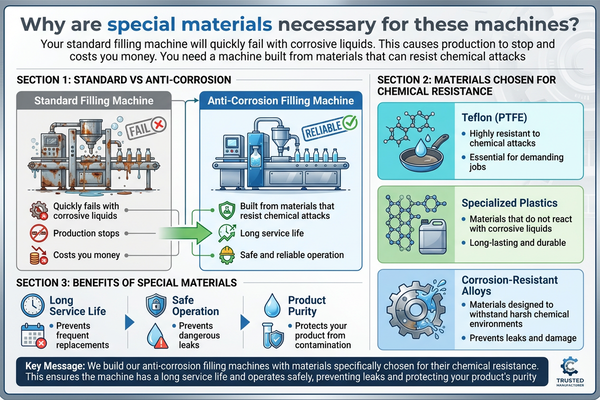
The choice of material is the most critical factor in an anti-corrosion filling machine2. Standard stainless steel, like grade 304, is great for many applications but can be quickly damaged by strong acids3 or bases. For example, hydrochloric acid or sodium hydroxide (a strong base) will eat away at it. This is why we turn to specialized materials. I remember a client in the chemical industry who tried to use a standard filler for their cleaning products. The machine failed in less than a month.
We primarily use materials that are chemically inert. This means they don't react with the liquids they touch.
Key Materials and Their Uses
| Material | Common Name | Key Properties | Best For |
|---|---|---|---|
| Polytetrafluoroethylene | Teflon (PTFE)4 | Excellent chemical resistance5, non-stick, wide temperature range. | Strong acids, strong bases, solvents. |
| Polyvinyl Chloride | PVC | Good resistance to many acids and bases, cost-effective. | Bleach, some acids, salt solutions. |
| Polypropylene | PP | Lightweight, good chemical resistance5, strong. | Weaker acids and bases, detergents. |
| Titanium Alloys | - | Extremely strong, excellent resistance to chlorides. | Highly corrosive environments like saltwater or chlorine. |
At RITO6, we analyze the specific chemical you are filling. Based on its properties, we select the perfect material for all contact parts, including the nozzles, tubing, and tank. This customized approach ensures your machine will last.
What industries commonly use anti-corrosion filling machine2s?
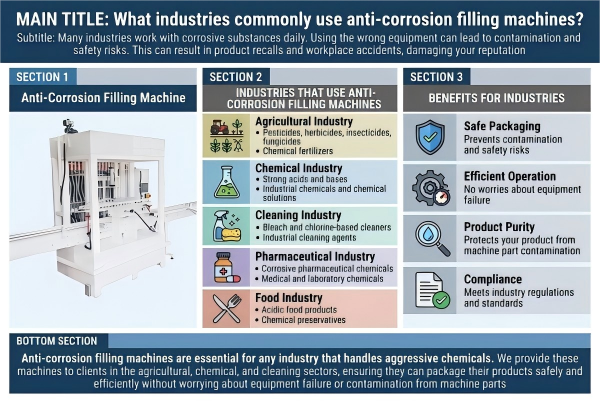
Many industries work with corrosive substances daily. Using the wrong equipment can lead to contamination and safety risks. This can result in product recalls and workplace accidents, damaging your reputation.
Anti-corrosion filling machines are essential for any industry that handles aggressive chemicals1. We provide these machines to clients in the agricultural, chemical, and cleaning sectors, ensuring they can package their products safely and efficiently without worrying about equipment failure7 or contamination from machine parts.
Over our years in business, we've seen a wide range of companies that need this technology. It’s not just for large chemical plants. Many businesses, big and small, rely on these machines to operate. The common thread is the nature of the liquid they need to bottle. If it's aggressive, they need a solution that won't fail. We have provided solutions for a variety of sectors, each with its unique challenges.
For instance, the agricultural industry is a major user. They need to bottle pesticides, herbicides, and liquid fertilizers. These products are often highly corrosive.
Common Industry Applications
| Industry | Typical Corrosive Liquids Handled | Why It's Critical |
|---|---|---|
| Agriculture | Pesticides, Herbicides, Liquid Fertilizers | Product purity is essential for effectiveness. Operator safety is a top priority due to the toxicity of the liquids. |
| Chemical Manufacturing | Strong Acids (Sulfuric, Hydrochloric), Strong Bases (Sodium Hydroxide) | Equipment must withstand extreme pH levels. Leaks can be extremely dangerous to personnel and the environment. |
| Cleaning Supplies | Bleach, Ammonia-based Cleaners, Industrial Solvents | The machine must not react with the cleaners, which would change their chemical formula. Durability is key for high-volume production8. |
| Pharmaceuticals | Certain reagents and sterile solutions | Requires both corrosion resistance9 and adherence to strict hygiene standards like GMP. Materials must be non-leaching. |
Each of these industries presents a unique puzzle. We don't offer a one-size-fits-all machine. Instead, we work with our clients to understand their product and process, then build a machine that is perfectly suited for the job.
How does RITO6 ensure its machines are truly anti-corrosive?
You might worry if a new machine can truly handle your specific chemical. An equipment failure7 is not just an inconvenience; it's a major setback. You need a partner you can trust.
At RITO6, we use a combination of expert design, premium materials, and rigorous testing. Our experienced R&D team, with over 20 years in the field, customizes each machine for the specific liquid it will handle, ensuring total compatibility and long-term reliability.
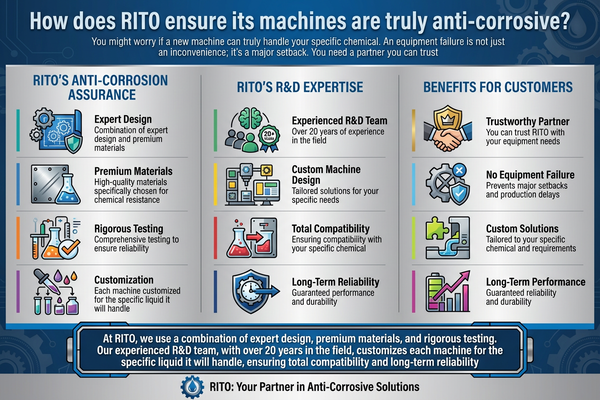
Our promise of quality isn't just a marketing slogan. It's built into everything we do. Since we started in 2013, our focus has been on solving real-world packaging problems for our customers. When it comes to corrosive liquids, there is no room for error. We have a dedicated process to make sure every anti-corrosion machine we deliver is up to the task.
It all starts with our R&D team. We have mechanical engineers, electrical engineers, and material specialists who work together.
Our Quality Assurance Process
- Customer Consultation: The first step is to listen. We ask you for the Material Safety Data Sheet (MSDS)10 of your product. We need to know exactly what we're dealing with—the chemical composition, pH level, and viscosity.
- Material Selection: Based on the data, our engineers select the best materials. For a highly acidic product, we might specify Teflon for all contact parts. For a less aggressive bleach solution, high-grade PVC might be sufficient and more cost-effective.
- Custom Design: We then design the machine. This includes not just the contact parts but also the seals and gaskets11, which are common failure points. We use materials like Viton or Kalrez for seals to ensure a perfect, leak-proof fit.
- Manufacturing and Testing: We build the machine in-house at our Guangzhou facility. After assembly, we test it rigorously, often using a liquid with similar properties to your product to ensure everything works perfectly before it ships.
This attention to detail is why companies in over 40 countries trust us. We combine our deep industry knowledge with a commitment to providing a truly customized solution.
What should you look for when buying an anti-corrosion filling machine2?
Buying a new machine is a big decision. Choosing the wrong one can lead to wasted money and production headaches. It's hard to know what features are most important for your needs.
When buying an anti-corrosion filler, focus on four key areas. Check the materials used for all parts that touch the liquid. Ensure the seals are made of a compatible material. Verify the manufacturer's experience. And finally, ask about after-sales support12 and service.
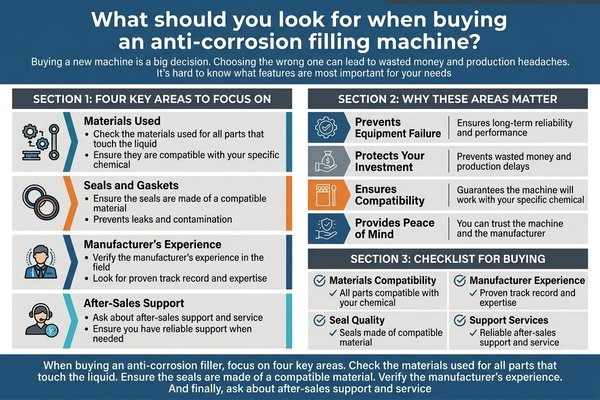
I've helped many customers navigate this process. The most successful ones are those who ask the right questions upfront. It's not just about the price tag; it's about the long-term value and reliability of the equipment. If you're in the market for an anti-corrosion filling machine2, you need to be an informed buyer. Think of it as investing in the safety and efficiency of your entire operation. Based on my experience, here are the most important things to consider.
Buyer's Checklist
-
What are the contact part materials? This is the most important question. Don't just accept "anti-corrosion" as an answer. Ask for the specific material used for the nozzles, pump, tank, and tubing. Make sure it's compatible with your product.
-
What kind of seals are used? Seals and O-rings are critical. A machine with Teflon parts is useless if the seals degrade and cause leaks. Ask if they use Viton, EPDM, or Kalrez seals, and check their compatibility with your liquid.
-
Can the machine be easily cleaned? You will need to clean the machine between batches or for maintenance. A good design allows for easy disassembly and cleaning without special tools. This reduces downtime and prevents cross-contamination.
-
What is the manufacturer's experience? Ask the supplier for case studies or references from companies in your industry. A manufacturer with a proven track record, like our 11+ years at RITO6, is more likely to provide a reliable machine and expert support.
-
What does after-sales support12 include? Look for a company that offers a solid warranty, technical support, and spare parts availability. We offer lifetime service because we believe in supporting our customers long after the initial sale.
Conclusion
In summary, an anti-corrosion filling machine2 is essential for safely handling aggressive liquids. The right materials and expert design are key to ensuring a long-lasting, reliable solution for your business.
Explore the industries that frequently deal with aggressive chemicals and the implications for equipment choice. ↩
Explore this link to understand the technology behind anti-corrosion filling machines and their importance in various industries. ↩
Learn about the challenges strong acids pose to equipment and how specialized materials can mitigate these risks. ↩
Discover why Teflon is a preferred material in corrosive environments and its unique properties. ↩
Find out which materials are best suited for handling aggressive chemicals in industrial settings. ↩
Explore RITO's expertise in anti-corrosion filling machines to understand their innovative solutions and commitment to quality. ↩
Learn about the potential risks and costs associated with equipment failure in industrial operations. ↩
Learn about the complexities of producing cleaning supplies at scale and the equipment needed. ↩
Find out what makes certain materials resistant to corrosion and their applications in industry. ↩
Learn about the critical information provided in an MSDS and its importance for safety in handling chemicals. ↩
Understand the importance of seals and gaskets in preventing leaks and ensuring machinery reliability. ↩
Learn about the significance of after-sales support and how it can impact your equipment's longevity. ↩