

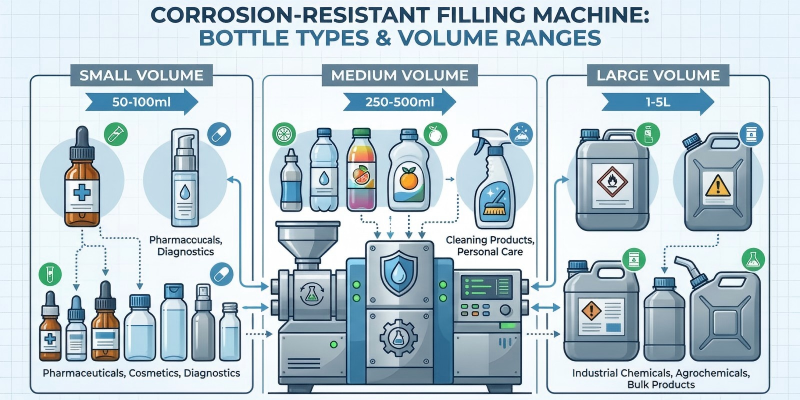
Handling corrosive liquids is tough. Finding a machine that fits your specific bottles and volumes is even harder. You need a flexible solution that works for your unique products.
Our corrosion-resistant filling machines1 support a wide variety of bottle types, including round, flat, and square shapes. For volume, we offer two specialized models: one for 100ml to 5000ml and another heavy-duty machine for 5L to 30L, ensuring precision across the board.
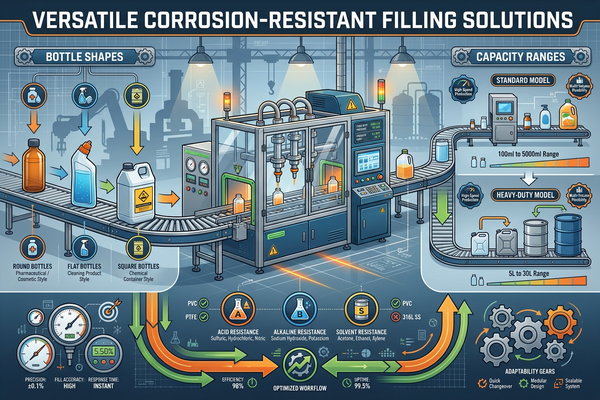
That’s the short answer, but the real value is in the details of how this versatility is achieved. Your production line's efficiency depends on a machine that can adapt to your needs, not the other way around. Let's break down exactly what this flexibility means for your operations and how we make it happen.
Can our corrosion-resistant filler2 really handle any bottle shape you have?
Worried your unique bottle shapes won't work with a standard filler? Custom molds are expensive and slow. You need a solution that adapts to you, not one you have to adapt to.
Yes, it can. Our corrosion3-resistant filling machines4 are engineered with adjustable components to handle a wide variety of bottle shapes, including round, flat, square, and even custom-designed containers without major, time-consuming changeovers.
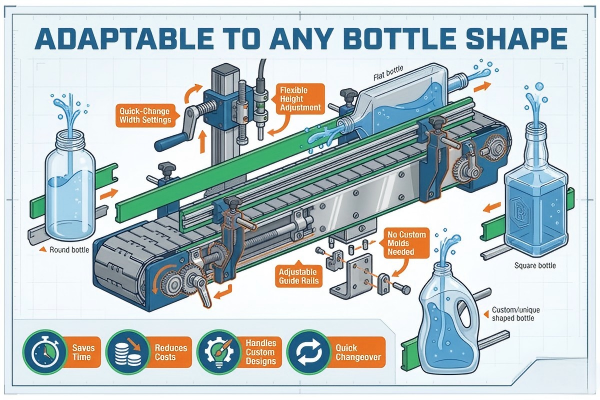
When we designed our corrosion-resistant fillers5 at RITO6 PACK, we knew that bottle shapes were a major pain point for our clients. You can't be limited to just one standard bottle. That's why we built our machines around the principle of adaptability. It’s not just about saying it works; it’s about the engineering behind it.
Adaptable Conveyor and Centering Systems
The first step is getting the bottle to the filling station correctly every time. Our machines use easily adjustable guide rails that can be widened or narrowed in minutes to fit anything from a slim, flat bottle to a wide, round jug. We also use a bottle-clamping or neck-clamping mechanism that centers the container precisely under the filling nozzle, regardless of its shape. This prevents spills and ensures a clean, professional fill. I remember a client who used a very unique hexagonal bottle for a premium cleaning product. They were sure they'd need a custom machine, but we had them up and running on our standard model in under an hour.
Versatile Nozzle Configuration
The filling nozzles7 themselves are also designed for versatility. They can be positioned to accommodate different bottle heights and mouth diameters. For containers with off-center openings, our multi-nozzle setups can be adjusted to match the exact entry point. This flexibility is crucial for ensuring the liquid is dispensed without splashing on the bottle neck or threads.
| Bottle Shape | Material Compatibility | Key Machine Feature |
|---|---|---|
| Round Bottles | PET, HDPE, Glass, PP8 | Adjustable Guide Rails |
| Flat/Oval Bottles | PET, HDPE, PP | Bottle Clamping System |
| Square/Rectangular | HDPE, Glass, PET | Precise Nozzle Placement |
| Custom Shapes | Most plastics & glass | Combination of all features |
How do we manage such a wide filling range from 100ml to 30L?
Your product line might have small retail bottles and large industrial drums. Buying two completely different systems seems inefficient and expensive. You're looking for a smarter, more cost-effective approach.
We solve this by offering two distinct, specialized machine classes. Our RITO9-CF-S series is optimized for 100ml to 5000ml for consumer goods, while our RITO-CF-L series is a robust model designed for bulk containers from 5L to 30L.
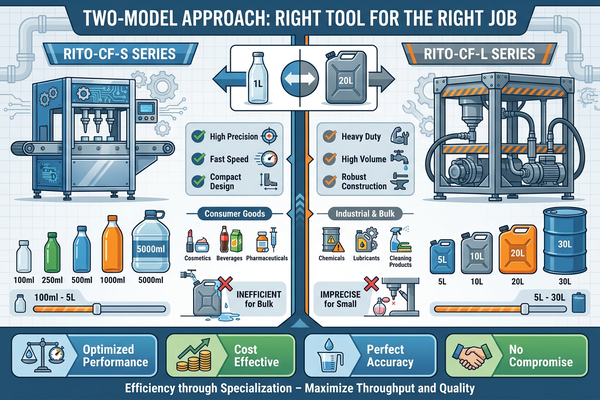
Trying to make one machine do everything from a tiny 100ml bottle to a massive 30L drum is a recipe for disaster. You lose accuracy at the low end and speed at the high end. That's why we took a two-model approach. This allows us to provide a solution that is perfectly optimized for your specific volume needs, ensuring you get the best performance and value. It's about using the right tool for the right job.
The RITO-CF-S Series (100ml - 5000ml)
This is our precision model, perfect for consumer-facing products. For these smaller volumes, accuracy is everything. Over-filling wastes expensive product, and under-filling can get you in trouble. We use high-accuracy10 piston filling technology, which measures out a precise volume of liquid for every cycle. This system is incredibly consistent, even with slightly foamy or viscous liquids. Changeover between a 250ml bottle and a 1L bottle is fast, often just requiring a simple adjustment on the control panel without changing any parts. This model is the workhorse for industries like household chemicals, personal care, and automotive fluids.
The RITO-CF-L Series (5L - 30L)
When you move into bulk sizes, the filling challenge changes. It's less about milliliter precision and more about managing heavy containers and large liquid volumes quickly and safely. Our heavy-duty L-Series is built for this. Instead of pistons, it often uses flowmeter or weigh-filling technology. A flowmeter measures11 the volume of liquid that passes through it, while a weigh-filler fills the container until it reaches a target weight. These methods are extremely reliable for large volumes. The machine itself is built with a stronger frame and a more robust conveyor system to handle the weight of 20L or 30L drums. The filling nozzles are also larger to allow for faster filling without causing excessive foaming.
| Feature | RITO-CF-S Series (100ml - 5L) | RITO-CF-L Series (5L - 30L) |
|---|---|---|
| Best For | Consumer products, high accuracy | Industrial, bulk, wholesale |
| Filling Tech | Piston Filling | Flowmeter or Weigh-Filling |
| Typical Apps | Cleaners, lotions, oils, sauces | Chemicals, lubricants, bulk ingredients |
| Key Benefit | Precise, repeatable fills | Fast, robust, handles heavy loads |
Conclusion
In short, our corrosion-resistant fillers provide unmatched flexibility in bottle type and volume, ensuring we have a specialized solution that fits your specific production needs perfectly.
"[PDF] Chemical Segregation and Storage Table - ORS", https://ors.od.nih.gov/sr/dohs/Documents/chemical-segregation-table.pdf. Engineering and occupational-safety sources describe corrosion-resistant materials and equipment as necessary where substances can chemically degrade ordinary metals or components. Evidence role: definition; source type: education. Supports: Filling equipment used with corrosive liquids should be made from corrosion-resistant materials.. Scope note: The source would define the need for corrosion resistance generally rather than verifying this article’s machine specifications. ↩
"Protecting Perishable Foods During Transport by Truck or Rail", https://ask.ifas.ufl.edu/publication/HS1328. A packaging-engineering source describing adjustable guide rails, container-centering mechanisms, and movable filling nozzles in liquid filling equipment would substantiate that such machines can be adapted to multiple container shapes with limited changeover. Evidence role: mechanism; source type: education. Supports: Corrosion-resistant filling machines can be engineered with adjustable components to handle a wide variety of bottle shapes, including round, flat, square, and custom-designed containers, without major changeovers.. Scope note: This would support the general engineering principle, not verify the specific capabilities of RITO PACK’s machines or every custom container design. ↩
"Toxic, Irritative, and Corrosive Gases and Liquids - OSHA", http://www.osha.gov/semiconductors/solutions/corrosive-gases. Authoritative chemical-safety guidance states that equipment and containers exposed to corrosive substances should be made from compatible, corrosion-resistant materials, supporting the premise that filling equipment used for corrosive liquids requires corrosion-resistant construction. Evidence role: general_support; source type: government. Supports: Corrosion-resistant filling machines are needed when handling corrosive liquids because equipment in contact with such liquids must use compatible materials that resist corrosion.. Scope note: This supports the general engineering and safety rationale for corrosion-resistant equipment, but it does not verify the manufacturer-specific bottle compatibility or filling-volume claims. ↩
"[PDF] Microcontroller Based Bottle Filling System - extnag.tacc.utexas.edu", https://extnag.tacc.utexas.edu/filedownload.ashx/s4D6BC/245408/Microcontroller%20Based%20Bottle%20Filling%20System.pdf. A technical packaging-machinery source explaining that liquid filling machines can use adjustable guides, conveyors, and nozzle assemblies to accommodate different container geometries supports the general feasibility of filling round, flat, and square bottles on adaptable equipment. Evidence role: mechanism; source type: institution. Supports: Corrosion-resistant filling machines can support a wide variety of bottle types, including round, flat, and square shapes.. Scope note: This would support the general engineering principle, not verify the specific capabilities of RITO PACK’s machines without manufacturer specifications or independent testing. ↩
"[PDF] Hazard Classification Guidance for Manufacturers, Importers ... - OSHA", https://www.osha.gov/sites/default/files/publications/OSHA3844.pdf. Authoritative guidance on corrosive-liquid handling and materials compatibility establishes that equipment surfaces contacting corrosive substances should be made from materials resistant to the specific chemical, supporting the use of the term “corrosion-resistant fillers” for filling machinery designed for such liquids. Evidence role: definition; source type: government. Supports: Corrosion-resistant fillers are filling machines designed for handling corrosive liquids by using chemically compatible, corrosion-resistant contact materials.. Scope note: This supports the general concept of corrosion-resistant filling equipment, not the article’s proprietary claims about RITO models, volume ranges, or “unmatched” flexibility. ↩
"[PDF] fof nt c1 d2 group d overflow - United Food & Beverage", http://www.unitedfoodandbeverage.com/wp-content/uploads/2016/04/Filler-Manual.pdf. A technical source on packaging-line container handling should document that adjustable guide rails and centering or clamping devices are used to position containers accurately beneath filling heads, supporting the article’s explanation of shape adaptability. Evidence role: mechanism; source type: paper. Supports: Corrosion-resistant filling machines can be engineered with adjustable guide rails and bottle-centering or clamping systems to accommodate varied bottle shapes and align containers under filling nozzles.. Scope note: Such evidence can support the general engineering mechanism, but it will not independently verify RITO PACK’s specific machine capabilities unless a source about that manufacturer is used. ↩
"ZONESUN ZS-DPYT1500A Intelligent Induction Liquid Filling Machine", https://met-cybersec.bu.edu/blog/index.html?id=14470516961. Packaging-engineering literature describes liquid filling nozzles as adjustable dispensing components that are aligned with container openings and set to appropriate heights to accommodate different bottle dimensions and reduce splashing during filling. Evidence role: mechanism; source type: education. Supports: Filling nozzles can be positioned to accommodate different bottle heights and mouth diameters, including containers with off-center openings, helping dispense liquid without splashing.. Scope note: This supports the general machinery principle; it does not independently verify the specific configuration or performance of RITO PACK machines. ↩
"Plastic containers can contain PFAS — and it's getting into food | News", https://news.nd.edu/news/plastic-containers-can-contain-pfas-and-its-getting-into-food/. A neutral materials reference identifies PP as polypropylene and documents its chemical resistance and common use in packaging/containers, supporting its inclusion among suitable bottle materials for corrosive-liquid filling applications. Evidence role: general_support; source type: encyclopedia. Supports: PP is one of the bottle materials compatible with corrosion-resistant filling machines for round and flat/oval containers.. Scope note: This would support the general material suitability of PP containers, not independently verify the specific compatibility or performance of RITO PACK machinery. ↩
"PLC Based Automatic Liquid Filling System For Different Sized Bottles", https://www.academia.edu/35592243/PLC_Based_Automatic_Liquid_Filling_System_For_Different_Sized_Bottles. A neutral technical source should document that liquid filling lines commonly use adjustable conveyor guide rails, container-clamping/centering devices, and adjustable filling nozzles to accommodate containers of differing shapes and sizes. Evidence role: mechanism; source type: education. Supports: RITO PACK’s corrosion-resistant filling machines are designed with adaptable components that allow them to handle a wide variety of bottle shapes without major changeovers.. Scope note: Such a source would support the general engineering principle behind the claim, but it would not independently verify the specific performance or design of RITO PACK machines unless the source directly evaluates those machines. ↩
"[PDF] positive displacement reciprocating pump fundamentals - OAKTrust", https://oaktrust.library.tamu.edu/bitstream/handle/1969.1/163923/06-tackett.pdf. Positive-displacement piston filling systems dispense a defined volume by drawing liquid into a cylinder and expelling it through a nozzle, a mechanism that supports repeatable volumetric filling accuracy. Evidence role: mechanism; source type: education. Supports: Piston filling technology can provide high-accuracy, repeatable fills by measuring out a precise volume of liquid for each cycle.. Scope note: The source should support the general operating principle and accuracy potential of piston/positive-displacement filling; it may not verify the performance of RITO-CF-S machines specifically. ↩
"[PDF] The National Measurement System for fluid flow", https://nvlpubs.nist.gov/nistpubs/Legacy/IR/nbsir75-930.pdf. A technical reference defining flow meters as instruments that measure the quantity or rate of fluid passing through a pipe or system supports the statement that a flowmeter measures the volume of liquid that passes through it. Evidence role: definition; source type: encyclopedia. Supports: A flowmeter measures the volume of liquid that passes through it.. ↩