

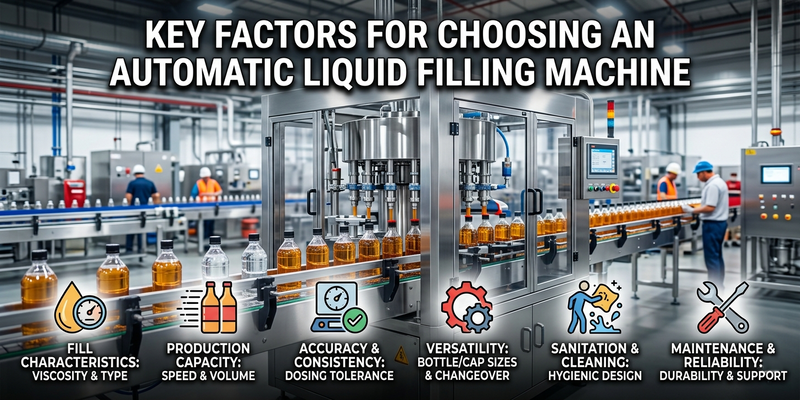
Choosing the right liquid filling machine1 feels overwhelming. A wrong move can lead to production nightmares and wasted money. But understanding a few key factors makes the decision simple and effective.
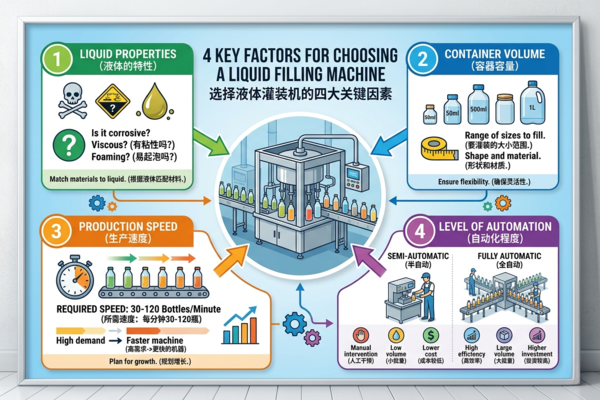
To choose the right automatic liquid filling machine1, you must consider four key factors: the properties of your liquid (is it corrosive?), your container volume2, your required production speed3 (bottles per minute), and the level of automation4 (semi-automatic vs. fully automatic) that fits your budget and scale.
I've spent over a decade helping businesses find the perfect packaging solutions. I've seen firsthand how the right machine can transform a production line, and how the wrong one can become a constant headache. It’s not just about buying a piece of equipment; it’s about investing in the efficiency and future of your business. The details might seem small, but they make all the difference. Let's break down these factors one by one so you can make a choice you feel confident about.
Does the type of liquid you're filling really matter?
You might think all filling machines can handle any liquid. But putting a corrosive product in the wrong machine can destroy your equipment and contaminate your entire batch of products.
Yes, the liquid type is critical. For corrosive liquids5 like acids or bleach, you must use an anti-corrosion filling machine6 made from materials like PVC. For non-corrosive products like oils or lotions, a standard stainless steel machine7 is a durable and cost-effective choice.
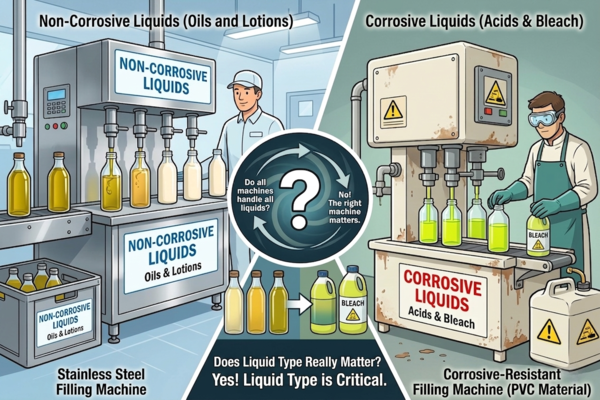
I remember a client who ran a cleaning supply company. They tried to save money by using a standard stainless steel filler for a new, highly acidic cleaning formula. Within a few weeks, the machine’s seals started failing, and the metal parts began to show signs of corrosion. The product was contaminated, and the machine was nearly ruined. This costly mistake taught them a valuable lesson: the machine's material must match the product's chemical properties. It’s the very first question you should ask.
Why Material Matters
The chemical composition of your liquid directly impacts the machine you need. Standard stainless steel (like grades 304 and 316L) is excellent for most food, beverage, and cosmetic products. It's hygienic, easy to clean, and resists rust. However, aggressive chemicals like strong acids, alkaline solutions, or high-salt liquids can eat away at stainless steel over time. This process, called chemical corrosion, not only damages expensive equipment but also introduces metal particles into your product, compromising its quality and safety.
Choosing the Right Material
Making the right choice starts with knowing your product. Always check the Material Safety Data Sheet (MSDS)8 for your liquid to understand its properties. This will guide your selection.
| Material | Best For | Avoid With | Key Benefit |
|---|---|---|---|
| Stainless Steel (316L) | Foods, beverages, oils, cosmetics, neutral pH products | Strong acids, bleach, high-chloride solutions | Hygienic, easy to clean, industry standard |
| PVC / Plastic | Corrosive chemicals, acids, bleach, chlorine | High-temperature liquids, certain solvents | Excellent chemical resistance at a lower cost |
| Titanium / Hastelloy | Highly corrosive and aggressive substances | - | Ultimate corrosion resistance, extremely durable |
Protecting your investment and your product starts here. Don't guess. Always verify what material is compatible with your liquid.
How do bottle size and production speed3 affect your choice?
You need to fill bottles, but you're not sure how container size and production goals connect. Choosing a machine too slow for your needs or one that can't handle your bottle size will create a major bottleneck.
Bottle size and speed are directly linked. Small-capacity containers often need precise fillers like piston or peristaltic machines. Large containers may use gravity or overflow fillers. Your required speed, measured in bottles per minute (BPM), determines how many filling nozzles your machine needs.
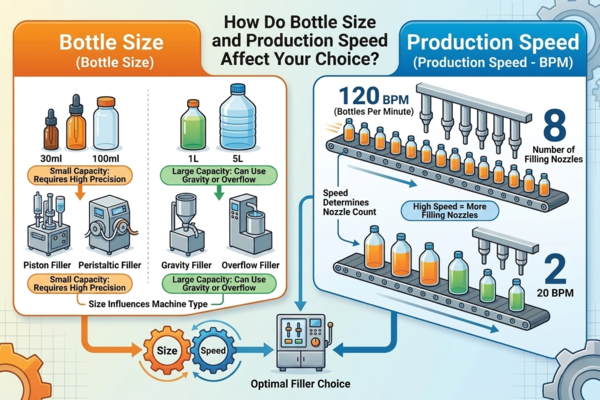
A few years ago, I worked with a startup making high-end essential oils. They sold their product in tiny 10ml vials. They almost bought a simple gravity filler9 because it was cheap, but we stopped them just in time. A gravity filler9 would have been incredibly inaccurate for such a small volume, leading to huge product loss. We set them up with a small, two-head piston filler10 instead. It was precise, reduced waste, and was perfect for their scale. This shows that the machine must fit the container, not the other way around.
Matching Filler Type to Volume
The technology inside the filling machine is designed for specific applications. You wouldn't use a fire hose to fill a water bottle. The same logic applies here. For small, high-value fills (like pharmaceuticals or cosmetics), you need precision. Peristaltic fillers are great because the liquid only touches the tubing, ensuring sterility. Piston fillers are also extremely accurate for a wide range of viscosities. For larger volumes of free-flowing liquids like water or juice, a gravity or overflow filler is much more efficient and cost-effective.
Calculating Your Speed Needs
Your production target dictates the machine's power. Speed is measured in Bottles Per Minute (BPM)11. A small business might only need 10-30 BPM, while a large industrial operation could require over 100 BPM. The number of filling heads, or nozzles, is the primary factor that determines this speed. A machine with two nozzles will be much slower than one with eight.
| Production Scale | Typical BPM | Recommended No. of Nozzles | Suitable Machine Type |
|---|---|---|---|
| Small / Startup | 10 - 30 | 1 - 2 | Semi-Automatic Piston/Peristaltic |
| Medium Business | 30 - 80 | 4 - 8 | Automatic Inline Piston/Overflow |
| Large Industrial | 80+ | 8 - 16+ | Rotary Filling Machine |
My advice is to always plan for growth. If you expect your demand to double in the next year, consider a machine that can be upgraded with more filling heads later. It’s a smart investment in your future.
Should you choose a semi-automatic or a fully automatic machine?
You know you need a machine, but you're not sure how much automation you really need. Buying a fully automatic line when you don't have the volume is a waste of money, but sticking with a semi-automatic machine can limit your growth.
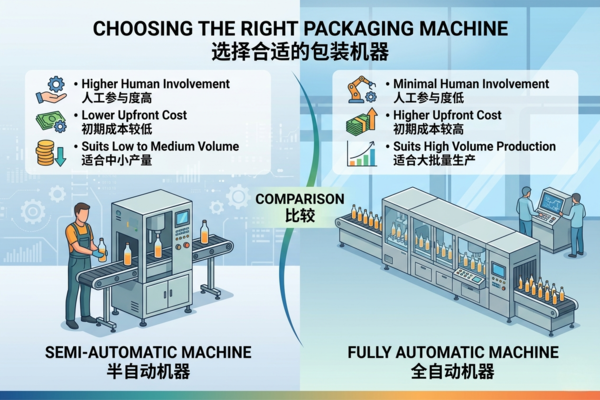
The choice depends on your production volume, labor costs, and budget. Semi-automatic machines require an operator for each cycle. Fully automatic machines handle the entire process from bottle feeding to capping, perfect for high-volume production with minimal labor.
I once consulted for a family-owned hot sauce business. They were filling thousands of bottles by hand, and it was becoming impossible to keep up with orders. They thought they needed a huge, fully automatic line. After looking at their numbers and their variety of sauce flavors, I recommended a 4-head semi-automatic piston filler10. It increased their production tenfold but was still flexible enough for them to switch between different bottle sizes and recipes easily. It was the perfect middle ground. For them, full automation would have been overkill and too rigid for their business model.
The Case for Semi-Automatic
Semi-automatic machines are the workhorses for small to medium-sized businesses. An operator places the bottles under the nozzles, presses a pedal or button to start the fill, and then removes the filled bottles. These machines are great for startups because they have a much lower initial cost and a smaller physical footprint. They are also incredibly flexible. If you produce many different products in small batches, a semi-automatic machine allows for quick and easy changeovers12. The main downside is the reliance on an operator, which means speed and consistency can vary.
When to Go Fully Automatic
A fully automatic filling line is a complete system. It includes conveyors to move bottles, a bottle unscrambler to orient them, the filler itself, a capping machine, and a labeler. This is an investment for established businesses with high, consistent demand. The upfront cost is significant, but the return on investment comes from drastically reduced labor costs, incredible speed, and pinpoint accuracy on every fill. These systems are designed for efficiency and are the backbone of any large-scale production facility.
| Feature | Semi-Automatic Filler | Fully Automatic Filler |
|---|---|---|
| Initial Cost | Low | High |
| Labor Required | High (1+ operator) | Low (supervisory) |
| Production Speed | Lower | High |
| Consistency | Operator-dependent | Very high and consistent |
| Flexibility | High (easy changeovers12) | Lower (changeovers12 take time) |
| Best For | Startups, small batches, R&D | High-volume, mass production |
Think about where your business is today and where you want it to be in two years. That will help you decide which level of automation4 is the right investment for you.
Conclusion
Choosing the right filler comes down to four things: your liquid, your bottle, your speed, and your scale. Get these right, and you'll have a machine that helps you grow.
Explore this link to discover top-rated liquid filling machines that can enhance your production efficiency. ↩
Understanding container volume is crucial for selecting the right filling machine; explore this resource for insights. ↩
Find out how to determine the ideal production speed for your filling machine to optimize efficiency. ↩
Explore the pros and cons of automation levels in filling machines to make an informed decision. ↩
Learn about the impact of corrosive liquids on filling machines to avoid costly mistakes in your production. ↩
Discover the materials that make anti-corrosion filling machines effective for handling corrosive liquids. ↩
Learn why stainless steel is a popular choice for filling machines and its benefits for various liquids. ↩
Understanding MSDS is essential for selecting compatible materials for your filling machine; explore this link. ↩
Find out when a gravity filler is the right choice for your production needs and its efficiency. ↩
Discover the benefits of piston fillers for precise liquid filling and how they can improve your production. ↩
Understanding BPM is crucial for selecting the right filling machine; explore this resource for details. ↩
Learn about the challenges of changeovers in filling machines and how to manage them effectively. ↩