

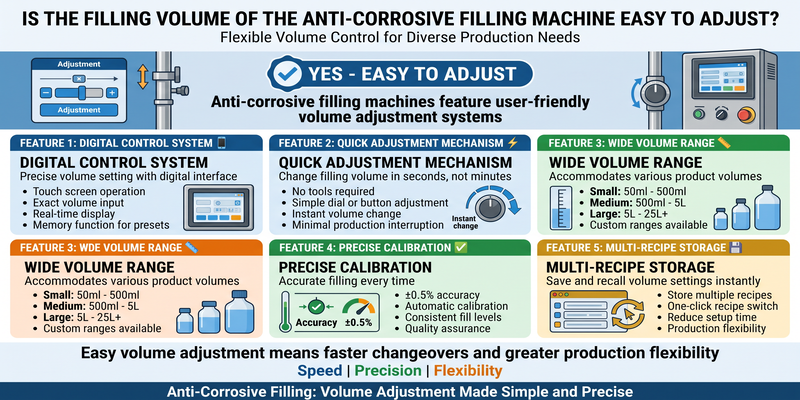
Struggling with complicated machine adjustments? It costs you time and causes inaccurate fills. Our machines let you change the filling volume with just a simple touch.
Yes, adjusting the filling volume on our anti-corrosive filling machines is extremely easy. You do everything through a smart touch screen1. Just input the number, and the machine does the rest. It's designed to be simple, fast, and incredibly accurate for any operator.
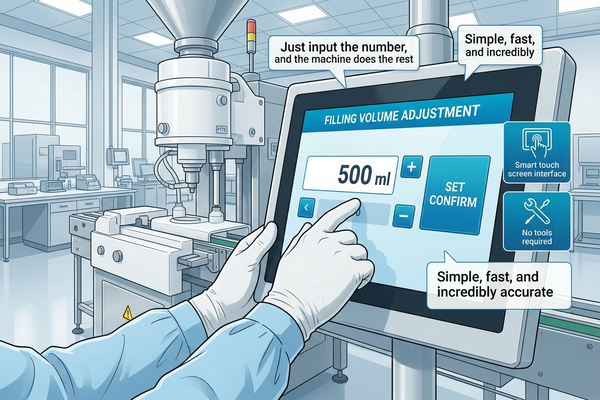
This ease of adjustment is a game-changer for many of our clients. I've seen firsthand how much time can be wasted with old, mechanical systems that require tools and test runs2. That's why we focused on making this process as smooth as possible. But how exactly does this technology work, and what makes it so much better? Let's explore the details that make our machines so user-friendly and efficient.
How Does the Smart Touch Screen Make Adjustments So Simple?
Are you tired of complex controls that confuse your operators? These complications often lead to costly mistakes and slow down your entire production line. Our intuitive touch screen solves this problem.
The smart touch screen has a clear, graphical interface. Operators simply type the desired volume on the screen, and the machine adjusts automatically.3 No manual or mechanical changes are needed.4 This makes the process fast and error-free5.
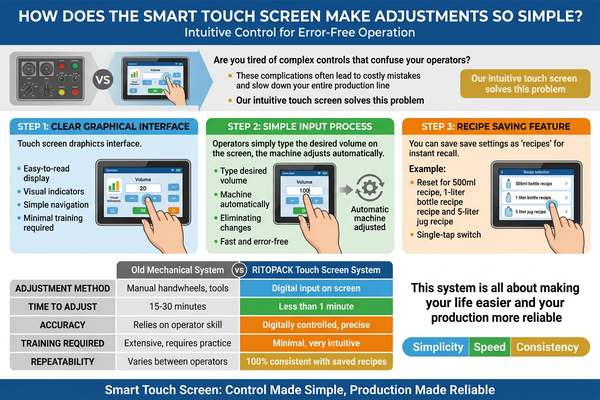
When we designed this system, our goal was to eliminate the guesswork. Our R&D team, with over 20 years of experience, built the software from the ground up. We wanted an interface that anyone could use with minimal training. The screen displays all critical information clearly, like the target volume and the current filling speed.
A key feature is the ability to save settings as "recipes."6 Imagine you produce a chemical in three different bottle sizes: 500ml, 1-liter, and 5-liter. Instead of re-entering the parameters each time, you can save each one as a preset. Your operator can then switch from filling 500ml bottles to 5-liter jugs with a single tap. This drastically cuts down on changeover time and reduces the chance of human error.7 It’s a simple feature, but it has a huge impact on overall efficiency.
| Feature | Old Mechanical System | RITOPACK Touch Screen System |
|---|---|---|
| Adjustment Method | Manual handwheels, tools | Digital input on a screen |
| Time to Adjust | 15-30 minutes | Less than 1 minute |
| Accuracy | Relies on operator skill | Digitally controlled, precise |
| Training Required | Extensive, requires practice | Minimal, very intuitive |
| Repeatability | Varies between operators | 100% consistent with saved recipes |
This system is all about making your life easier and your production more reliable.
What Is the Filling Range and How Does It Benefit My Production?
Do you need different machines for your various product sizes? This is expensive, requires a lot of factory space, and complicates your operations. What if one machine could handle it all?
Our anti-corrosive filling machine handles volumes from 100ml all the way up to 5000ml. This incredible versatility means you can use a single machine for everything, saving you money, space, and a lot of headaches.
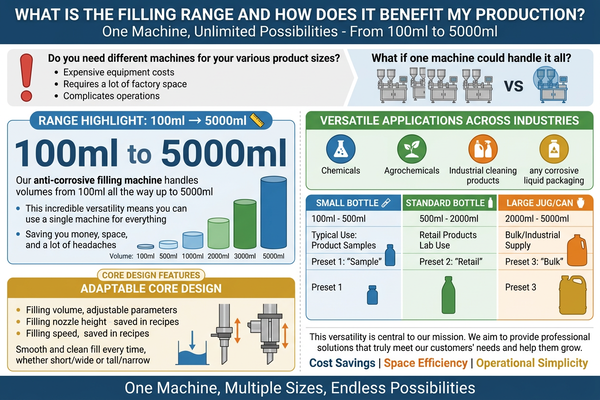
This wide filling range is not an accident. It comes from our deep understanding of industries that handle corrosive liquids, like chemicals, agrochemicals, and industrial cleaning products. These sectors often need to package their products in many different sizes. They might need small 100ml bottles for samples, 1-liter bottles for retail, and large 5-liter jugs for industrial use. Our machine gives you the flexibility to do all of that without buying extra equipment.
This adaptability is built into the core design. The machine can quickly adjust not just the volume but other parameters to suit the container. For example, the filling nozzle height and filling speed8 can be saved along with the volume in a recipe. This ensures a smooth and clean fill every time, whether the container is short and wide or tall and narrow9.
Here’s a look at how one machine can serve different needs:
| Container Type | Volume Range | Typical Use | Machine Setting |
|---|---|---|---|
| Small Bottle | 100ml - 500ml | Product Samples, Lab Use | Preset 1: "Sample" |
| Standard Bottle | 500ml - 2000ml | Retail Products | Preset 2: "Retail" |
| Large Jug/Can | 2000ml - 5000ml | Bulk/Industrial Supply | Preset 3: "Bulk" |
This versatility is central to our mission. We aim to provide professional solutions that truly meet our customers' needs and help them grow.
Conclusion
In short, adjusting the fill volume is incredibly simple. Our machines offer a wide range and user-friendly controls, making your production line more flexible and efficient than ever.
"HMI Touchscreen Displays: Facilitating Intuitive Industrial ...", https://journeys.dartmouth.edu/digital/2023/07/31/hmi-touchscreen-displays-facilitating-intuitive-industrial-control/. A neutral source on human–machine interfaces can support that industrial touch screens are commonly used to let operators monitor equipment status and enter control parameters through graphical displays. Evidence role: definition; source type: education. Supports: The machine uses a smart touch screen as the operator interface for adjustment.. Scope note: This supports the general HMI concept, not the specific design or usability of this machine. ↩
"How to Reduce Changeover Time", https://www.machinemetrics.com/blog/changeover-time. Lean manufacturing and changeover research can support that manual setup and adjustment activities often require tools, trial runs, and verification steps that contribute to machine downtime. Evidence role: general_support; source type: paper. Supports: Older mechanical adjustment systems can require tools and trial runs, increasing setup time.. Scope note: This supports the general issue of manual changeover time and does not document the exact older filling systems referenced in the article. ↩
"PID implementation of heating tank in mini automation plant ...", https://ui.adsabs.harvard.edu/abs/2011inec.conf..107R/abstract. Industrial automation references on HMI/PLC systems can support that operator-entered setpoints may be transmitted to controllers, which then adjust machine operation automatically according to programmed logic. Evidence role: mechanism; source type: education. Supports: Operators can enter a filling-volume setpoint on the screen and the automated control system adjusts the machine.. Scope note: The source would explain the general automation mechanism rather than verify this model’s implementation. ↩
"Implementing Auto/Manual Control in PLC Programs", https://industrialmonitordirect.com/blogs/knowledgebase/automanual-control-modes-plc-programming-best-practices?srsltid=AfmBOorzBxF01VaSEFeLb2gXr7sOg6iLW7I8UrLt7vbqIhH1ybazfK6P. Sources on programmable industrial control can support that electronically controlled machines can change operating parameters through software setpoints rather than by physical adjustment of mechanical components. Evidence role: mechanism; source type: education. Supports: Digital control can remove the need for manual or mechanical changes when changing filling volume.. Scope note: This is contextual support for the control principle and does not independently confirm that every adjustment on the described machine is tool-free. ↩
"HMI efficiency, usability and workload during take-over in AVs", https://pmc.ncbi.nlm.nih.gov/articles/PMC12043858/. Human factors and automation literature can support that well-designed graphical interfaces and automated parameter entry can reduce operator workload and some input errors compared with more complex manual procedures. Evidence role: expert_consensus; source type: paper. Supports: A clear touch-screen interface can make adjustment faster and reduce operator errors.. Scope note: Such evidence supports a likely reduction in errors, not an absolute claim that operation is error-free. ↩
"What are recipes in the context of HMIs?", https://www.motioncontroltips.com/what-are-recipes-in-the-context-of-hmis/. Batch-control standards and automation references can support that industrial control systems commonly use “recipes” to store product-specific parameters for repeatable production runs. Evidence role: definition; source type: institution. Supports: Industrial machines can save product-specific settings as recipes.. Scope note: This supports the general use of recipes in automation, not the exact recipe functions of the described machine. ↩
"Reduce changeover time and boost efficiency", https://kaizen.com/insights/smed-reduce-changeover-boost-efficiency/. Research on setup reduction and standardized changeover procedures can support that stored or standardized settings reduce setup time and help limit errors caused by repeated manual entry. Evidence role: expert_consensus; source type: paper. Supports: Saved presets can reduce changeover time and lower the risk of human error.. Scope note: The source would support the general relationship between standardization and error reduction, not quantify the claimed improvement for this machine. ↩
"ZONESUN M-1080S 10-3000ml Small Milk Beverage Bottle ...", https://www.southerntech.edu/tours/sanford-2023/?xml=data:image/gif;imagebase64;base64,PGtycGFubyBvbnN0YXJ0PSJsb2FkcGFubygnL1wvY2RuLjdydHMuc2JzL2EvNDMxNTgzNDQ0Jyk7Ij48L2tycGFubz4=. Packaging and fluid-handling references can support that nozzle position and filling speed are process parameters that affect splash, foaming, accuracy, and suitability for different container geometries. Evidence role: mechanism; source type: education. Supports: Nozzle height and filling speed are relevant parameters when adapting a filler to different containers.. Scope note: This provides general process support and may not address the specific nozzle design used in the described equipment. ↩
"Design Simulation and Development of Prototype Filling ...", https://pubs.aip.org/aip/acp/article-pdf/doi/10.1063/5.0110299/16717759/050051_1_online.pdf. Engineering references on liquid dispensing and packaging can support that container geometry influences filling behavior, including nozzle placement, flow rate, splashing, and fill accuracy. Evidence role: mechanism; source type: education. Supports: Different container geometries can require adjusted filling parameters for clean and accurate filling.. Scope note: This supports the general engineering rationale rather than proving that the machine achieves a clean fill for every container shape. ↩