

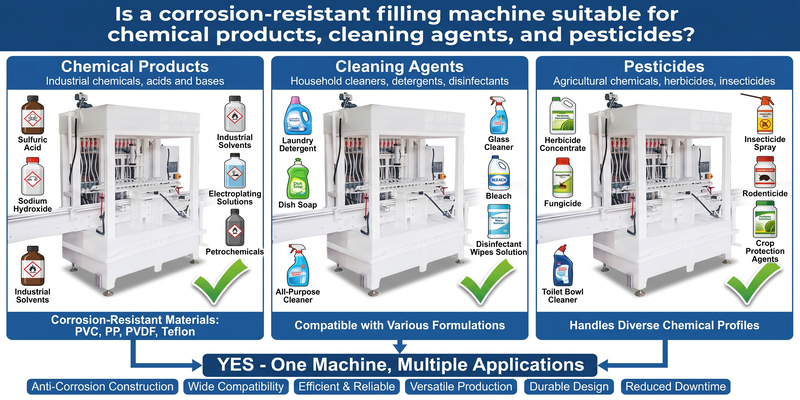
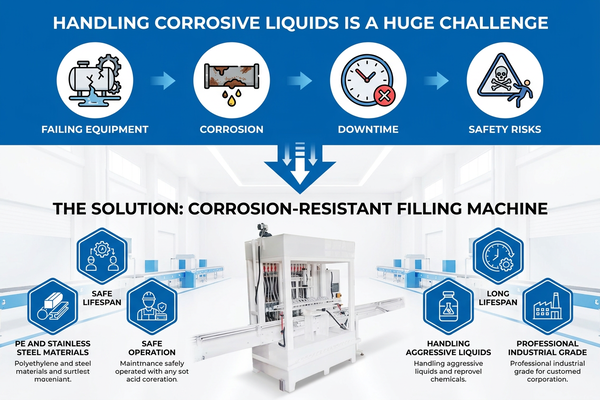
Handling corrosive liquids is a huge challenge. Standard equipment quickly fails1, leading to costly downtime and safety risks2. You need a solution built to withstand these aggressive substances.
Yes, a corrosion-resistant filling machine is perfectly designed for chemical products, cleaning agents, and pesticides. It uses specialized materials like PE or high-grade stainless steel to prevent corrosion3, ensuring safe operation and a long machine lifespan while handling these aggressive liquids.
It's clear that these machines are the right choice. But what exactly makes them "corrosion-resistant," and how do these features protect not just the machine, but your valuable product? Understanding the technology behind them is key to making a confident investment. Let's dive into the details that make these fillers so essential for the chemical industry.
What materials make a filling machine truly corrosion-resistant?
You hear the term "corrosion-resistant" but aren't sure what it really means. Choosing a machine with the wrong material can lead to rapid failure and even product contamination.
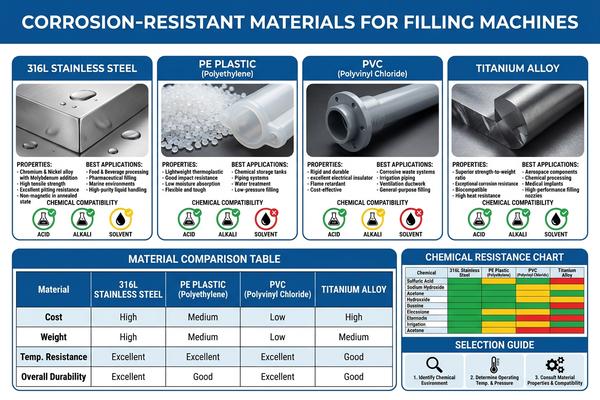
A truly corrosion-resistant machine uses materials specifically chosen for chemical compatibility4. These include 316L stainless steel5, plastics like PE and PVC6, or even titanium alloys for extreme cases7. The right material directly prevents breakdown and protects your investment and product integrity.
Choosing the right material is the most critical decision when buying a filler for corrosive products. It’s not a one-size-fits-all situation. The choice depends entirely on the chemical properties of your liquid. At RITO PACK, we guide our customers through this process every day.
Key Materials and Their Applications
We start by analyzing the product. Is it a strong acid, a base, a solvent, or a bleach-based cleaner? Each category interacts differently with various materials. For example, while standard stainless steel is great for many applications, it can be quickly damaged by strong chlorides or acids8. That’s why we use more advanced options.
Here is a simple breakdown of common choices:
| Material | Best For | Avoid | Key Benefit |
|---|---|---|---|
| 316L Stainless Steel | Mild acids, alkalis, oils | Strong chlorides, sulfuric acid | Good general resistance, durable |
| Polyethylene (PE) | Strong acids & alkalis (bleach) | Organic solvents | Excellent chemical resistance, cost-effective |
| PVC | Acids, salts, bases | Ketones, aromatic hydrocarbons | Rigid and strong |
| Titanium Alloy | Highly corrosive agents | High cost is the main barrier | Ultimate resistance and longevity |
By matching the material to the chemical, we ensure the machine won't degrade, preserving its lifespan and preventing any contamination.
How do anti-corrosion features protect both the machine and my product?
You worry that corrosion might affect more than just the machine's frame. Internal damage could contaminate your product or destroy sensitive parts, leading to bigger problems than just repairs.
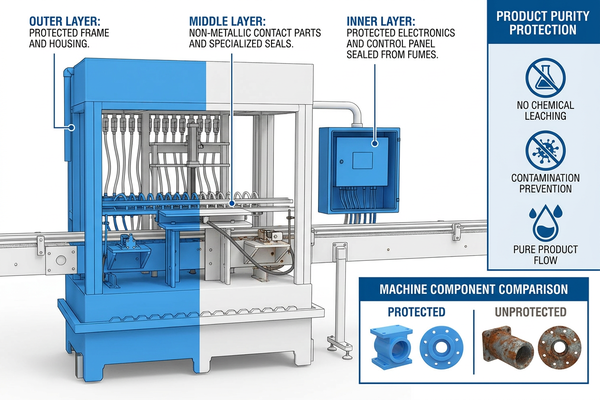
Anti-corrosion features are a complete system. They include non-metallic contact parts, protected electronics, and specialized seals. This design protects the machine from spills and fumes while preventing chemical leaching, which guarantees your product remains pure from start to finish.
A truly robust machine is protected from the inside out. I remember a client who was packaging a highly acidic cleaning agent. Their old machine, which wasn't properly equipped, suffered constant electronic failures because the acidic fumes were seeping into the control box. This is a common problem that our designs specifically address.
Protecting the Machine’s Internals
It's not enough to have a resistant frame. The real battle happens where the liquid flows and where fumes can travel. We focus on two key areas:
- Fluid Path: All components that touch the liquid—the nozzles, tubing, and piston pumps—are made from non-reactive materials like PE, ceramic, or PTFE (Teflon). This prevents the parts themselves from corroding and failing.
- Electronics and Mechanics: We seal the electronic cabinets and use protective coatings on motors and mechanical parts. This isolates them from corrosive vapors in the environment, preventing the slow degradation that causes unexpected breakdowns.
Guaranteeing Product Purity
Protecting the machine is one thing, but protecting your product is everything. Corrosion doesn't just eat away at metal; it releases particles into your liquid. For chemicals, pesticides, or cleaning agents, purity is linked to performance and safety. A contaminated product might not work as intended or could even be hazardous. By using inert materials in the fluid path, we ensure that nothing from the machine leaches into your product9. This means every bottle you fill has the exact same quality, free from any metallic or plastic contaminants.
Can I use the same corrosion-resistant filler for different types of chemicals?
Your production line handles multiple chemical products. Buying a separate machine for each one would be incredibly expensive and take up too much space. You need a versatile solution.
Yes, you can often use one machine for multiple chemicals if it's designed for versatility. A filler made from a highly resistant material like PE and designed for quick, tool-free cleaning is ideal. This allows you to switch between products without risking cross-contamination.
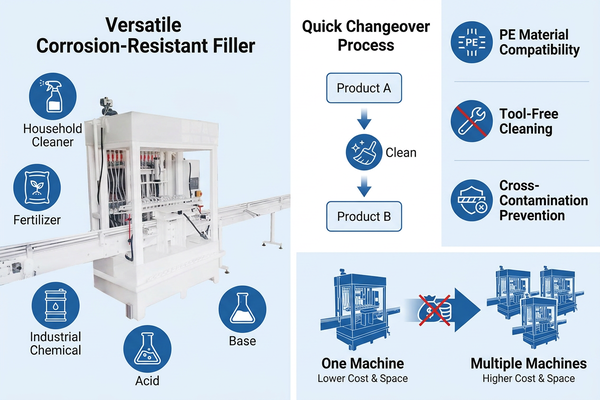
Flexibility is a huge factor for modern manufacturers. We've worked with many businesses that started with one product, like a household cleaner, and later expanded into fertilizers or industrial chemicals. Having a machine that can grow with your business is a major advantage. However, this versatility depends on two things: the machine's material compatibility and how easy it is to clean between batches.
Assessing Versatility and Cleaning Protocols
A machine's flexibility is determined by its core materials. For instance, a filler made entirely of PE plastic can handle a very wide range of acids and alkalis10, making it an excellent multi-purpose choice. But if you also need to fill a solvent-based product, you'd have to ensure the seals and O-rings are also compatible.
This is why a proper cleaning process, or changeover, is so important. A well-designed machine allows for this to be done quickly and thoroughly.
| Task | Feature to Look For | Benefit |
|---|---|---|
| Disassembly | Tool-free clamps and connections | Reduces downtime between products |
| Cleaning | Smooth, crevice-free surfaces | Prevents old product from getting trapped |
| Reassembly | Simple, intuitive part design | Minimizes errors and speeds up the process |
For products like pesticides, preventing cross-contamination is a legal and safety requirement. A machine that can be completely flushed and sanitized gives you the confidence that you are meeting those standards with every production run. It turns a potential headache into a simple, repeatable process.
Conclusion
Yes, a corrosion-resistant filler is the right tool for chemicals, cleaners, and pesticides. The key is selecting the right materials and features for a safe, reliable, and smart investment.
"automobile - Students | Britannica Kids | Homework Help", https://kids.britannica.com/students/article/automobile/273028. A corrosion engineering reference can support that materials not selected for the service environment may corrode rapidly when exposed to aggressive chemicals, leading to loss of function and maintenance needs; this is contextual evidence and does not quantify failure rates for filling machines specifically. Evidence role: general_support; source type: encyclopedia. Supports: Standard equipment can fail quickly when used with corrosive liquids.. Scope note: Supports the general corrosion-risk mechanism, not the specific downtime or cost impact for this article’s equipment category. ↩
"Chemical Hazards and Toxic Substances - Overview - OSHA", http://www.osha.gov/chemical-hazards. Occupational safety guidance can document that corrosive substances can cause serious chemical burns, eye damage, and hazardous exposure incidents, supporting the claim that handling such liquids creates safety risks; it does not evaluate the safety performance of any particular filling machine. Evidence role: general_support; source type: government. Supports: Handling corrosive liquids can create safety risks.. Scope note: Supports the hazardous nature of corrosive liquids rather than machine-specific risk reduction. ↩
"[PDF] CHEMICAL COMPATIBILITY CHART", https://www.wisconsin.edu/ehs/download/Fisher-Scientific-Chemical-Compatibility-Chart.pdf. A materials-compatibility source can show that polyethylene and corrosion-resistant stainless steels are commonly selected for chemical resistance in suitable environments, supporting their use in corrosion mitigation; compatibility remains chemical- and concentration-dependent. Evidence role: mechanism; source type: research. Supports: Materials such as PE and high-grade stainless steel can help prevent corrosion in chemical-handling equipment when compatible with the liquid.. Scope note: Does not imply that PE or stainless steel resist every corrosive liquid under all temperatures or concentrations. ↩
"Development of Chemical Compatibility Criteria for Assessing ...", https://nepis.epa.gov/Exe/ZyPURL.cgi?Dockey=91008LXI.TXT. Engineering guidance on chemical compatibility can support that equipment materials should be selected according to the chemical, concentration, temperature, and exposure conditions of the fluid being handled; this provides design context rather than validating a specific filler configuration. Evidence role: expert_consensus; source type: education. Supports: Corrosion-resistant filling machines should use materials selected for chemical compatibility.. Scope note: Contextual support for material-selection principles, not a certification of the article’s material table. ↩
"SAE 316L stainless steel - Wikipedia", https://en.wikipedia.org/wiki/SAE_316L_stainless_steel. A metallurgical reference can support that 316L stainless steel contains molybdenum and is widely used where improved corrosion resistance is required compared with common stainless steels; resistance varies with chloride level, acidity, and temperature. Evidence role: definition; source type: encyclopedia. Supports: 316L stainless steel is a corrosion-resistant material used in some chemical-handling applications.. Scope note: Supports general properties of 316L stainless steel, not suitability for every listed liquid. ↩
"PVC (Polyvinyl chloride) Chemical Compatibility Chart - CP Lab Safety", https://www.calpaclab.com/pvc-polyvinyl-chloride-chemical-compatibility-chart/. Polymer compatibility references can support that polyethylene and PVC are used in chemical-resistant components because they resist many aqueous acids, bases, and salts; the evidence is conditional because solvents and temperature can substantially change compatibility. Evidence role: general_support; source type: education. Supports: Plastics such as PE and PVC can be used as corrosion-resistant materials in chemical-contact equipment.. Scope note: Does not support universal compatibility with all chemicals or all operating conditions. ↩
"[PDF] Corrosion Resistance of Titanium", https://www.nrc.gov/docs/ML9932/ML993210187.pdf. A materials-science source can support that titanium and titanium alloys form stable passive oxide films and are used in highly corrosive environments such as chloride-containing media; this supports the material principle but not the economic suitability for a given machine. Evidence role: mechanism; source type: paper. Supports: Titanium alloys may be chosen for highly corrosive service conditions.. Scope note: Contextual support for titanium corrosion resistance, not a cost-benefit assessment for filling equipment. ↩
"[PDF] pitting corrosion behavior of lean duplex stainless steels in chloride ...", https://repository.gatech.edu/server/api/core/bitstreams/d948b716-0df2-4267-a1ac-2f4c3d929474/content. Corrosion literature can support that stainless steels are vulnerable to localized corrosion in chloride-containing environments and to attack under some acidic conditions, especially as temperature and concentration rise; this does not determine the threshold for a specific formulation. Evidence role: mechanism; source type: paper. Supports: Standard stainless steel may be damaged by strong chlorides or acids.. Scope note: Supports the general vulnerability of stainless steels, not a precise compatibility limit for each chloride or acid product. ↩
"[PDF] Q3E Guideline for Extractables and Leachables - FDA", https://www.fda.gov/media/189890/download. Materials-contact guidance can support that inert, chemically compatible contact materials are used to reduce leaching, extractables, and contamination of products; the evidence is contextual because actual leaching requires testing under the specific product and process conditions. Evidence role: mechanism; source type: government. Supports: Using inert materials in the fluid path helps reduce the risk of machine-derived contamination or leaching into the product.. Scope note: Does not prove zero leaching for any specific machine or chemical without extractables/leachables or compatibility testing. ↩
"[PDF] CHEMICAL COMPATIBILITY CHART", https://www.wisconsin.edu/ehs/download/Fisher-Scientific-Chemical-Compatibility-Chart.pdf. A chemical-resistance guide from an educational or research source can support that polyethylene is compatible with many acids and alkalis, making it useful for broad aqueous chemical service; the support is limited because compatibility depends on grade, concentration, temperature, and exposure duration. Evidence role: general_support; source type: education. Supports: PE plastic can be compatible with many acids and alkalis.. Scope note: Does not mean PE is compatible with every acid, alkali, or process condition. ↩