

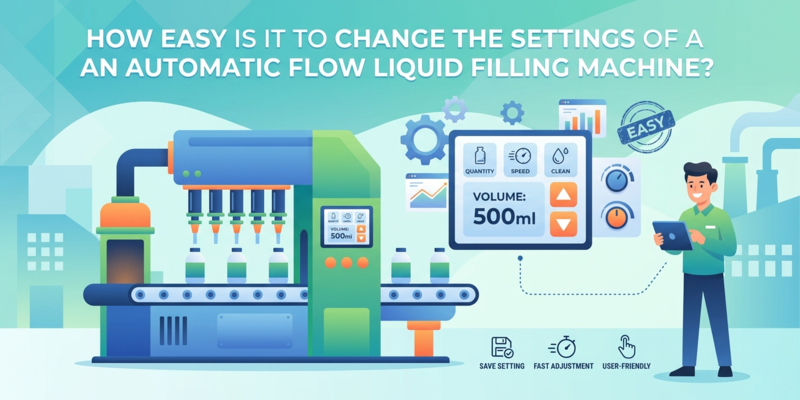
Worried that complex machine settings will slow down your production? Adjusting filling machines1 can seem hard, leading to downtime. But what if changing settings was simple?
Changing the settings on an automatic flow liquid filling machine is surprisingly easy. You can adjust key parameters like filling volume and speed directly through a user-friendly touch screen2. Just follow the clear instructions in the manual for a quick and simple setup process.
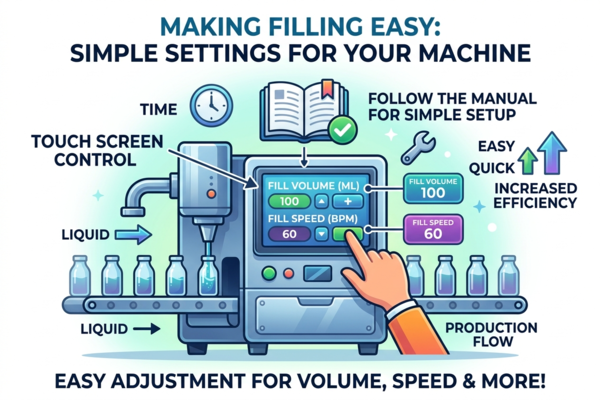
It sounds simple, and it really is. But you might be wondering what specific settings you can change and how exactly you do it. Let's break down the most common adjustments you will need to make on your machine.
How do you adjust the filling volume?
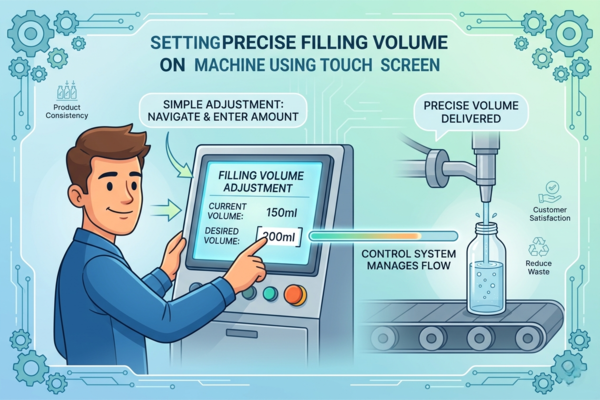
Getting the exact fill volume is critical for product consistency.3 Incorrect volumes lead to waste and customer complaints. Our machines let you set the precise volume with just a few taps.
Adjusting the filling volume is done directly on the touch screen interface. You simply navigate to the volume setting menu and enter the desired amount. The machine's control system then precisely manages the flow to deliver that exact volume.
The heart of this simple adjustment is the machine's PLC, or Programmable Logic Controller4. When you input a number on the screen, you are giving the PLC a direct command.5 For our flow filling machines, this command is typically based on time. A longer opening time for the filling valve means more liquid flows into the bottle.6 It's a very direct and reliable system.
Key Control Parameters
To get started, you will usually find a "Settings" or "Parameters" menu. From there, you can select the specific filling head you want to adjust. I remember a client in the beverage industry who needed to switch from 500ml bottles to 750ml bottles. It took them less than a minute per nozzle to update the new settings. They were back up and running very quickly.
Here's a simple breakdown of how it works:
| Setting Type | Control Method | How it Works |
|---|---|---|
| Time-Based | PLC controls7 valve open time | You set a specific duration, like 3.5 seconds, for the valve to stay open. |
| Flow Meter8 | Sensor measures liquid volume | You set a target volume, like 500ml, and the valve closes once that amount has passed through the sensor. |
Initial calibration is important, but once that is set, making small tweaks is incredibly fast.
Can you change the filling speed easily?
Do you need to match your filler's speed to the rest of your production line? A mismatched speed can cause bottlenecks.9 Adjusting the filling speed is straightforward, ensuring your whole line runs smoothly.
Yes, changing the filling speed is very easy. Most automatic machines have a speed control setting on the main touch screen. You can increase or decrease the speed to match your capper or labeler, ensuring a seamless production flow.
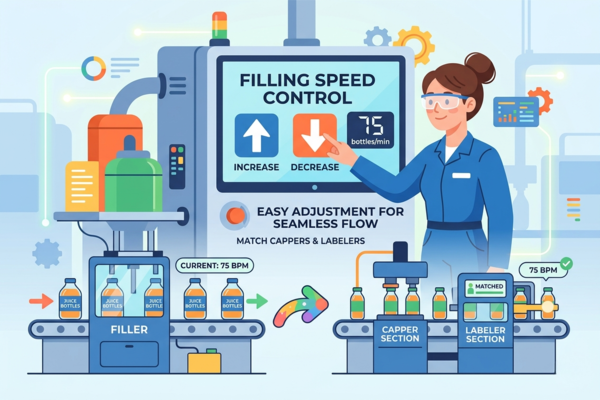
Adjusting the filling speed is not just about going faster. It is about optimizing your entire production process. For example, if your capping machine can only handle 40 bottles per minute, you should set your filler to the same speed10. This prevents a pile-up of bottles between the two machines. The speed setting on the touch screen usually controls the conveyor belt speed and the time between each filling cycle11. This simple control helps you sync your entire line perfectly.
Finding the Sweet Spot: Speed vs. Accuracy
Sometimes, you need to slow down to get better results. I worked with a company that was filling a foamy soap12. When they ran the machine at top speed, the foam created inaccurate fills and a lot of mess. By simply reducing the filling speed by 20% on the control panel, the liquid filled more gently. The foam problem disappeared, and their fill accuracy became perfect. This simple software adjustment saved them from a major product waste problem. It is all about finding the right balance for your specific product. Our machines make that trial-and-error process quick and painless.
What about switching between different bottle sizes?
Running multiple products often means using different bottle sizes. The thought of a long, complicated changeover process can be stressful. Our machines are designed for quick and easy changeovers between bottle types.
Switching between bottle sizes involves both software and minor physical adjustments. On the touch screen, you can often save and load preset "recipes" for each bottle. Physically, you just adjust the guide rails and nozzle height, usually with simple hand-cranks.
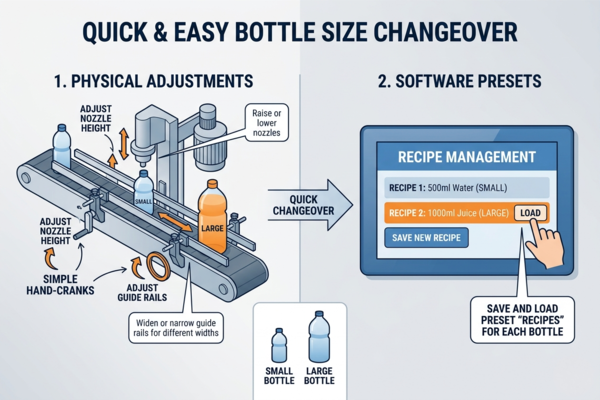
A full changeover is a two-step process, but it is designed to be fast. The first step is digital. Many of our machines allow you to save settings as a "recipe." Imagine you have a "500ml Juice Bottle" recipe. It stores the correct fill volume, speed, and nozzle timing all in one place. When you need to run that product, you just select that recipe from a list on the screen. This feature is incredibly efficient and reduces human error13.
Simple Physical Adjustments
The second step is physical, but it is not difficult. You need to make sure the new bottles fit and are positioned correctly under the nozzles. This usually involves two simple tasks:
- Guide Rails: You widen or narrow the conveyor guide rails to fit the bottle's diameter. This is done with a simple hand-wheel, so no tools are needed.
- Nozzle Height: You adjust the height of the filling nozzles to be just above the new bottle's opening. This is also typically a hand-crank adjustment.
I have seen operators complete a full changeover in under 15 minutes. This speed and simplicity are key to keeping your production flexible and efficient.
Conclusion
In short, modern automatic flow fillers are designed for ease of use. Adjusting settings through a touch screen is simple, fast, and empowers you to manage your production line efficiently.
"Industrial Revaluation 4.0 Transformation of Job market", https://www.academia.edu/63315195/Industrial_Revaluation_4_0_Transformation_of_Job_market. A peer-reviewed manufacturing or packaging-engineering source documenting setup/changeover activities and adjustment-related stoppages would support the statement that modifying filling-machine settings can contribute to production downtime. Evidence role: general_support; source type: paper. Supports: Adjusting filling machines can seem hard, leading to downtime.. Scope note: Evidence may address packaging or manufacturing equipment changeovers generally rather than automatic flow liquid filling machines specifically. ↩
"Low End Human Machine Interface (HMI) Display using ARM Cortex ...", https://www.academia.edu/14294445/Low_End_Human_Machine_Interface_HMI_Display_using_ARM_Cortex_M4_Based_Controller. A neutral source on industrial human–machine interfaces explains that touch-screen HMIs are commonly used to let operators monitor equipment and change control parameters in automated machinery. Evidence role: general_support; source type: education. Supports: Automatic flow liquid filling machines commonly allow settings to be adjusted through a touch-screen interface.. Scope note: This supports the general use of touch-screen HMIs in automation, not the usability of any specific filling-machine model. ↩
"[PDF] 2023 NIST Handbook 133 Checking the Net Contents of Packaged ...", https://www.nist.gov/system/files/documents/2023/02/10/2023%20NIST%20Handbook%20133.pdf. Weights-and-measures or packaging-control guidance from government sources emphasizes that packaged goods must meet declared quantity requirements, which makes accurate and consistent fill volume important in production. Evidence role: general_support; source type: government. Supports: Accurate fill volume is important for packaged-product consistency and compliance with declared quantity requirements.. Scope note: Such regulations support the importance of fill accuracy broadly, but they do not prove customer complaint rates for this article’s products. ↩
"Programmable logic controller - Wikipedia", https://en.wikipedia.org/wiki/Programmable_logic_controller. An encyclopedia or educational source defines a programmable logic controller as an industrial digital controller used to automate electromechanical processes and execute control logic for machinery. Evidence role: definition; source type: encyclopedia. Supports: A PLC is the control component that receives operator inputs and controls machine actions in automated filling equipment.. Scope note: The definition establishes what a PLC is, but it does not verify the configuration of the article’s specific machines. ↩
"Industrial Automation Using Plc, Hmi and its Protocols Based on ...", https://www.academia.edu/44737313/Industrial_Automation_Using_Plc_Hmi_and_its_Protocols_Based_on_Real_Time_Data_for_Analysis. Industrial automation references describe HMIs as operator interfaces that send setpoints or commands to PLCs, which then execute the programmed control logic. Evidence role: mechanism; source type: education. Supports: Touch-screen operator inputs can be passed to a PLC as setpoints or commands for machine control.. Scope note: This supports the general HMI-to-PLC control mechanism, not the exact screen workflow of a particular filler. ↩
"[PDF] Chapter 4: Volumetric Flowrate, Velocity and the Continuity Equation", https://ecommons.udayton.edu/cgi/viewcontent.cgi?article=1004&context=cee_coursenotes. Fluid mechanics sources describe volumetric flow as the product of flow rate and time, supporting the principle that, under otherwise stable conditions, increasing valve-open duration increases delivered volume. Evidence role: mechanism; source type: education. Supports: In time-based filling, increasing the duration that a valve remains open generally increases the volume dispensed.. Scope note: The relationship assumes reasonably stable flow conditions and does not account for changes in pressure, viscosity, valve dynamics, or nozzle design. ↩
"Figure 7 - from PLC Based Automatic Liquid Filling System", https://www.academia.edu/figures/43297457/figure-7-and-the-solenoid-valve-operates-and-the-bottle. A technical source on PLC-controlled liquid or bottle-filling systems can show that a PLC actuates the filling valve or solenoid according to programmed timing or sensor inputs, so valve open duration is a mechanism for controlling dispensed volume in time-based filling. Evidence role: mechanism; source type: paper. Supports: In a time-based automatic liquid filling machine, the PLC controls the filling valve’s open time to regulate how much liquid is dispensed.. Scope note: This supports the general control principle; individual filling machines may instead use flow meters, piston pumps, weight feedback, or other metering methods. ↩
"Flow measurement - Wikipedia", https://en.wikipedia.org/wiki/Flow_measurement. A technical or encyclopedia source on flow meters explains that these instruments measure the quantity or rate of fluid passing through a system, which can be used as feedback for dispensing control. Evidence role: definition; source type: encyclopedia. Supports: Flow-meter-based filling uses a sensor to measure liquid flow so that a control system can stop dispensing when the target volume is reached.. Scope note: This supports the measurement principle, not the performance or accuracy of any specific flow-meter filling system. ↩
"[PDF] Balancing of Production Line in a Bearing Industry to improve ...", https://scholarworks.wmich.edu/cgi/viewcontent.cgi?article=1234&context=hilltopreview. Operations-management sources on production line balancing explain that when sequential workstations have different capacities, the lower-capacity station constrains throughput and creates waiting or accumulation upstream. Evidence role: mechanism; source type: education. Supports: If a filler, capper, or labeler operates at mismatched rates, the slower station can create a production bottleneck.. Scope note: The source would support the production-line principle generally, not the exact bottleneck behavior of a particular filling line layout. ↩
"[PDF] A production line that balances itself.", https://www2.isye.gatech.edu/~jjb/bucket-brigades/papers/1996_Bartholdi_Eisenstein.pdf. Line-balancing literature explains that coordinated station capacities help maintain continuous flow and reduce work-in-process accumulation between serial processes. Evidence role: expert_consensus; source type: education. Supports: Filler speed should be coordinated with downstream equipment such as cappers or labelers to maintain smooth production flow.. Scope note: This supports matching or coordinating rates as a general production principle; the optimal setpoint may also depend on buffers, uptime, and control strategy. ↩
"[PDF] A Throughput-Based Technique for Identifying Production System ...", https://scholarsjunction.msstate.edu/cgi/viewcontent.cgi?article=1331&context=td. Packaging and automation references describe production rate as depending on conveyor motion and cycle timing, since both determine how frequently containers are positioned, filled, and advanced. Evidence role: mechanism; source type: education. Supports: Filling-machine speed settings commonly affect conveyor movement and cycle timing, which together influence throughput.. Scope note: This supports the general determinants of machine throughput; individual machines may use additional controls such as indexing, servo motion, or buffer logic. ↩
"[PDF] Foam in porous media - Rutgers School of Engineering", http://coewww.rutgers.edu/~aneimark/PDFs/FoamReview99.pdf. Technical sources on foam and liquid filling note that agitation, turbulence, and rapid dispensing can promote foam formation, while gentler filling can reduce entrained air and foaming. Evidence role: mechanism; source type: paper. Supports: Foamy liquids may require slower or gentler filling to reduce foam formation and improve fill consistency.. Scope note: The support is contextual because foaming behavior depends on formulation, surfactant concentration, temperature, nozzle geometry, and filling method. ↩
"Understanding human management of automation errors - PMC - NIH", https://pmc.ncbi.nlm.nih.gov/articles/PMC4221095/. Human-factors and automation literature indicates that standardized procedures, stored settings, and reduced manual data entry can lower the likelihood of operator error in repetitive industrial tasks. Evidence role: expert_consensus; source type: research. Supports: Using saved recipes for machine settings can reduce errors associated with repeated manual setup.. Scope note: This supports the general error-reduction rationale; it does not quantify the reduction for the article’s machines or for liquid filling specifically. ↩