

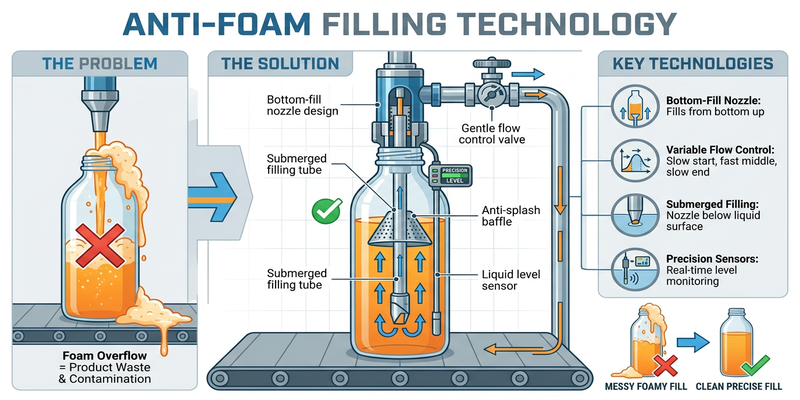
Foaming liquids creating a mess? This wastes product and slows down your line. Our machines use specific methods to fill these liquids cleanly and accurately every time.
A corrosion-resistant filling machine prevents foam by using two main methods. It uses low-speed, gentle filling1 to reduce agitation. It also employs bottom-up filling2, where the nozzle starts at the container's base and rises with the liquid level, minimizing splashing and air mixing.
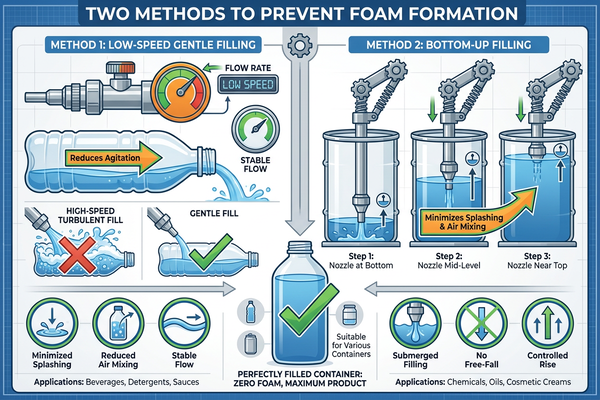
These two techniques sound simple, but the way they work is quite clever. Understanding them can help you choose the right machine for your specific product, whether it's a cleaning solution, a beverage, or a chemical. Let's break down each method so you can see exactly how it improves your filling process.
Why is slow-and-steady filling the secret to handling foam?
Trying to fill foaming liquids quickly? This high speed is likely causing massive foam-overs and inaccurate volumes. The solution is counterintuitive: slowing down actually boosts your overall efficiency.
Slow-and-steady filling is key because it minimizes turbulence. By filling the container gently and continuously, the liquid isn't violently agitated. This reduces the amount of air that gets mixed in, which is the primary cause of foam formation3 during the filling process.
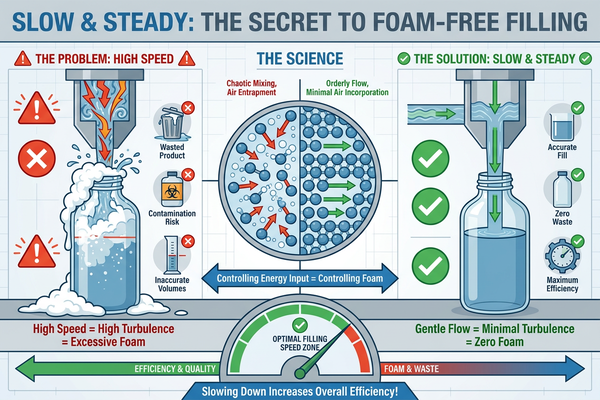
Let's dive into why speed is so critical. It all comes down to controlling the energy you introduce into the liquid.
The Physics of Foam
Foam is simply gas (usually air) trapped in a liquid. Many products, like soaps or certain chemicals, have surfactants that stabilize these bubbles. When you pour the liquid aggressively, you're essentially whipping air into it, and the surfactants make sure that air stays put, creating foam. This isn't just a cosmetic issue; it leads to under-filled containers and messy overflows, directly impacting your bottom line.
How Speed Affects Turbulence
Think about filling a glass from the tap. A gentle stream creates almost no bubbles. A powerful blast creates a lot. Our machines control the filling speed precisely to mimic that gentle stream. This is called laminar flow4, where the liquid moves in smooth, parallel layers. High speed creates turbulent flow5, which is chaotic and mixes air in aggressively. At RITO, we program our filling machines to maintain a flow rate that stays below the turbulence threshold for your specific product. This means we can achieve the fastest possible speed without creating foam.
| Feature | High-Speed Filling6 | Controlled-Speed Filling |
|---|---|---|
| Flow Type | Turbulent | Laminar |
| Air Mixing | High | Minimal |
| Foam Level | High | Low / None |
| Fill Accuracy | Poor | Excellent |
| Product Waste | Significant | Negligible |
By managing the flow rate, we maintain control. This ensures the product fills cleanly and that every bottle meets the target volume, maximizing your yield.
How does filling from the bottom up eliminate splashing and foam?
Is your filling nozzle dropping liquid from a height? This splashing is a major cause of foam. By changing the starting point, we can eliminate this problem entirely.
Bottom-up filling7 works by placing the nozzle tip at the base of the empty container. As the liquid fills, the nozzle rises, but its tip always stays just below the liquid's surface. This method completely prevents the liquid from splashing, which stops air from getting trapped.
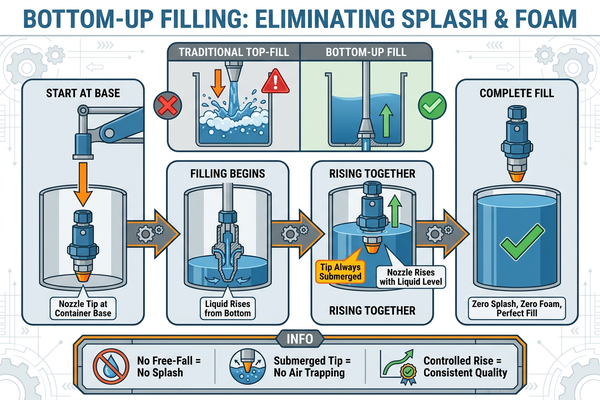
This method is one of the most effective tools we have against foam. It’s a simple concept with powerful results that we've perfected in our machines.
The Sub-Surface Advantage
The key is that the liquid is always dispensed into other liquid, not into air. When liquid falls from a height and hits the bottom of the container or the surface of the rising liquid, it creates a huge amount of turbulence. By keeping the nozzle submerged, we are essentially pushing the liquid up from below, creating a gentle, non-violent rise. There is no drop, no splash, and therefore, no opportunity for air to get forcefully mixed in. This is especially crucial for products that are sensitive not just to foaming but also to oxidation.
Synchronizing Speed and Movement
Our machines use advanced servo motors and sensors to precisely control the nozzle's upward movement. It must be perfectly synchronized with the liquid flow rate to keep the nozzle tip at the ideal depth—not too deep to cause drag, and not too shallow to cause a splash. This is a dynamic process. The machine can be programmed to accelerate and decelerate both the filling speed and the nozzle lift to optimize the cycle for different container shapes and product viscosities.
| Filling Method | Drop Height | Splashing | Foam Creation |
|---|---|---|---|
| Top-Down | High | Significant | High |
| Bottom-Up | Zero | Minimal / None | Minimal / None |
This synchronized system ensures a smooth, splash-free fill from start to finish, making it ideal for the most sensitive foaming products.
How do machine materials and design also help manage foam?
You're thinking about filling methods, but what about the machine itself? If the machine's surface interacts poorly with your product, it can actually increase foaming and cause other issues.
Corrosion-resistant materials8 like 316L stainless steel9 or specific polymers provide an ultra-smooth surface. This smoothness reduces friction as the liquid flows, minimizing a source of micro-turbulence. A clean, non-reactive surface ensures the product's chemical properties aren't altered, which can prevent unexpected foaming.
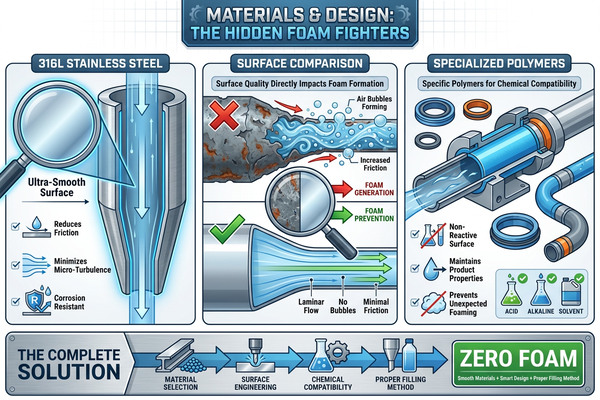
It’s not just about how you fill, but also what you fill with. The construction of our corrosion-resistant machines plays a subtle but important role in foam management.
Surface Finish and Friction
Think of water flowing over a rough rock versus smooth glass. The rock creates more disturbance. Similarly, the internal surfaces of a filling machine matter. We use high-grade materials like 316L stainless steel and polish them to a very smooth, often mirror-like, finish. This reduces the friction between the liquid and the machine parts (nozzles, pipes, valves). Less friction means less energy and turbulence imparted to the liquid, which contributes to lower foam generation. Even microscopic scratches10 on a lower-quality surface can act as nucleation sites, encouraging bubbles to form.
Chemical Compatibility and Design
Some liquids can react with certain metals or plastics. This reaction can release tiny gas bubbles or change the liquid's surface tension, making it more likely to foam. Our corrosion-resistant machines are built to be inert. We also design the fluid path to be as simple and direct as possible, with minimal bends and no dead legs where product can get trapped and agitated.
| Material | Surface Smoothness | Chemical Reactivity11 | Best For |
|---|---|---|---|
| 316L Stainless Steel | Very High | Very Low | Food, Pharma, Chemicals |
| PTFE / Teflon® | High | Chemically Inert | Highly Corrosive Acids |
| Standard Plastic | Varies | Can be reactive | Non-corrosive liquids |
By choosing the right material and optimizing the design, we guarantee the machine won't interfere with your product's stability, keeping foaming predictable and under control.
Conclusion
By combining controlled, low-speed filling, smart bottom-up techniques, and inert materials, our corrosion-resistant fillers give you a perfect, foam-free fill for even the most challenging liquids.
"Transition and Turbulence - Princeton University", https://www.princeton.edu/~asmits/Bicycle_web/transition.html. A fluid-mechanics source explaining Reynolds number and laminar–turbulent transition supports the premise that lowering flow velocity can reduce turbulence during liquid transfer. Evidence role: mechanism; source type: education. Supports: Low-speed, gentle filling reduces agitation and helps prevent foam during filling.. Scope note: This is contextual fluid-mechanics support and does not establish a universal filling speed for all formulations or container geometries. ↩
"Liquid Filling Solutions for Formulated Liquid Products", https://dandrpackaging.com/liquid-filling-solutions-for-formulated-liquid-products/. A packaging-engineering or filling-technology reference describing bottom-up or subsurface filling supports the claim that dispensing from near the container base can reduce splashing and foam formation. Evidence role: mechanism; source type: institution. Supports: Bottom-up filling reduces splashing and air mixing by dispensing liquid from the bottom of the container upward.. Scope note: Such sources usually describe the operating principle generally and may not quantify foam reduction for this specific machine or liquid. ↩
"[PDF] Background What is a surfactant? What is a foam? Surfactants are ...", https://www.ou.edu/content/dam/ureca/Overholt_UReCA_APG_Research_Proposal.pdf. Foam-science literature supports that foam formation requires gas dispersion into a liquid and that mechanical agitation can entrain air into surfactant-containing liquids. Evidence role: mechanism; source type: paper. Supports: Air mixed into the liquid by agitation is a primary cause of foam formation during filling.. Scope note: The source would support the general mechanism, while the dominant cause in a specific filling process depends on formulation, nozzle design, and operating conditions. ↩
"Laminar Flow - HyperPhysics", http://hyperphysics.phy-astr.gsu.edu/hbase/pfric.html. A fluid-mechanics reference defining laminar flow supports the description of liquid moving in smooth layers under low-turbulence conditions. Evidence role: definition; source type: encyclopedia. Supports: Laminar flow is characterized by smooth, orderly liquid motion rather than chaotic mixing.. Scope note: The definition does not prove that the filling machine always maintains laminar flow in every product or nozzle configuration. ↩
"[PDF] Mixing rates and symmetry breaking in two-dimensional chaotic flow", https://scholarship.haverford.edu/cgi/viewcontent.cgi?article=1088&context=physics_facpubs. A fluid-mechanics source on turbulent flow supports that turbulence is characterized by chaotic velocity fluctuations and enhanced mixing. Evidence role: definition; source type: education. Supports: Turbulent flow is chaotic and promotes mixing, including air mixing in a filling stream.. Scope note: The source supports the general definition, not the exact turbulence threshold of any particular filling formulation. ↩
"Fast and slow surfactants in turbulent bubble breakup", https://arxiv.org/html/2601.03157v1. A fluid-mechanics or foam-science source should document that higher liquid dispensing velocities increase turbulence and air entrainment, which promotes bubble formation and foam in surfactant-containing liquids. Evidence role: mechanism; source type: paper. Supports: High-speed filling tends to create turbulent flow, increased air mixing, and higher foam levels when filling foaming liquids.. Scope note: The source may explain the general physical mechanism rather than test this specific filling-machine model or product formulation. ↩
"Filling Foamy Products - The Bottom Up Fill Solution", https://www.liquidpackagingsolution.com/news/filling-foamy-products---the-bottom-up-fill-solution. A technical source on bottom-up or subsurface filling can substantiate that positioning the nozzle near the container base and keeping discharge below the rising liquid surface reduces drop height, splashing, air entrainment, and consequent foam formation. Evidence role: mechanism; source type: paper. Supports: Bottom-up filling works by placing the nozzle tip at the base of the empty container and raising it with the liquid level so the tip stays just below the surface, preventing splashing and reducing trapped air that causes foam.. Scope note: The degree of foam reduction depends on liquid formulation, viscosity, surfactant content, nozzle geometry, and fill speed. ↩
"Roughness effects in turbulent pipe flow - Princeton University", https://collaborate.princeton.edu/en/publications/roughness-effects-in-turbulent-pipe-flow/. A materials-science or fluid-mechanics source should substantiate that corrosion-resistant contact materials such as 316L stainless steel and PTFE are chemically inert in many process environments, and that smoother wetted surfaces reduce wall friction and flow disturbances that can contribute to air entrainment and foam formation. Evidence role: mechanism; source type: paper. Supports: Corrosion-resistant materials such as 316L stainless steel or specific polymers provide smooth, non-reactive contact surfaces that reduce friction-related micro-turbulence and help prevent chemical changes that could promote unexpected foaming.. Scope note: This supports the general mechanism; actual foam reduction depends on the liquid formulation, flow rate, nozzle geometry, surface finish specification, and cleaning condition. ↩
"Corrosion Resistance Measurement of 316L Stainless Steel ... - PMC", https://pmc.ncbi.nlm.nih.gov/articles/PMC8402199/. A materials or standards source supports that 316L stainless steel is widely used where corrosion resistance and hygienic processing compatibility are required. Evidence role: general_support; source type: government. Supports: 316L stainless steel is a corrosion-resistant material commonly used in food, pharmaceutical, or chemical processing equipment.. Scope note: The citation would support material suitability generally, while actual corrosion resistance depends on the chemical environment, temperature, and surface finish. ↩
"Nanoscale Investigation of Bubble Nucleation and Boiling ...", https://pubmed.ncbi.nlm.nih.gov/37646437/. Heterogeneous-nucleation literature supports that surface defects, roughness, and cavities can serve as sites for bubble nucleation in liquids. Evidence role: mechanism; source type: paper. Supports: Microscopic scratches or rough surfaces can encourage bubble formation by acting as nucleation sites.. Scope note: The source supports bubble nucleation physics generally, not the magnitude of foam increase in a particular filling machine. ↩
"[PDF] Intrinsic Chemical Reactivity of Silicon Electrode Materials - OSTI", https://www.osti.gov/servlets/purl/1615215. A peer-reviewed source on foam formation and materials compatibility can substantiate that chemically inert, corrosion-resistant contact surfaces reduce unintended reactions with liquids, while gas evolution, surface-tension changes, and air entrainment are mechanisms that promote foaming. Evidence role: mechanism; source type: paper. Supports: Corrosion-resistant, chemically non-reactive materials in a filling machine help prevent product reactions that could release gas or alter surface tension, thereby reducing unexpected foaming.. Scope note: The source may support the underlying chemistry and foaming mechanisms generally rather than evaluating this specific filling-machine design. ↩