

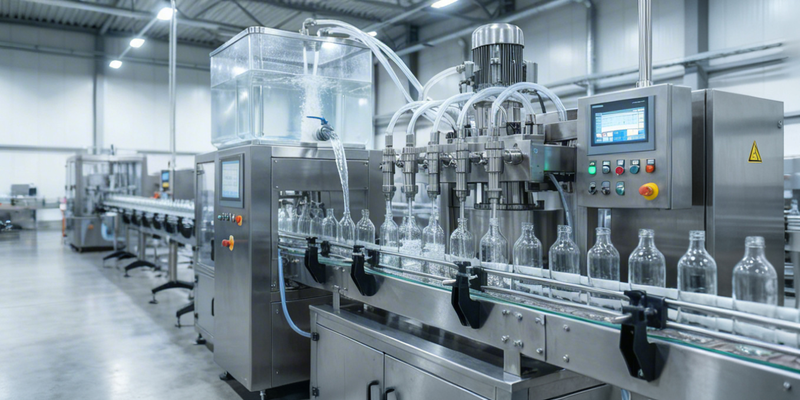
Struggling with slow, inconsistent bottle filling? This manual process wastes product and money, slowing down your entire production line. Automation is the key to fixing this.
A liquid filling machine1 works by precisely measuring and dispensing liquid into containers. It uses a pump system, like a piston or peristaltic pump2, to transfer liquid from a tank through nozzles, ensuring accurate and consistent fills every time.
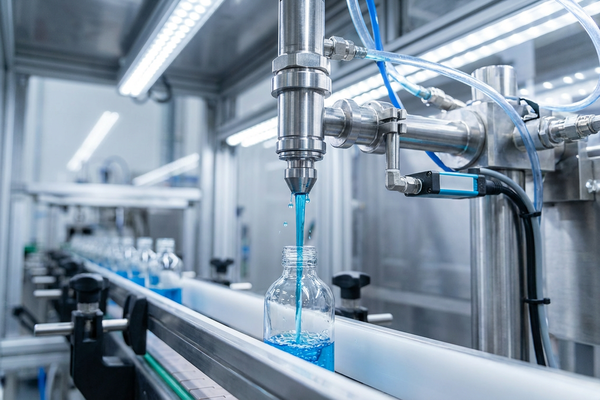
So, you get the basic idea. But the real magic is in the details. The type of pump and the machine's setup can change everything. Let's look closer at how these components work together to create a seamless production line and help you understand what might be the best fit for your business.
What are the core components of a liquid filling machine1?
Confused by the different parts of a filling machine? Not knowing what each component does can make choosing or operating one difficult. Let's break it down simply.
A typical liquid filling machine1 has a product hopper3 to hold the liquid, a pump system (like a piston) to measure it, filling nozzles4 to dispense it, and a conveyor to move containers. An operator interface controls the fill volume and speed.
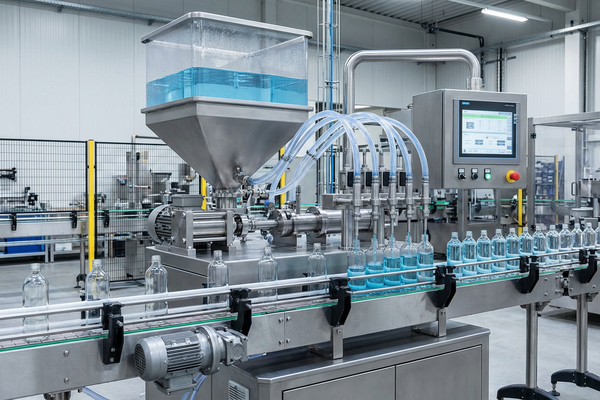
At its heart, every liquid filling machine1 is a system of coordinated parts. Think of it like this: the product hopper3 is the starting point, holding your bulk liquid. From there, the pump system—the machine's engine—draws a precise amount. This could be a piston, a gear, or another type, which we'll cover next. The liquid then travels through tubing to the filling nozzles4, which are designed to dispense the product cleanly into your containers. A conveyor belt5 moves the containers into position and then carries them away for capping and labeling. Finally, the control panel (HMI)6 is the brain. This is where we, as operators, can set the fill volume, speed, and other parameters. At RITO7, we focus on making these controls intuitive. Our 20+ years of R&D experience means we design each part for durability and easy cleaning, ensuring your production runs smoothly.
How do piston filler8s ensure accurate volume?
Worried about over-filling or under-filling your products? Inaccurate fills lead to wasted inventory and unhappy customers. Piston fillers offer a reliable solution for precise measurements.
A piston filler8 uses a cylinder and a piston to work like a large syringe. The piston retracts, drawing a specific volume of liquid into the cylinder. Then, it pushes forward, dispensing that exact amount through the nozzle into the container.
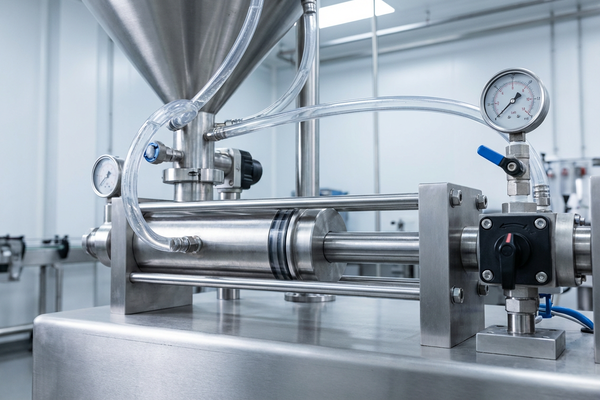
The piston filler8 is a classic for a reason: its accuracy is outstanding, especially for liquids with a wide range of viscosities, from thin juices to thick creams. The mechanism is straightforward. Imagine a syringe. The machine's cylinder is the barrel, and the piston moves back and forth inside it. When the piston pulls back, it creates a vacuum that sucks a pre-set volume of liquid from the hopper into the cylinder. The volume is determined by the length of the piston's stroke, which is easily adjustable on the control panel. Once the cylinder is full, a valve switches, and the piston pushes forward, ejecting the liquid into the container below. This positive displacement method is incredibly consistent. At RITO7, we refine this design further, using high-quality seals and precision engineering to prevent drips and ensure every single fill is as accurate as the last. This is crucial for industries like pharmaceuticals and cosmetics9 where dosage is critical.
What makes peristaltic and gear pump10 fillers different?
Is your product sensitive, sterile, or abrasive? Using the wrong pump can contaminate your product or damage the machine. Peristaltic and gear pump10s offer unique solutions for these challenges.
A peristaltic pump2 uses rollers to squeeze a flexible tube, pushing the liquid forward without it ever touching mechanical parts. A gear pump10 uses two meshing gears to trap and move liquid, ideal for thicker products that need more power.
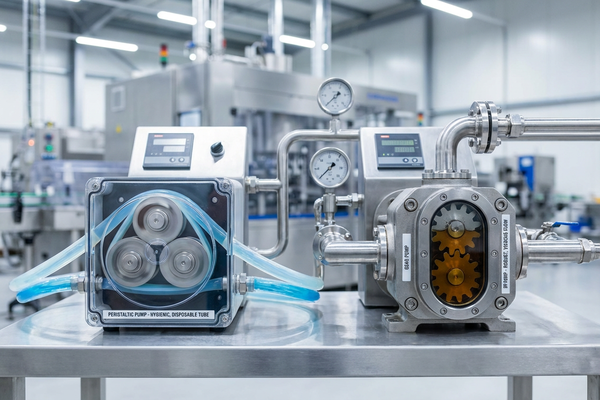
While piston filler8s are great, they are not always the best fit. This is where other pump technologies shine. A peristaltic pump2 is perfect for sterile or aggressive liquids. The product only ever touches the inside of a single, disposable tube. Rollers on a rotor press down on the tube, creating a pocket of liquid that gets pushed forward as the rotor turns. Since the liquid never touches the pump's mechanical parts, it is incredibly hygienic and ideal for pharmaceutical or biotech applications.
A gear pump10, on the other hand, is a real workhorse. It uses two interlocking gears. As they rotate, they create a vacuum on the inlet side, pulling liquid in. The liquid gets trapped in the spaces between the gear teeth and the pump's housing, then it is carried around and forced out the outlet side. This provides a continuous, smooth flow, making it excellent for thick products like lotions, honey, or industrial greases.
| Feature | Peristaltic Pump | Gear Pump |
|---|---|---|
| Product Contact | Liquid only touches the tube | Liquid touches gears and housing |
| Best For | Sterile, sensitive, or abrasive liquids | High-viscosity11, thick liquids |
| Cleaning | Very easy (just change the tube) | More involved cleaning required |
| Flow Type | Pulsating (can be smoothed) | Continuous, smooth flow |
How do you choose the right filling machine for your product?
Feeling overwhelmed by the options? Choosing the wrong filling machine can be a costly mistake, leading to inefficiency and production bottlenecks12. Let's simplify the decision for you.
To choose the right machine, first consider your liquid's viscosity11 (is it thin like water or thick like honey?), its characteristics (is it foamy?), your container type, and your required production speed13. These factors determine the best pump technology.
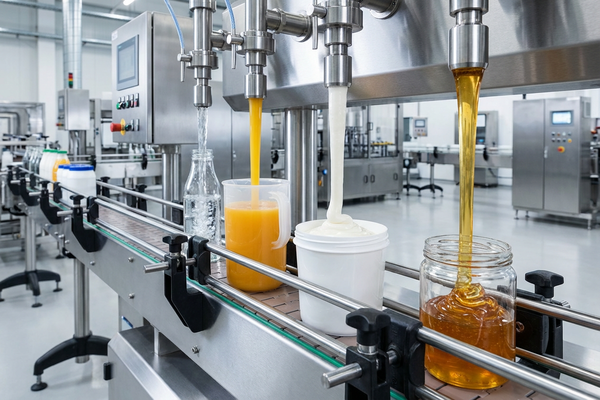
Choosing the perfect filling machine is not just about the machine itself; it's about matching it to your specific needs. The first question we always ask our clients is about their product. Is it a free-flowing liquid like water, or a viscous paste like tomato sauce? This determines the pump type. A piston filler8 handles both well, but a gear pump10 might be better for very thick products. Does your product foam? If so, you will need bottom-up filling nozzles14s](https://www.youtube.com/watch?v=eFiFpKLwU2Q)%%%FOOTNOTE_REF_4%%% that dispense from the bottom of the container to minimize air. Do you have particles in your liquid, like in a fruit salsa? You will need a machine with valves that will not crush them. Next, we look at your production goals. How many bottles per minute do you need to fill? This will tell us if you need a semi-automatic machine or a fully automated line. With our 11+ years of industry experience, we at RITO7 offer exclusive customizations15 to create a solution just for you, ensuring it meets your exact needs.
Conclusion
Liquid filling machines use piston, peristaltic, or gear pump10s for accurate dispensing. Choosing the right one depends on your product and speed needs, ensuring efficient and consistent production.
Explore this link to understand the mechanics and benefits of liquid filling machines for your production. ↩
Discover why peristaltic pumps are ideal for sensitive and sterile liquids in various industries. ↩
Understand the role of the product hopper in maintaining a steady supply of liquid for filling. ↩
Explore the design and function of filling nozzles for clean and efficient dispensing. ↩
Learn how conveyor belts streamline the filling process and enhance production efficiency. ↩
Discover the importance of intuitive control panels in optimizing filling operations. ↩
Explore RITO's innovative solutions and expertise in liquid filling technology to enhance your production efficiency. ↩
Learn about the precision and reliability of piston fillers in ensuring accurate liquid measurements. ↩
Explore the importance of precise filling in industries where dosage is crucial. ↩
Find out how gear pumps provide powerful solutions for high-viscosity liquids. ↩
Understand how the viscosity of your product influences the selection of filling technology. ↩
Learn how the right filling machine can streamline your production line and reduce delays. ↩
Explore the key elements that determine the efficiency of your filling process. ↩
Learn how bottom-up filling nozzles minimize air exposure for foamy products. ↩
Find out how tailored solutions can enhance your filling process to meet specific needs. ↩