

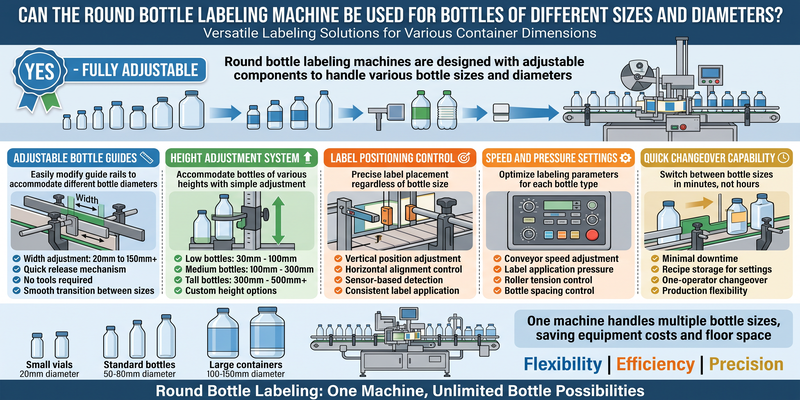
Are you managing multiple products in different bottle sizes? You might be worried that you need a separate labeling machine for each one, which sounds expensive and complicated.
Yes, a single round bottle labeling machine can absolutely handle bottles of different sizes and diameters1. Our machines are designed with a specific operational range, and as long as your bottles fit within this range, you can label them all with simple, quick adjustments.
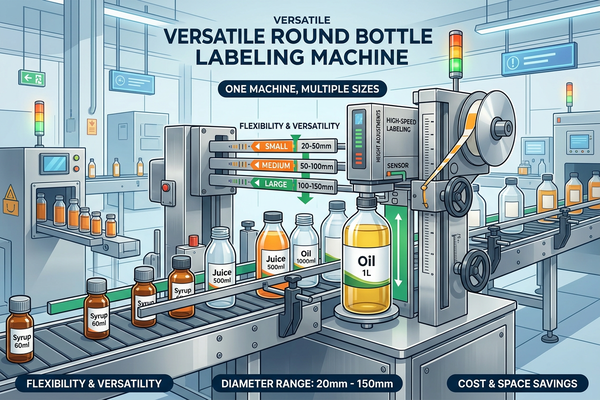
Knowing that one machine can do the job of many is a huge relief. It saves space, money, and simplifies your production line. But you are probably wondering how exactly this works. It's great to hear that it's possible, but what does the adjustment process actually look like, and are there any limits? Let's dive in and explore how this incredible flexibility is achieved, so you can feel confident in your equipment choice.
How do round bottle labelers handle different bottle sizes?
You see the solid metal parts of a labeling machine and might struggle to imagine how it adapts. It can seem like the mechanism must be incredibly complex or fragile.
Round bottle labelers accommodate various sizes by using a few key adjustable components. These include the guide rails, the conveyor, and the labeling head2. These parts can be moved, widened, or repositioned to securely hold and label bottles of different diameters perfectly.
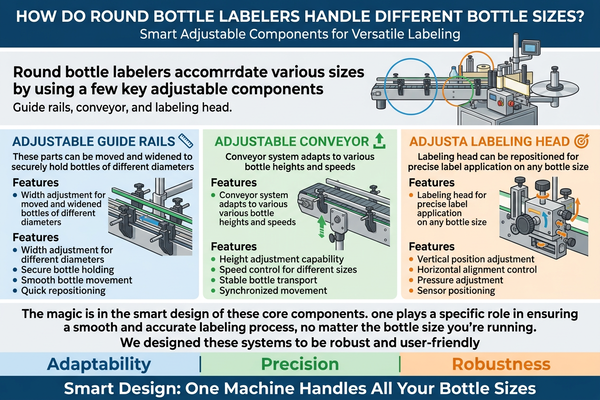
The magic is in the smart design of these core components. Each one plays a specific role in ensuring a smooth and accurate labeling process, no matter the bottle size you're running. We designed these systems to be robust and user-friendly.
Key Adjustable Components
Let's look at the main parts you'll be adjusting.
| Component | Function | How it Adjusts |
|---|---|---|
| Guide Rails | Keep bottles stable, upright, and centered on the conveyor. | Can be widened or narrowed using a hand-crank to fit the bottle's diameter.3 |
| Separator Wheel | Creates a consistent gap between bottles to prevent jams.4 | The speed and position can be changed to manage different bottle diameters.5 |
| Labeling Head | Applies the label onto the bottle surface. | Its height and angle can be adjusted to match the bottle's height and curve.6 |
| Top Pressing Belt | Holds the bottle down from the top for extra stability.7 | Can be raised or lowered to accommodate taller or shorter bottles. |
These parts work together in harmony. The guide rails create a perfect path. The separator wheel feeds bottles one by one. The top pressing belt prevents any wobbling. And finally, the labeling head applies the label at the exact right moment and position. This coordinated system is what gives our machines the flexibility to handle your diverse product line.
What is the process for adjusting the machine for a new bottle size?
Hearing the words "machine adjustment" might make you think of long downtimes and complex manuals. You might worry that production will stop for hours while a technician fiddles with tools.
Adjusting our labeling machines is a straightforward process that takes just a few minutes.8 It mainly involves turning hand-cranks to move guide rails, setting the labeling head height, and ensuring the sensors are aligned. Many of our models include digital readouts to make this even faster9.
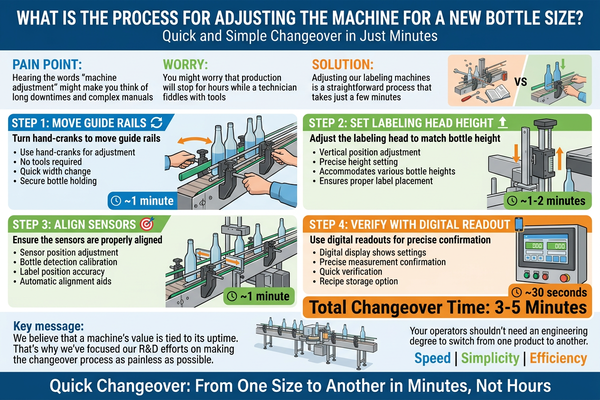
We believe that a machine's value is tied to its uptime. That’s why we’ve focused our R&D efforts on making the changeover process as painless as possible. Your operators shouldn't need an engineering degree to switch from one product to another.
A Simple, Three-Step Process
Here is a general breakdown of how simple the changeover is.
Step 1: Adjusting the Bottle Path
First, you place one of your new bottles on the conveyor belt. Then, you use the hand-cranks to adjust the guide rails and the top pressing belt. You want the bottle to move smoothly along the conveyor without wobbling or being squeezed too tightly. This ensures it arrives at the labeling station perfectly positioned.
Step 2: Setting the Labeling Head
Next, you adjust the height and angle of the labeling head. You want the label to be applied at the precise height you desire on the bottle. This is also typically done with a simple hand-crank. You will also adjust the position of the bottle detection sensor so it triggers the label release at the right time10.
Step 3: Fine-Tuning and Testing
Finally, you run one or two bottles through the system as a test. This allows you to check the label placement and make any tiny final adjustments. Once you are happy with the result, you are ready for full production. This entire process is designed to be quick, intuitive, and to get you back to making your products with minimal delay.
Are there limitations to the bottle sizes a single machine can handle?
It might sound too good to be true. Can one machine really handle any round bottle you throw at it? You might be concerned about buying a machine, only to find your most important product size doesn't fit.
Yes, there are limitations, and it's important to be aware of them. Every labeling machine is manufactured to work within a specific range of bottle diameters and heights. For example, a machine might be designed for bottles from 20mm to 100mm in diameter.
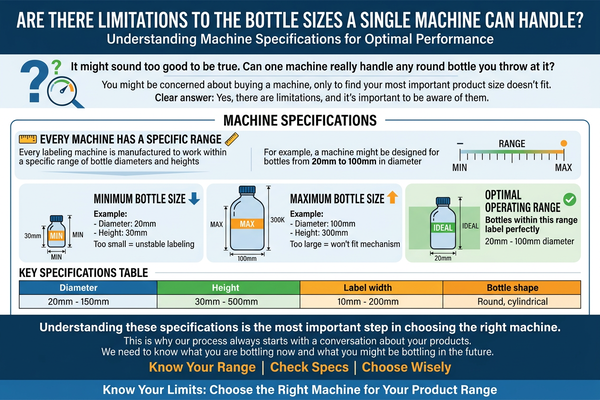
Understanding these specifications is the most important step in choosing the right machine. This is why our process always starts with a conversation about your products. We need to know what you are bottling now and what you might be bottling in the future.
Reading the Specification Sheet
The technical specifications will clearly define the machine's capabilities.
| Parameter | Example Range | What It Means for You |
|---|---|---|
| Applicable Bottle Diameter | 20mm - 100mm | Your bottles must be wider than 20mm and narrower than 100mm. |
| Applicable Bottle Height | 50mm - 300mm | The machine can handle bottles within this height range. |
| Applicable Label Size | Length: 25-300mm | Defines the minimum and maximum label length the machine can dispense. |
| Applicable Label Size | Width: 15-150mm | This relates to the height of the label as it sits on the bottle. |
These ranges exist due to the physical design of the machine frame, the travel distance of the adjustment mechanisms, and the power of the motors.11 A bottle that is too small might not be detected by sensors, while a bottle that is too large simply won't fit. That's why we always ask for bottle samples from our customers. We test them on our machines to guarantee a perfect fit and provide you with a solution that truly meets your needs, both today and for years to come.
Conclusion
A round bottle labeling machine is a flexible and powerful asset. It can handle a wide variety of bottle sizes, making it a smart investment for your growing business.
"Automatic Adjustable Filling and Capping Machine Using ...", https://www.academia.edu/44722974/Automatic_Adjustable_Filling_and_Capping_Machine_Using_Programmable_Logic_Controller_and_Human_Interface. The cited packaging-machinery source explains that bottle or container labeling systems can be configured with adjustable handling components to accommodate multiple container diameters within a defined operating envelope. Evidence role: general_support; source type: research. Supports: A single round bottle labeling machine can handle bottles of different sizes and diameters.. Scope note: This would support the general capability of adjustable round-bottle labelers, not the performance of any specific manufacturer’s model. ↩
"Design of Automatic Stamping Machine for Date and Dash ...", https://www.academia.edu/82461146/Design_of_Automatic_Stamping_Machine_for_Date_and_Dash_Code_Marking_Using_Pneumatic_System_and_PLC_Controller. The cited packaging-machinery reference identifies conveyor transport, guide rails, and label application heads as core subsystems in automatic labeling equipment. Evidence role: mechanism; source type: research. Supports: Round bottle labelers accommodate different sizes using adjustable components such as guide rails, a conveyor, and a labeling head.. Scope note: The source may describe typical labeling-machine architecture rather than the exact construction of the article’s machines. ↩
"What are Adjustable Guide Rails for Conveyors?", https://www.septimatech.com/blog/what-are-adjustable-guide-rails-for-conveyors/. The cited machine-design or packaging-equipment source describes adjustable guide rails or side guides as a means of setting conveyor lanes to match container width or diameter. Evidence role: mechanism; source type: research. Supports: Guide rails on bottle labeling machines can be adjusted to fit the bottle diameter.. Scope note: The source may support guide-rail adjustability generally; hand-crank operation may vary by machine design. ↩
"Metering Conveyors for Packaging Lines | PackagingConveyor.com", https://packagingconveyor.com/conveyor-functions/metering/. The cited packaging-line reference explains that spacing or metering devices separate containers before downstream operations to maintain orderly flow and reduce interference between items. Evidence role: mechanism; source type: institution. Supports: A separator wheel creates consistent gaps between bottles to help prevent jams.. Scope note: The evidence would support the general purpose of spacing devices; it may not specifically use the term “separator wheel.” ↩
"Metering & Dosing for Packaging", http://www.dispensingliquid.com/metering-dosing-packaging.html. The cited packaging-machinery source discusses adjustment of container spacing or metering mechanisms to suit different container sizes and line speeds. Evidence role: mechanism; source type: research. Supports: The speed and position of a separator wheel can be adjusted to manage different bottle diameters.. Scope note: The source may discuss adjustable metering systems broadly rather than the exact speed and position settings of this article’s separator wheel. ↩
"Automatic Labeling Machine for Tapered Plastic Containers", https://www.quadrel.com/automatic-labeling-machine-for-tapered-plastic-containers/. The cited labeling-machine design source explains that label applicator heads are positioned relative to the container geometry so that labels contact the product at the intended height and orientation. Evidence role: mechanism; source type: research. Supports: A labeling head’s height and angle can be adjusted to match bottle height and curvature.. Scope note: The source can support the principle of applicator-head positioning; exact adjustment ranges are model-specific. ↩
"Bottle Labeler Machine", https://www.globaltekconveyors.com/labeling-machine/?srsltid=AfmBOop1VvB1znfFEWqloylVUsDlciL-YpFTmuAamlG8xORq2druDF0i. The cited packaging-equipment reference describes top hold-down belts or stabilizing belts as devices used to restrain containers during conveying or labeling operations. Evidence role: mechanism; source type: institution. Supports: A top pressing belt holds bottles down from the top for added stability during labeling.. Scope note: The evidence would support the general stabilizing role of top belts, not necessarily their presence on every round-bottle labeler. ↩
"SMED Quick Changeover: Reduce Setup Time Fast", https://oxmaint.com/industries/manufacturing-plant/smed-quick-changeover-techniques-reduce-setup-time. The cited manufacturing-changeover literature shows that standardized adjustments, preset positions, and quick-changeover methods can substantially reduce equipment setup time. Evidence role: expert_consensus; source type: paper. Supports: Labeling-machine adjustment can be a quick, straightforward process when designed for rapid changeover.. Scope note: This provides contextual support for the feasibility of short changeovers; it does not verify the exact changeover time for the article’s specific machines. ↩
"Improve Phase: Understanding Setup Time Reduction for Enhanced ...", https://lean6sigmahub.com/improve-phase-understanding-setup-time-reduction-for-enhanced-manufacturing-efficiency/. The cited manufacturing or human-factors source reports that visible position indicators, presets, or digital measurement displays can reduce setup variability and speed repeatable machine adjustments. Evidence role: mechanism; source type: paper. Supports: Digital readouts can make labeling-machine adjustments faster.. Scope note: The source would support the general effect of readouts or preset indicators on setup efficiency, not a quantified time saving for these specific labelers. ↩
"Photoelectric Sensors", https://www.bannerengineering.com/us/en/products/sensors/photoelectric-sensors.html?srsltid=AfmBOoreSnbMLxkhzGkZ3bMzrNSbGZ2jLQJkYUVDTmtYr9pD2vA9t51O. The cited automation or packaging-control source explains that sensors detect product presence or position on conveyors and send signals used to time downstream actions such as dispensing or actuation. Evidence role: mechanism; source type: education. Supports: A bottle detection sensor triggers label release at the correct time during labeling.. Scope note: The source may describe sensor-triggered automation generally; specific label-release timing depends on the machine controller and setup. ↩
"Linear Actuator Stroke Length Guide | How to Choose ...", https://www.progressiveautomations.ca/pages/linear-actuator-stroke-length-guide?srsltid=AfmBOooTFUQWKyp77dtbUmxQ25bNTC9Yv_YD1bSgoEF-zFeVOMGtms1z. The cited machine-design reference explains that equipment operating envelopes are constrained by structural dimensions, actuator travel, and motor or drive capacity. Evidence role: mechanism; source type: education. Supports: A labeling machine’s bottle-size range is limited by frame geometry, adjustment travel, and motor capacity.. Scope note: The source would support the engineering principle behind size limits; it would not establish the exact constraints of any particular labeling machine. ↩