

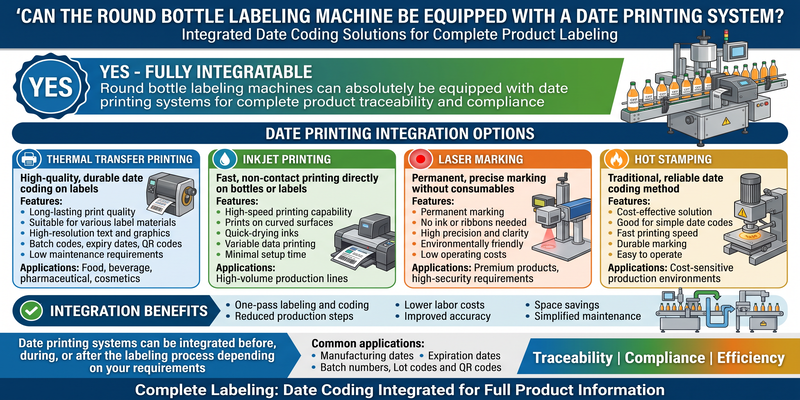
Are you tired of labeling your bottles and then printing dates in a separate, slow step? This two-step process wastes time, costs more, and creates inconsistencies on your products.
Yes, a round bottle labeling machine can absolutely be equipped with a date printing system. This integration is a standard and highly effective feature on modern packaging lines.1 It streamlines production, ensures regulatory compliance, and boosts overall efficiency2 for industries like food, cosmetics, and pharmaceuticals.
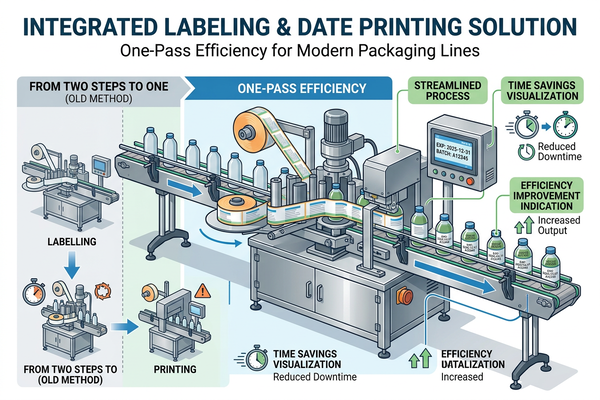
The answer is a clear yes, but knowing it's possible is just the beginning. The real value comes from understanding how this technology works and what specific advantages it can bring to your production line. Let's dive deeper into how this integration happens and why it's a game-changer for so many businesses we work with. This simple upgrade can completely transform your packaging process from a bottleneck into a smooth, efficient operation.
How does a date printing system integrate with a labeling machine?
You know it's possible to combine labeling and printing, but the technical details might seem complicated. You might worry about difficult installations or the printer not keeping up with your labeler's speed.
The integration is actually very straightforward and designed for seamless, high-speed operation. A date printer is mounted onto the labeling machine's conveyor. As a bottle moves along, a sensor triggers the printer to apply the date code3 onto the bottle or the label in one continuous motion.
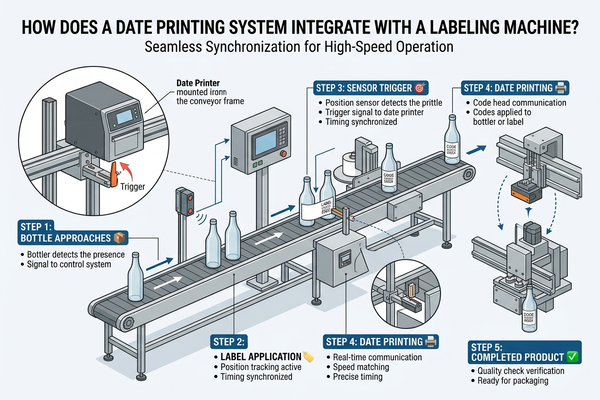
This process is all about perfect synchronization. At RITO, we ensure the integration is flawless, but here’s a breakdown of how it generally works.
The Mechanical Setup
First, we physically mount the printer. We typically install a sturdy bracket over the conveyor belt that holds the printhead in a fixed, precise position. This ensures that every code is printed in the exact same spot on every bottle or label. The placement can be just before the labeling station to print on the bottle itself, or just after to print directly onto the freshly applied label.
Electronic Synchronization
The real magic is in the electronic handshake between the two machines. The labeling machine’s main control system (the PLC) communicates with the printer.4 A small sensor on the conveyor detects when a bottle is in the perfect position. This sensor sends a signal that instantly triggers the printer to fire. This all happens in a fraction of a second, allowing the system to keep up with even the fastest production lines without missing a beat. This ensures no bottle passes without a code and no code is printed in empty space.5
| Printing Location | Pros | Cons |
|---|---|---|
| On the Bottle (Pre-Labeling) | The code is permanent on the container. | Requires precise label application to avoid covering the code. |
| On the Label (Post-Labeling) | Simplest setup; code is part of the label. | Requires label material that accepts the ink without smudging. |
What are the benefits of combining labeling and date printing?
Right now, you might be running two separate machines for these tasks. This setup uses double the floor space, requires more operators, and often creates a major bottleneck in your production flow.
The main benefits are increased efficiency, reduced labor costs, and improved accuracy. A single, integrated system streamlines your workflow, minimizes product handling, saves valuable factory floor space, and ensures every product is consistently labeled and coded correctly, every single time.
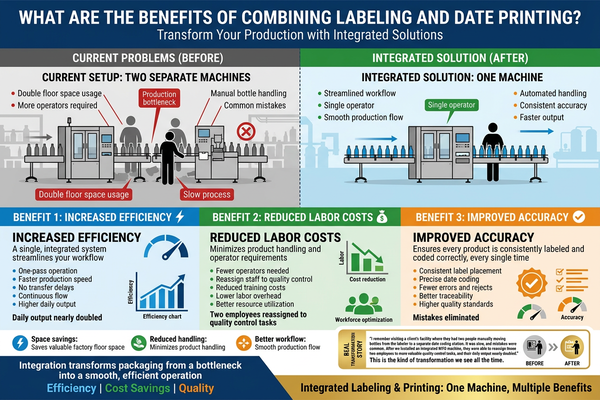
I remember visiting a client’s facility where they had two people manually moving bottles from the labeler to a separate date coding station. It was slow, and mistakes were common. After we installed an integrated RITO machine, they were able to reassign those two employees to more valuable quality control tasks, and their daily output nearly doubled. This is the kind of transformation we see all the time.
Boosted Efficiency and Throughput
Combining two steps into one immediately speeds up your entire line.6 There is no longer a delay or manual handling between labeling and coding. Products flow smoothly from start to finish. This directly translates to a higher number of finished units per hour, increasing your overall production capacity without needing to run longer shifts.
Enhanced Accuracy and Compliance
Automating the process eliminates human error.7 Every date code is printed clearly and in the exact same location, which is critical for legibility and brand consistency. More importantly, this ensures you meet regulatory requirements for batch numbers, expiration dates, and traceability codes8. This helps you avoid costly recalls and maintain compliance with standards like GMP and FDA9.
Cost and Space Savings
An integrated machine has a smaller footprint than two separate ones, freeing up valuable floor space in your facility. It also reduces costs. You only need one operator instead of two, lowering labor expenses. Furthermore, running one machine is more energy-efficient than running two, leading to long-term savings on utility bills.
What types of date printers can be used with labeling machines?
You know you need to print dates, but you are not sure which printing technology is right for your product. Choosing the wrong one could lead to smudged codes, high consumable costs, or poor print quality.
The most common types are Thermal Inkjet (TIJ) and Continuous Inkjet (CIJ) printers. TIJ is great for high-resolution codes on flat surfaces like labels.10 CIJ is more versatile, perfect for high-speed lines and printing on curved or uneven surfaces like the bottle itself.11
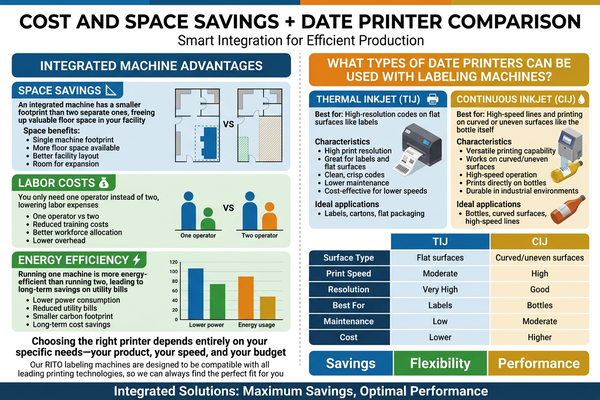
Choosing the right printer depends entirely on your specific needs—your product, your speed, and your budget. Our RITO labeling machines are designed to be compatible with all leading printing technologies, so we can always find the perfect fit for you. Here’s a closer look at the most popular options.
Thermal Inkjet (TIJ)
TIJ printers use small, clean ink cartridges, much like a desktop office printer. They are excellent for printing very clear, high-resolution text and barcodes directly onto paper or coated labels. Because they are cartridge-based, they are very low-maintenance and easy to use. They are the ideal choice for environments where cleanliness is key, like in pharmaceuticals or cosmetics.
Continuous Inkjet (CIJ)
CIJ printers are the workhorses of the industrial world. They use a continuous flow of ink and can print at extremely high speeds. Their real advantage is versatility; they can print on almost any surface, including glass, plastic, and metal, whether it's flat or curved. They require more maintenance than TIJ systems but are unbeatable for high-volume, 24/7 operations.
Thermal Transfer Overprinter (TTO)
TTO printers use a heated printhead to melt ink from a ribbon directly onto the label material before the label is applied to the bottle. This process creates an extremely durable, high-quality print that will not smudge or fade. It's a fantastic option if you need to print a lot of information, like ingredient lists or complex barcodes, with perfect clarity.
| Feature | Thermal Inkjet (TIJ) | Continuous Inkjet (CIJ) | Thermal Transfer (TTO) |
|---|---|---|---|
| Best For | High-resolution on labels. | High-speed, any surface. | Highest quality on label film. |
| Print Quality | High | Good to High | Excellent |
| Speed | Moderate to High | Very High | Moderate to High |
| Maintenance | Very Low | Moderate | Low |
| Surface | Porous, labels | Any surface | Label web/film only |
Conclusion
So, you can absolutely add a date printer to a round bottle labeling machine. This integration boosts efficiency, ensures accuracy, and is a vital step for any modern production line.
"The Justification of a packaging line based on capacity issues", https://repository.rit.edu/cgi/viewcontent.cgi?article=1564&context=theses. Technical literature on automated packaging lines documents the routine integration of labeling, coding, and inspection functions within continuous packaging operations. Evidence role: general_support; source type: institution. Supports: Date printing can be integrated with bottle labeling equipment as a common feature of modern packaging lines.. Scope note: This would support the general industry practice, not the performance of any particular machine model. ↩
"FSMA Final Rule on Requirements for Additional ...", https://www.fda.gov/food/food-safety-modernization-act-fsma/fsma-final-rule-requirements-additional-traceability-records-certain-foods. Manufacturing automation research associates integrated, automated handling and marking steps with reduced manual intervention and improved process consistency; regulatory compliance benefits depend on the applicable product category and jurisdiction. Evidence role: general_support; source type: paper. Supports: Combining date printing with labeling can streamline production, support compliance workflows, and improve efficiency.. Scope note: The source would provide contextual support for automation benefits, not direct proof that every integrated labeler improves compliance or efficiency. ↩
"ﻲﻘ ﻟا ﻟا ﻘ ﻟا ﻟا ﻟ ﻞء اﻟ ﺎﺋﻞ ﺎﺳ ام ﺔﻣ ﻣ ﺗ ﺔﻣ ﻣ", https://repository.sustech.edu/jspui/bitstream/123456789/26611/1/Design%20of%20Liquid%20Filling%20System%20Using%20Programmble%20Logic%20Controller.pdf. Sources on conveyor automation and photoelectric sensing describe how object-detection sensors trigger downstream actuators or marking devices when products reach a defined position. Evidence role: mechanism; source type: education. Supports: A sensor can detect a bottle on a conveyor and trigger a printer to apply a date code.. Scope note: This supports the operating principle of sensor-triggered printing, not the exact configuration of the article’s illustrated system. ↩
"Programmable logic controller", https://en.wikipedia.org/wiki/Programmable_logic_controller. Technical references on programmable logic controllers describe PLCs as industrial controllers that coordinate sensors, actuators, and peripheral devices in automated machinery. Evidence role: definition; source type: encyclopedia. Supports: A PLC can coordinate communication between a labeling machine and a printer.. Scope note: This supports the general role of PLCs in machine coordination, not the specific communication protocol used by a given labeler and printer. ↩
"Improving Product Traceability and Compliance with Date and Lot ...", https://www.keyence.com/products/marker/inkjet-printers/resources/inkjet-printer-resources/improving-product-traceability-and-compliance-with-date-and-lot-coding-in-food-packaging.jsp. Machine-vision and sensor-based packaging-control literature describes product-detection and reject-control systems used to reduce missing or misplaced package codes. Evidence role: mechanism; source type: paper. Supports: Sensor synchronization can reduce missing codes and prevent printing when no product is present.. Scope note: Such sources support the principle of detection-based control; actual zero-miss performance requires validation data from the specific line. ↩
"Throughput bottleneck detection in manufacturing: a systematic review ...", https://www.tandfonline.com/doi/abs/10.1080/21693277.2023.2283031. Operations-management research on process integration and bottleneck reduction supports that eliminating transfer and waiting steps can increase throughput in production systems. Evidence role: mechanism; source type: paper. Supports: Combining labeling and date printing into one operation can improve line speed by eliminating an intermediate step.. Scope note: This supports the production-flow logic, but the amount of speed improvement depends on the original bottleneck and equipment capacities. ↩
"Understanding human management of automation errors - PMC - NIH", https://pmc.ncbi.nlm.nih.gov/articles/PMC4221095/. Human-factors research generally finds that automation can reduce errors associated with repetitive manual tasks, although it may introduce different risks such as setup or monitoring errors. Evidence role: expert_consensus; source type: paper. Supports: Automation can reduce human error in repetitive labeling and coding tasks.. Scope note: The source would support error reduction, not the absolute elimination of all human error. ↩
"Product Identifiers Under the Drug Supply Chain Security ...", https://www.fda.gov/media/116304/download. FDA current good manufacturing practice regulations for drugs require controls over labeling and records such as lot or control numbers, and require expiration dating for many drug products. Evidence role: general_support; source type: government. Supports: Some regulated products require batch, lot, expiration, or traceability information on packaging or associated records.. Scope note: This directly supports pharmaceutical contexts; requirements differ for foods, cosmetics, and other jurisdictions. ↩
"Current Good Manufacturing Practice (CGMP) Regulations", https://www.fda.gov/drugs/pharmaceutical-quality-resources/current-good-manufacturing-practice-cgmp-regulations. Official FDA materials explain that current good manufacturing practice requirements govern manufacturing controls, labeling, and quality systems for regulated products such as pharmaceuticals. Evidence role: definition; source type: government. Supports: GMP and FDA regulatory frameworks are relevant to packaging, labeling, and quality-control compliance in regulated industries.. Scope note: FDA is an agency rather than a single standard, and GMP obligations vary by product category. ↩
"Thermal printing", https://en.wikipedia.org/wiki/Thermal_printing. Technical descriptions of thermal inkjet printing explain that it ejects small ink droplets from cartridge-based printheads and is capable of high-resolution printing on suitable substrates. Evidence role: mechanism; source type: encyclopedia. Supports: Thermal inkjet printing is suited to high-resolution coding on compatible flat label materials.. Scope note: Suitability depends on ink formulation, label coating, drying conditions, and line speed. ↩
"Inkjet printing", https://en.wikipedia.org/wiki/Inkjet_printing. Technical sources on continuous inkjet printing describe it as a non-contact industrial marking method used on moving products and varied substrates, which supports its use on high-speed lines and non-flat containers. Evidence role: mechanism; source type: encyclopedia. Supports: Continuous Inkjet can be used for high-speed, non-contact marking on varied surfaces, including bottles.. Scope note: The word “perfect” is promotional; actual suitability depends on substrate, ink, speed, and code-size requirements. ↩