

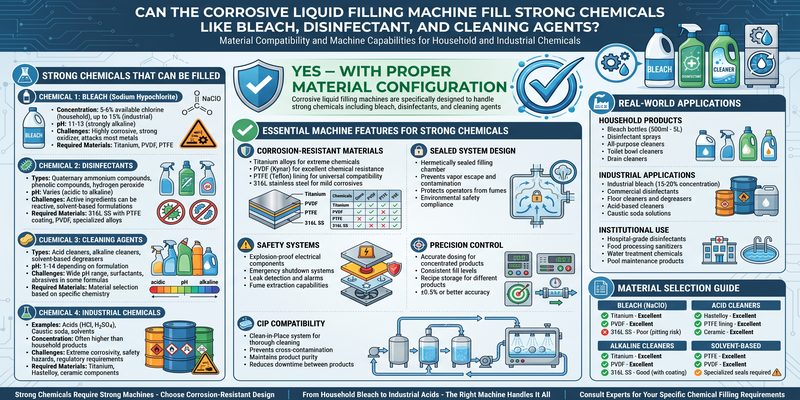
Filling corrosive liquids is a huge challenge. One mistake can mean damaged equipment or serious safety risks.1 You need a solution that protects your product, people, and investment.
Yes, a specially designed corrosive liquid filling machine can safely and efficiently handle strong chemicals2. This includes bleach, disinfectants, and acid-based cleaners. The key is using machines built with the right anti-corrosion materials and specific engineering features to withstand these harsh substances.
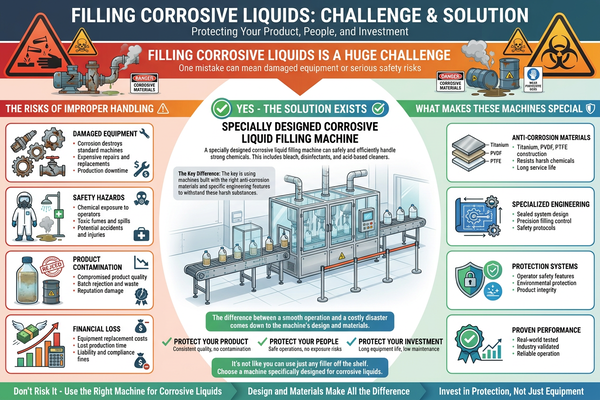
So, the short answer is yes. But you probably want to know how. It's not like you can use just any filler off the shelf. The difference between a smooth operation and a costly disaster comes down to the machine's design and materials. Let's look closer at what makes these machines so special.
What makes a filling machine resistant to corrosive liquids?
Choosing the wrong machine for corrosive chemicals is a recipe for disaster. Leaks, rust, and constant breakdowns can halt your production. You need to know what to look for.
Resistance comes from the materials. These machines use non-metallic materials like UPVC, PP, or Teflon3 for all parts that touch the liquid. For extremely strong chemicals, we might use titanium alloys4. Special seals and non-contact filling methods also prevent corrosion and ensure durability.
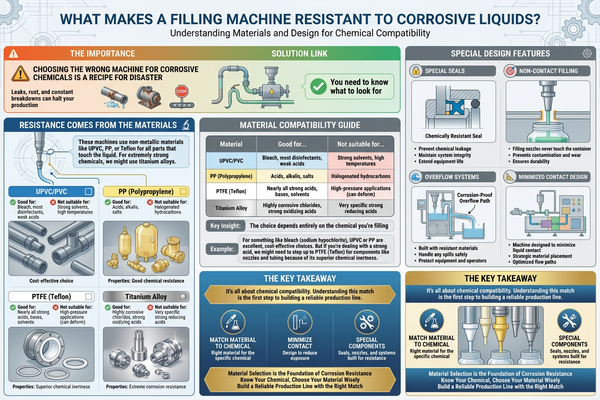
When I talk about the right materials, it's not a one-size-fits-all solution. The choice depends entirely on the chemical you're filling. For something like bleach (sodium hypochlorite)5, UPVC or PP are excellent, cost-effective choices6. But if you're dealing with a strong acid, we might need to step up to PTFE (Teflon)7 for components like nozzles and tubing because of its superior chemical inertness. It’s all about chemical compatibility. We also design the machine to minimize contact. For instance, the filling nozzles might be designed to never touch the container, and overflow systems are built with the same resistant materials to handle any spills. Here's a simple breakdown:
| Material | Good for... | Not suitable for... |
|---|---|---|
| UPVC/PVC | Bleach, most disinfectants, weak acids | Strong solvents, high temperatures |
| PP (Polypropylene)8 | Acids, alkalis, salts | Halogenated hydrocarbons |
| PTFE (Teflon) | Nearly all strong acids, bases, solvents | High-pressure applications (can deform) |
| Titanium Alloy | Highly corrosive chlorides, strong oxidizing acids | Very specific strong reducing acids |
Understanding this match is the first step to building a reliable production line.
How do you choose the right corrosive liquid filling machine for your product?
You know you need a special machine, but which one? Picking the wrong model can lead to inefficiency or, worse, not being able to handle your product at all.
To choose the right machine, first confirm the chemical compatibility of all contact parts with your product. Then, consider your product's viscosity, your required production speed (bottles per minute), and the size and type of your containers. This ensures the machine fits your specific needs.
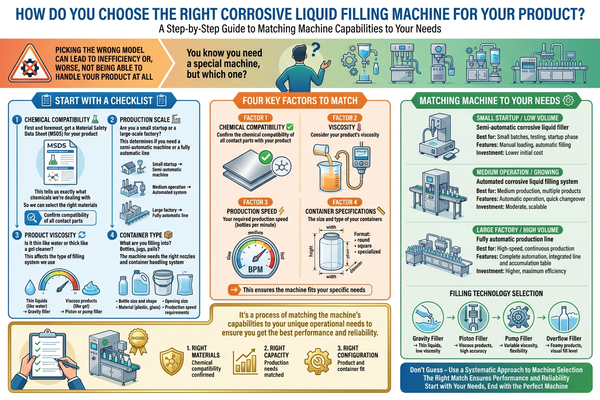
I always tell my clients to start with a checklist. First and foremost, get a Material Safety Data Sheet (MSDS)9 for your product. This tells us exactly what chemicals we're dealing with so we can select the right materials, as we discussed. Next, think about your production. Are you a small startup or a large-scale factory? This determines if you need a semi-automatic machine or a fully automatic line. Then, consider the product itself. Is it thin like water or thick like a gel cleaner? This affects the type of filling system we use—a gravity filler works for thin liquids, but you'll need a piston or pump filler for viscous products10. Finally, what are you filling into? Bottles, jugs, pails? The machine needs to be configured with the right nozzles and container handling system. It's a process of matching the machine's capabilities to your unique operational needs to ensure you get the best performance and reliability.
What safety features are essential for a corrosive liquid filler?
Working with corrosive chemicals is inherently risky. Splashes, fumes, and spills are real dangers for your team. You need a machine that puts safety first, not as an afterthought.
Essential safety features include a full protective enclosure to contain splashes and fumes11, often with an exhaust port. Look for drip trays under the conveyor, interlocking safety doors that stop the machine when opened12, and clearly marked emergency stop buttons. These features protect your operators and your facility.
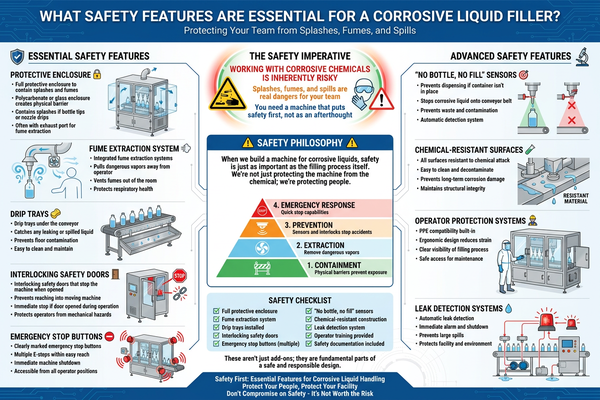
When we build a machine for corrosive liquids, safety is just as important as the filling process itself. We're not just protecting the machine from the chemical; we're protecting people. A full polycarbonate or glass enclosure is standard. This creates a physical barrier. If a bottle tips over or a nozzle drips, the splash is contained. We often integrate fume extraction systems to pull dangerous vapors away from the operator and out of the room. Every machine has multiple emergency stop buttons within easy reach. Another critical feature is the interlocking safety guards. If an operator opens a door while the machine is running, it immediately stops. This prevents anyone from reaching into a moving machine. We also use "no bottle, no fill" sensors to prevent the machine from dispensing corrosive liquid onto the conveyor belt if a container isn't in place. These aren't just add-ons; they are fundamental parts of a safe and responsible design.
Conclusion
Yes, you can fill strong chemicals with the right machine. The key is choosing one with the correct corrosion-resistant materials, the right features for your product, and essential safety guards.
"Toxic, Irritative, and Corrosive Gases and Liquids - OSHA", http://www.osha.gov/semiconductors/solutions/corrosive-gases. Occupational safety guidance on corrosive chemicals identifies them as substances that can damage skin, eyes, respiratory tissue, and equipment surfaces, supporting the statement that handling errors can create safety and asset risks. Evidence role: general_support; source type: government. Supports: Errors during corrosive-liquid filling can damage equipment and create serious safety risks.. Scope note: This supports the general hazard of corrosive chemicals rather than quantifying risks for filling operations specifically. ↩
"1926.152 - Flammable liquids. | Occupational Safety and ... - OSHA", http://www.osha.gov/laws-regs/regulations/standardnumber/1926/1926.152. Engineering and occupational-safety sources describe the use of corrosion-resistant materials, containment, ventilation, and guarding as engineering controls for hazardous liquid handling, supporting the claim that specialized equipment can reduce risks in corrosive-liquid filling. Evidence role: expert_consensus; source type: government. Supports: A specially designed corrosive liquid filling machine can safely and efficiently handle strong chemicals.. Scope note: The source would support the design principle, not prove that any specific machine is safe or efficient in all applications. ↩
"[PDF] Materials Compatability", https://scs.illinois.edu/system/files/inline-files/MaterialsCompatability.pdf. Materials-engineering references describe PVC/UPVC, polypropylene, and PTFE as polymers commonly selected for chemical resistance in corrosive environments, supporting their use in wetted components for corrosive-liquid equipment. Evidence role: mechanism; source type: education. Supports: Corrosive liquid filling machines use non-metallic materials like UPVC, PP, or Teflon for parts that contact the liquid.. Scope note: Actual compatibility still depends on concentration, temperature, exposure time, and the specific chemical formulation. ↩
"[PDF] TITANIUM IN THE GEOTHERMAL INDUSTRY", https://pangea.stanford.edu/ERE/pdf/IGAstandard/EGC/szeged/O-7-10.pdf. Metallurgical references report that titanium and many titanium alloys develop stable passive oxide films that provide high corrosion resistance in several chloride and oxidizing-acid environments, supporting their use where polymers may be unsuitable. Evidence role: mechanism; source type: research. Supports: Titanium alloys may be used for extremely strong or highly corrosive chemicals.. Scope note: Titanium is not universally resistant; performance varies with acid type, concentration, temperature, and reducing conditions. ↩
"Sodium Hypochlorite (Bleach)", https://ehs.stanford.edu/reference/sodium-hypochlorite-bleach. Public-health and chemical references identify household bleach as an aqueous sodium hypochlorite solution and describe its oxidizing and corrosive hazards, supporting the relevance of corrosion-resistant equipment for bleach filling. Evidence role: definition; source type: government. Supports: Bleach is sodium hypochlorite and requires attention to chemical compatibility in filling equipment.. Scope note: This supports the chemical identity and hazard profile of bleach, not the compatibility of a particular filling-machine material. ↩
"Polypropylene Chemical Compatibility Chart - CP Lab Safety", https://www.calpaclab.com/polypropylene-chemical-compatibility-chart/?srsltid=AfmBOooFaxaVFbVsbBlkav0g2-7fmeOFN0prL3FvKHcscEmstR7zupP5. Chemical-resistance references for PVC/UPVC and polypropylene list many aqueous hypochlorite or bleach solutions as compatible under specified conditions, supporting their common selection for bleach-contact components. Evidence role: general_support; source type: research. Supports: UPVC or PP are suitable material choices for filling bleach or sodium hypochlorite solutions.. Scope note: Compatibility ratings are conditional and may change with concentration, temperature, exposure duration, and stabilizers in the formulation. ↩
"[PDF] Materials Compatability", https://scs.illinois.edu/system/files/inline-files/MaterialsCompatability.pdf. Reference sources on polytetrafluoroethylene describe its very low chemical reactivity and broad resistance to acids, bases, and many solvents, supporting its selection for nozzles and tubing exposed to aggressive chemicals. Evidence role: mechanism; source type: encyclopedia. Supports: PTFE is used for components such as nozzles and tubing because of its superior chemical inertness.. Scope note: This supports PTFE’s chemical inertness generally, not mechanical suitability for every pressure or temperature condition. ↩
"[PDF] CHEMICAL COMPATIBILITY CHART", https://www.wisconsin.edu/ehs/download/Fisher-Scientific-Chemical-Compatibility-Chart.pdf. Polymer compatibility references commonly characterize polypropylene as resistant to many acids, alkalis, and salts while noting vulnerability to certain chlorinated or halogenated solvents, supporting the table’s general compatibility statement. Evidence role: general_support; source type: education. Supports: Polypropylene is generally suitable for acids, alkalis, and salts but may be unsuitable for halogenated hydrocarbons.. Scope note: The table is a simplified screening guide and cannot replace chemical-specific compatibility testing. ↩
"[PDF] Hazard Communication Standard: Safety Data Sheets - OSHA", https://www.osha.gov/Publications/OSHA3514.html. Hazard-communication regulations and guidance explain that safety data sheets provide chemical identity, hazards, handling precautions, and exposure-control information, supporting their use as a starting point for material and equipment selection. Evidence role: definition; source type: government. Supports: An MSDS/SDS helps identify the chemicals and hazards relevant to selecting compatible filling-machine materials.. Scope note: An SDS may not provide complete compatibility data for every machine component and may need to be supplemented with material testing. ↩
"Product Viscosity and the Impact on Liquid Filling Machines", https://www.liquidpackagingsolution.com/news/product-viscosity-and-the-impact-on-liquid-filling-machines. Fluid-mechanics and packaging-engineering references describe viscosity as a determinant of flow rate and dispensing method, supporting the distinction between gravity filling for low-viscosity liquids and positive-displacement or pump systems for more viscous products. Evidence role: mechanism; source type: education. Supports: Viscosity affects filling-system selection; gravity fillers suit thin liquids, while piston or pump fillers are used for viscous products.. Scope note: The exact filler choice also depends on target accuracy, foaming, container geometry, and production rate. ↩
"OSHA Technical Manual (OTM) - Section III: Chapter 3", http://www.osha.gov/otm/section-3-health-hazards/chapter-3. Occupational-safety guidance treats physical barriers, splash guards, and local exhaust ventilation as engineering controls for chemical splash and vapor exposure, supporting the use of enclosures for corrosive-liquid filling operations. Evidence role: expert_consensus; source type: government. Supports: Protective enclosures help contain splashes and fumes during corrosive-liquid filling.. Scope note: The source supports the safety-control principle but not the adequacy of any particular enclosure design. ↩
"1910.212 - General requirements for all machines. - OSHA", http://www.osha.gov/laws-regs/regulations/standardnumber/1910/1910.212. Machine-safety standards describe interlocked guards as protective devices that prevent or stop hazardous machine motion when guards are opened, supporting the use of interlocking safety doors on automated filling machinery. Evidence role: expert_consensus; source type: institution. Supports: Interlocking safety doors should stop the machine when opened to protect operators.. Scope note: Specific compliance depends on the applicable jurisdiction, risk assessment, and performance level of the interlock system. ↩