

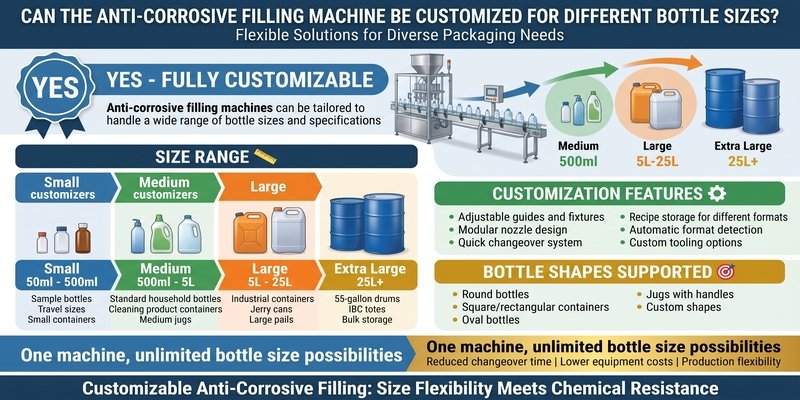
Struggling to find one machine for corrosive liquids and various bottle sizes? This can be a major headache, costing you time and money. Our customizable solutions are the answer.
Yes, anti-corrosive filling machines are highly customizable. At RITO PACK, we design them based on your specific needs, including different bottle sizes and shapes, filling volumes, production speeds, and the type of corrosive material you are handling. This ensures a perfect fit for your line.
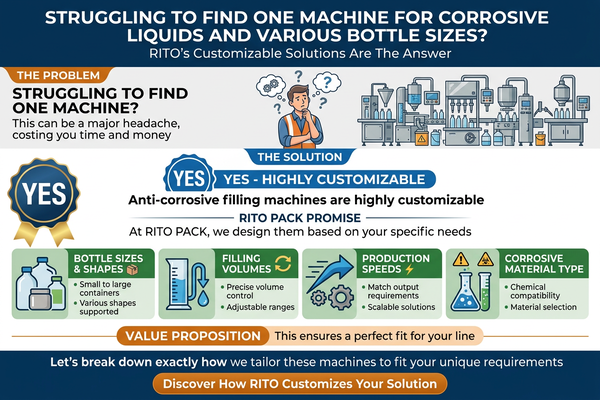
It’s great to know that customization is possible, but you’re probably wondering what that process actually involves. The real value is in the details of how we engineer a machine that perfectly matches your production goals. Let's break down exactly how we tailor these machines to fit your unique requirements and solve your bottling challenges for good.
What key factors influence the customization?
You know you need a custom machine, but where do you even begin? The details can feel overwhelming, and you worry about missing a critical point for your project. We simplify this.
The main factors are your bottle specifications (size, shape, material), your production needs (filling volume, speed), and your product's characteristics (viscosity, corrosiveness). These details guide the entire design and engineering process for your custom machine, ensuring it performs exactly as you need it to.
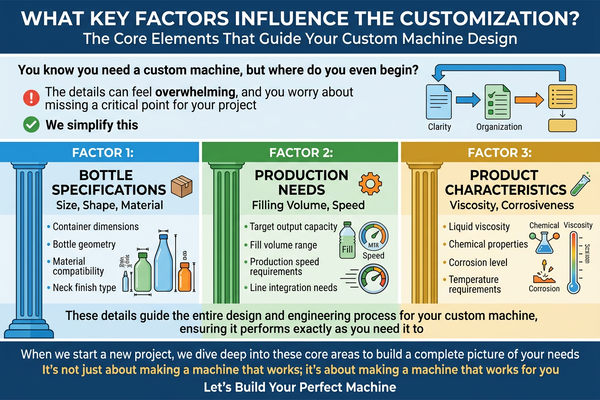
When we start a new project, we dive deep into these core areas to build a complete picture of your needs. It's not just about making a machine that works; it's about making a machine that works for you.
Bottle Specifications
The physical dimensions of your containers are the starting point. We look at the bottle's height, diameter, and mouth opening. These factors determine the design of the conveyor guides, the height adjustment range of the filling nozzles, and the bottle-neck clamping or centering mechanism. For example, a line that needs to handle both tall, thin bottles and short, wide jars will require easily adjustable or swappable parts.
Production and Product Requirements
Next, we discuss your operational goals. How many bottles do you need to fill per minute?1 What is the range of fill volumes, from smallest to largest? The required speed influences whether we recommend a semi-automatic machine or a fully automated rotary system2. The viscosity of your liquid3—whether it's thin like water or thick like a gel—determines the type of filling technology we use, such as piston, gravity, or peristaltic pumps4.
| Factor | Influence on Machine Design |
|---|---|
| Bottle Shape/Size | Adjustable guide rails, multi-format star wheels, custom bottle holders. |
| Filling Speed | Number of filling nozzles5, level of automation (linear vs. rotary). |
| Liquid Viscosity | Type of pump (piston, peristaltic, gear), nozzle design (anti-drip). |
| Corrosiveness | Selection of contact part materials6 (e.g., 316L SS, Titanium, PTFE). |
By analyzing these factors together, we create a holistic solution that addresses every aspect of your production.
How does the customization process work with us?
Ordering custom machinery can sound complicated and risky. You might worry about miscommunication, long delays, and getting a final product that doesn't quite meet your expectations.
Our process is clear and collaborative. It starts with a detailed consultation, followed by a technical proposal with 3D drawings for your review. You approve every detail before we begin manufacturing, ensuring the final machine is exactly what you envisioned.
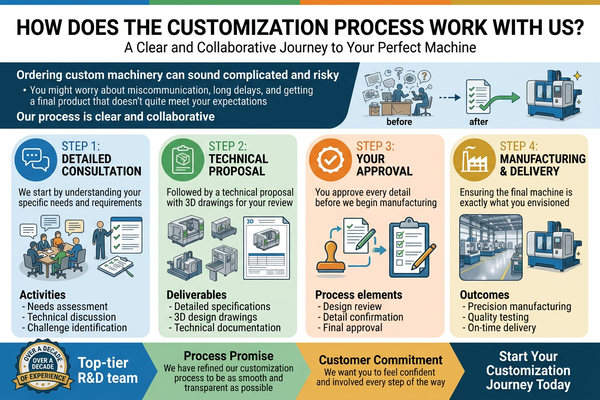
As a company with over a decade of experience and a top-tier R&D team, we have refined our customization process to be as smooth and transparent as possible. We want you to feel confident and involved every step of the way. I remember a client in the agricultural chemical sector who needed to fill both 250ml bottles and 5L jugs with a highly corrosive herbicide. This was a huge challenge for their existing equipment.
Step 1: Initial Consultation and Needs Analysis
It all begins with a conversation. You tell us about your product, your containers, and your production goals. We ask detailed questions to understand the nuances of your operation.
Step 2: Solution Design and Proposal
Our engineers take this information and create a tailored solution. We provide you with a detailed technical proposal, including 3D models and drawings. This allows you to see exactly how the machine will look and function before committing.
Step 3: Manufacturing and In-House Testing
Once you approve the design, our skilled team begins manufacturing. We use high-quality materials and components. Before the machine ever leaves our 3,000-square-meter facility, we conduct rigorous testing using your bottle samples and, if possible, your product to ensure everything runs perfectly.
Step 4: Delivery, Installation, and Lifetime Support
We handle the delivery and can assist with installation and training at your site. But our partnership doesn't end there. We offer lifetime service, including maintenance support and free software upgrades, to ensure your investment continues to pay off for years to come.
What materials are used to ensure durability and flexibility?
You might worry that even a custom machine won't last when handling harsh chemicals. The fear of corrosion, leaks, and constant breakdowns can make anyone hesitant to invest.
We use specialized, high-grade materials like 316L stainless steel, titanium alloys, and polymers like PTFE (Teflon). The specific material is chosen based on your chemical's properties, guaranteeing maximum corrosion resistance and a long operational life for the machine.
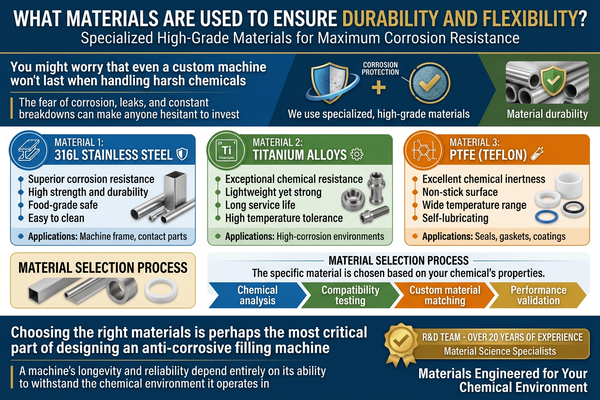
Choosing the right materials is perhaps the most critical part of designing an anti-corrosive filling machine. A machine's longevity and reliability depend entirely on its ability to withstand the chemical environment it operates in. Our R&D team, with over 20 years of experience, specializes in material science to make the right choice for every application.
Contact Parts Materials
Any part of the machine that directly touches your product is considered a "contact part." This includes the product hopper, filling nozzles, valves, and seals. For many applications, 316L stainless steel offers good resistance. However, for highly aggressive acids or bases, we upgrade to more robust options.
| Material | Best For | Reason |
|---|---|---|
| 316L Stainless Steel | Mild corrosives, food, cosmetics | Good general resistance, industry standard. |
| PTFE (Teflon) | Strong acids and bases | Almost completely chemically inert, used for seals and tubing. |
| Titanium Alloy | Strong oxidizing acids, chlorides | Excellent strength-to-weight ratio and superior corrosion resistance7. |
| PE/PP Plastic | Bleach, certain acids | Cost-effective and highly resistant to a specific range of chemicals. |
Structural and Non-Contact Parts
The frame and other structural components that don't touch the liquid can be made from materials like high-quality 304 stainless steel8. This provides the necessary strength and general protection against splashes or fumes in the production environment without the higher cost of specialized alloys. This smart engineering approach ensures your machine is both durable and cost-effective, delivering value where it matters most.
Conclusion
In short, yes, anti-corrosive filling machines are highly customizable. We can tailor every aspect, from bottle size compatibility to material selection, to create your perfect filling solution.
"[PDF] The Justification of a packaging line based on capacity issues", https://repository.rit.edu/cgi/viewcontent.cgi?article=1564&context=theses. Manufacturing and packaging engineering sources commonly use throughput, often expressed as units or bottles per minute, as a key parameter for selecting equipment configuration and automation level. Evidence role: definition; source type: education. Supports: Bottles per minute is a key production requirement used to specify filling equipment.. Scope note: This provides contextual support for using bottles per minute as a design criterion, not for any quoted production capacity. ↩
"(PDF) Comparative Performance Analysis of Semi-automatic and ...", https://www.academia.edu/9288645/Comparative_Performance_Analysis_of_Semi_automatic_and_Automatic_cement_packing_process. Packaging machinery references distinguish semi-automatic, inline, and rotary filling systems by automation level and achievable throughput, supporting the link between required production speed and machine configuration. Evidence role: mechanism; source type: education. Supports: Required filling speed influences whether a semi-automatic or fully automated rotary filling system is appropriate.. Scope note: The source would support the general relationship between throughput and configuration, not a precise threshold for choosing one system over another. ↩
"(PDF) Pumping highly viscous fluids with centrifugal pumps — Part 1", https://www.academia.edu/100864260/Pumping_highly_viscous_fluids_with_centrifugal_pumps_Part_1. Fluid mechanics and packaging-engineering sources identify viscosity as a primary property affecting flow rate, pumping requirements, and dispensing accuracy, which explains why filler type is selected according to liquid viscosity. Evidence role: mechanism; source type: education. Supports: Liquid viscosity helps determine the appropriate filling technology.. Scope note: This supports viscosity as a design factor generally; actual filler choice also depends on foaming, particulates, chemical compatibility, and fill accuracy requirements. ↩
"Peristaltic Pump Filling Machine: 2026 Complete Guide for Industrial ...", https://www.jihpump.net/technical-support/blogs/peristaltic-pump-filling-machine. Technical descriptions of liquid filling systems classify piston, gravity, and peristaltic fillers by different operating principles and suitability for different fluid properties, including viscosity and product-contact constraints. Evidence role: definition; source type: education. Supports: Piston, gravity, and peristaltic systems are different filling technologies selected according to product and process requirements.. Scope note: Such sources usually describe suitability ranges rather than proving that one technology is optimal for a specific product. ↩
"Filling Machine Types, Working Principles & Selection Guide ...", https://idaequipment.com/blog/filling-machine-guide/. Packaging-line design references explain that increasing the number of filling heads or nozzles can increase line throughput by filling multiple containers in parallel, subject to pump capacity and indexing constraints. Evidence role: mechanism; source type: education. Supports: The number of filling nozzles affects filling speed and machine throughput.. Scope note: This supports the general throughput mechanism; it does not establish the output of any particular machine model. ↩
"PDR: CORR-DATA - NIST Data Repository", https://data.nist.gov/pdr/lps/54AE54FB37AC022DE0531A570681D4291851. Chemical compatibility guidance from engineering and safety institutions states that materials in contact with chemicals should be selected according to the chemical medium, concentration, temperature, and exposure conditions to prevent corrosion or degradation. Evidence role: expert_consensus; source type: institution. Supports: Corrosiveness drives the selection of contact-part materials in filling equipment.. Scope note: Compatibility tables and guidance are condition-dependent and should not be treated as universal proof of suitability without the exact chemical and operating conditions. ↩
"[PDF] Corrosion Resistance of Titanium", https://www.nrc.gov/docs/ML9932/ML993210187.pdf. Materials-science sources attribute titanium’s corrosion resistance to the formation of a stable, adherent titanium oxide passive film, which provides resistance in many oxidizing and chloride-containing environments. Evidence role: mechanism; source type: research. Supports: Titanium alloys can provide superior corrosion resistance in selected aggressive chemical environments.. Scope note: Titanium can still corrode or fail in some reducing acids, high-temperature chloride conditions, or crevice environments; suitability depends on grade and service conditions. ↩
"SAE 304 stainless steel - Wikipedia", https://en.wikipedia.org/wiki/SAE_304_stainless_steel. Stainless-steel references describe type 304 as a widely used austenitic stainless steel with general atmospheric and mild chemical corrosion resistance, supporting its use for structural parts where exposure is limited. Evidence role: general_support; source type: encyclopedia. Supports: 304 stainless steel is suitable for structural and non-contact machine parts that require general corrosion resistance.. Scope note: 304 stainless steel is less resistant than 316 grades in chloride-rich or strongly corrosive environments and may not be suitable for wetted parts exposed to aggressive chemicals. ↩