

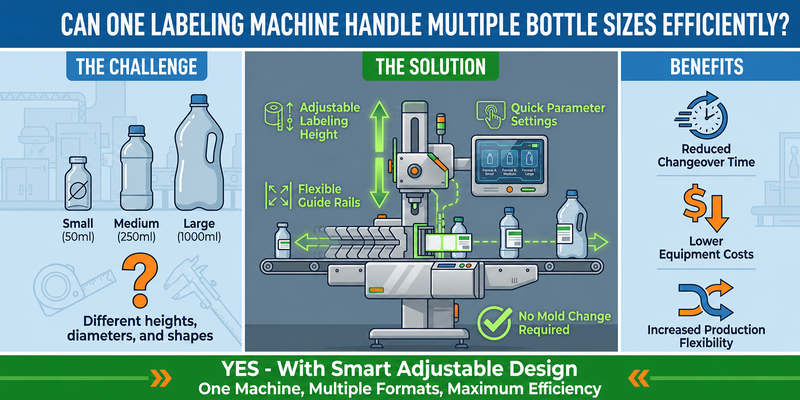
Struggling with different machines for every bottle size1? This costs space, time, and money. It feels inefficient and complex, slowing down your entire production line with constant changeovers.
Yes, a single labeling machine can absolutely handle multiple bottle sizes and shapes efficiently. Modern machines, like a double-sided labeler with a round bottle attachment, are designed for this versatility, adapting to square, flat, and round containers with simple adjustments.
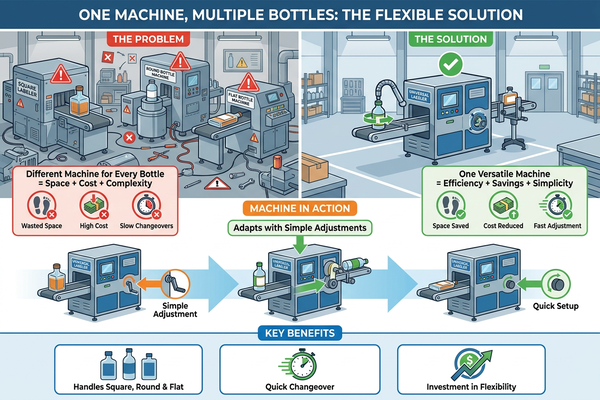
You've seen the problem: a growing product line means a growing collection of bottles. Square ones for one product, round for another, and maybe a unique flat bottle for a special edition. The traditional answer was a different machine for each, a solution that quickly eats up factory floor space and your budget. But we've found that it doesn't have to be this way. The key is investing in flexibility from the start. Let's look at how this is possible and what it means for your operation.
How does a single machine adapt to different bottle shapes?
You have square bottles and round bottles, and you think you need two separate labelers. This common problem leads to higher costs and wasted space. What if one machine could do both jobs?
A versatile machine, like a double-sided labeler, uses modular attachments. By adding a simple wrap station2, the same machine that applies labels to the front and back of a flat bottle can apply a full wrap-around label to a round bottle, making it incredibly adaptable.
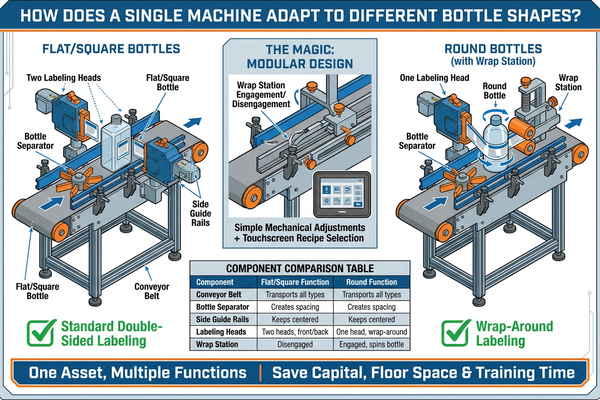
I remember visiting a client who was running three separate, slow labeling lines for their different sauce bottles. They had a small space and were constantly struggling with bottlenecks. We showed them how one machine could replace all three. The magic is in the design. A standard double-sided labeler has two opposing labeling heads. Bottles travel on a conveyor between them, and guide rails keep them perfectly aligned. When a square or flat bottle passes the sensor, the heads apply labels to both sides at once.
To handle round bottles, we add a "wrap station." This is a specialized belt or roller system positioned above the conveyor. When you switch to a round bottle run, you engage this station. As the bottle enters, the wrap station spins it precisely as the labeling head dispenses the label. The result is a perfect, smooth wrap-around application. The changeover between bottle types is often quick, involving simple mechanical adjustments and selecting a new recipe on the machine's touchscreen.
| Component | Function for Flat/Square Bottles | Function for Round Bottles (with Wrap Station) |
|---|---|---|
| Conveyor Belt | Transports all bottle types | Transports all bottle types |
| Bottle Separator | Creates consistent spacing for accurate timing | Creates consistent spacing for accurate timing |
| Side Guide Rails | Keeps bottles centered and stable | Keeps bottles centered and stable |
| Labeling Heads | Two heads apply front and back labels simultaneously | One head applies a single label that wraps around |
| Wrap Station | Disengaged and not in use | Engaged; spins the bottle to apply the wrap label |
This dual functionality means you invest in one asset that does the work of two or more, saving you capital, floor space, and training time.
What other types of versatile labeling machine3s are available?
Thinking a double-sided machine4 is your only option for flexibility can be limiting. Different production needs call for different solutions, and you might miss the perfect fit for your specific products.
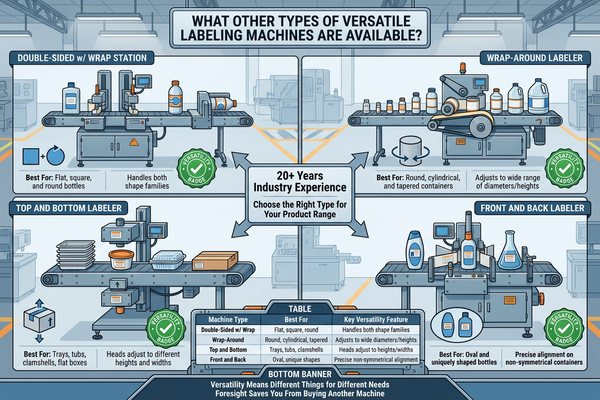
Beyond double-sided models, you have wrap-around labelers for various diameters, top-and-bottom labelers for trays and jars, and front-and-back systems for oval bottles. Each offers a unique form of versatility to match your product range and packaging demands.
Over our 20+ years in the industry, we've seen that "versatility" means different things to different companies. For a beverage company, it might mean handling 250ml, 500ml, and 1-liter round bottles. For a cosmetics brand, it could be labeling small jars, oval lotion bottles, and flat-sided serum containers. That's why a whole family of adaptable labelers exists.
A Wrap-Around Labeler5 is a champion for cylindrical containers. It's designed to handle a wide range of diameters and heights with minimal adjustments to the guide rails and wrap station. Some advanced models can even handle slightly tapered bottles, which are common in the wine and spirits industry.
A Top and Bottom Labeler6 is perfect for products where labels go on the lid and the base. Think of plastic clamshells for salads, rectangular butter tubs, or flat boxes. The top and bottom labeling heads can be adjusted vertically and horizontally to accommodate a huge variety of product heights and widths.
Finally, a Front and Back Labeler is a specialized version of the double-sided machine. It's optimized for containers that are not perfectly square, like oval shampoo bottles or flask-shaped containers, ensuring both labels are placed with perfect alignment.
| Machine Type | Best For | Key Versatility Feature |
|---|---|---|
| Double-Sided w/ Wrap | Flat, square, and round bottles | Handles both shape families (flat and cylindrical) |
| Wrap-Around | Round, cylindrical, and tapered containers | Adjusts easily to a wide range of diameters/heights |
| Top and Bottom | Trays, tubs, clamshells, flat boxes | Heads adjust to different product heights and widths |
| Front and Back | Oval and uniquely shaped bottles | Precise alignment on non-symmetrical containers |
Choosing the right type depends on your current and future product lineup. A little foresight here can save you from buying another machine down the road.
What factors affect the efficiency of a multi-size labeler7?
You've bought a versatile machine, but your output isn't what you expected. Just because a machine can handle multiple sizes doesn't mean it will do so efficiently without the right setup and understanding.
Efficiency isn't just about speed; it's about minimizing downtime. The most critical factors are changeover time, running speed adjustments based on bottle stability, and maintaining label accuracy. Operator skill is the key that ties it all together.
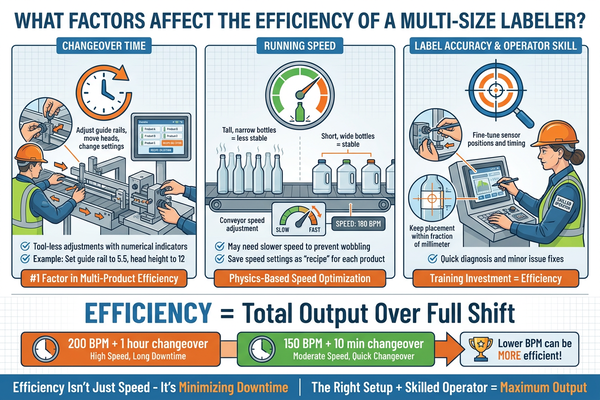
When we talk about efficiency, we mean total output over a full shift, not just the peak "bottles per minute" (BPM) rate. A machine that runs at 200 BPM but takes an hour to change over might be less efficient than a 150 BPM machine with a 10-minute changeover.
Changeover Time: This is the time it takes to switch from one bottle size to another. On modern machines from RITO8, this process is streamlined. It involves adjusting guide rails, moving labeling heads, and changing settings on a touch screen. Many adjustments are tool-less and have numerical indicators, so an operator can follow a simple checklist (e.g., "Set guide rail to 5.5, set head height to 12"). A quick changeover is the number one factor in maintaining high efficiency in a multi-product environment.
Running Speed: As the insight from the beginning mentioned, bottle size affects speed. This is simple physics. A tall, narrow bottle is less stable than a short, wide one. To guarantee a perfectly placed label every time, you may need to slow the conveyor speed for less stable bottles to prevent them from wobbling. A good machine allows you to save these speed settings as part of a "recipe" for each product, ensuring consistent quality.
Label Accuracy and Operator Skill: A versatile machine is only as good as its setup. An experienced operator knows how to fine-tune sensor positions and timing to keep label placement within a fraction of a millimeter, every time. They can also quickly diagnose and fix minor issues, preventing long stops. Investing in training for your team is just as important as investing in the machine itself.
Conclusion
Yes, one labeling machine can efficiently handle many bottle sizes. The key is choosing a versatile model like a double-sided or wrap-around labeler and mastering the quick-changeover process.
"[PDF] Investigation and Improvement of the Conveyor System at a Bottle ...", https://dc.etsu.edu/cgi/viewcontent.cgi?article=2061&context=etd. A technical source on packaging-line dynamics or conveyor handling can substantiate that container dimensions and stability influence permissible conveyor or labeling speeds, because taller or narrower bottles are more prone to wobble or tipping during handling. Evidence role: mechanism; source type: paper. Supports: Bottle size affects labeling machine running speed because taller, narrower bottles are less stable and may require slower conveyor speeds to maintain accurate label placement.. Scope note: The evidence should support the general relationship between bottle geometry, stability, and operating speed; exact speed limits will vary by machine design, container material, fill level, and line setup. ↩
"Wrap-around Labeling | HERMA Labeling Machines", https://www.herma.us/machines/types-of-labeling/wrap-around-labeling/. A technical packaging reference describing wrap-around pressure-sensitive labeling would support that a wrap station rotates or controls a cylindrical container while the label is applied around its circumference. Evidence role: definition; source type: institution. Supports: A wrap station enables wrap-around label application on round bottles.. Scope note: Terminology may vary by manufacturer, with similar mechanisms called wrap belts, rollers, or wrap modules. ↩
"PMMI, The Association for Packaging and Processing Technologies", https://www.pmmi.org/. The cited source explains that automatic labeling equipment can be configured for different label placements and container geometries, including front/back and wrap-around applications, supporting the claim that one suitably designed labeling machine can serve multiple bottle formats. Evidence role: general_support; source type: institution. Supports: A single versatile labeling machine can handle multiple bottle sizes and shapes efficiently by using adjustable or modular configurations such as double-sided labeling and wrap-around attachments.. Scope note: The source should verify the general capability of configurable labeling equipment; it may not substantiate specific efficiency gains, changeover times, or performance for every bottle shape without machine-specific data. ↩
"Labeling Machines - PMMI ProSource Directory", https://www.prosource.org/category/coding-labeling-printing-and-reading-equipment/labeling-machines. A neutral packaging-machinery reference describing labeling-machine configurations—such as wrap-around, top/bottom, and front/back systems—supports the classification of versatile labelers by container shape and label placement. Evidence role: definition; source type: institution. Supports: Beyond double-sided models, there are other versatile labeling machine types, including wrap-around labelers for different diameters, top-and-bottom labelers for trays and jars, and front-and-back systems for oval or shaped bottles.. Scope note: The source may describe machine categories and typical applications generally, rather than validating the performance of any specific double-sided model. ↩
"An Overview of Wraparound Pressure Sensitive Labelers", https://www.sigmaequipment.com/guide/wraparound-pressure-sensitive-labeler/?srsltid=AfmBOooKckJ5hRytcYvTbjtzS4zA-ct2GKEj2nuh5DUxKxjltK_WTG9v. A packaging reference defining wrap-around labelers would support that these machines are designed for cylindrical containers and apply labels around the container circumference. Evidence role: definition; source type: encyclopedia. Supports: A wrap-around labeler is suited to cylindrical containers.. Scope note: This definition does not by itself establish the diameter range or throughput of any particular wrap-around labeler. ↩
"MFlex Top & Bottom – Labeling Applicator System for Containers ...", https://www.epilabelers.com/products/mflex-top-bottom-labeling-for-containers-products-and-packaging/. A packaging-machinery source defining top-and-bottom labelers would support that these systems apply labels to the upper and lower surfaces of packages such as trays, tubs, clamshells, and boxes. Evidence role: definition; source type: institution. Supports: Top-and-bottom labelers are used for products requiring labels on both the top and bottom surfaces.. Scope note: The source would establish the machine category; exact product compatibility depends on package rigidity, dimensions, and conveyor handling. ↩
"[PDF] chapter 1 - s2.SMU", https://s2.smu.edu/~barr/praxis/Via-Praxis.pdf. A manufacturing-engineering source on packaging-line performance and changeover reduction can substantiate that overall efficiency for equipment handling multiple product formats depends not only on nominal running speed but also on downtime for changeovers, setup accuracy, and operator-controlled adjustments. Evidence role: general_support; source type: paper. Supports: Efficiency in a multi-size labeler is affected by changeover time, running-speed adjustments for container stability, label-placement accuracy, and operator skill.. Scope note: The source may support these as general packaging/manufacturing efficiency factors rather than addressing this exact labeling-machine model. ↩
"Automatic Labeling Machine for Tapered Plastic Containers", https://www.quadrel.com/automatic-labeling-machine-for-tapered-plastic-containers/. A technical source on automatic pressure-sensitive labeling systems should document that modern labelers reduce product-size changeover by using adjustable guide rails, movable labeling heads, tool-less settings, and HMI or touchscreen recipe controls. Evidence role: mechanism; source type: institution. Supports: Modern machines from RITO streamline changeover between bottle sizes by using adjustable guide rails, movable labeling heads, and touchscreen settings.. Scope note: This would support the general changeover mechanism for modern labeling machines, but may not independently verify the performance of RITO-specific models unless a RITO technical manual or third-party evaluation is used. ↩