

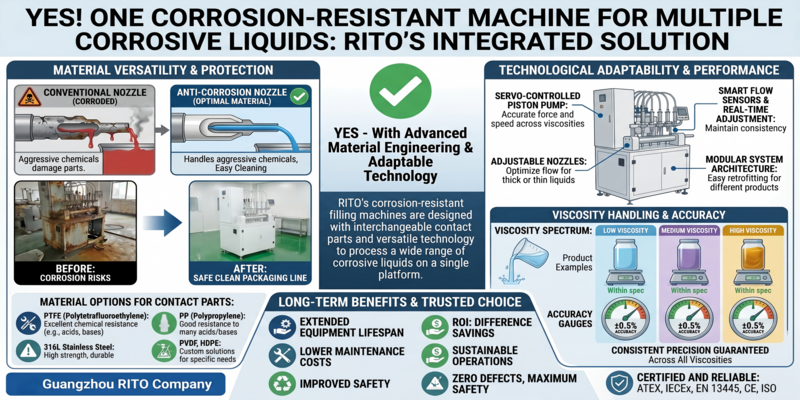
Struggling with the high cost and space of using separate machines for each corrosive liquid? You worry that mixing products could lead to contamination, safety hazards, or equipment failure.
Yes, you can use a single corrosion-resistant filling machine for different liquids.1 The key is to implement strict separation protocols, especially between products for human contact and harsh industrial chemicals. Thorough cleaning and validation between batches are absolutely essential2 to ensure both safety and product integrity.
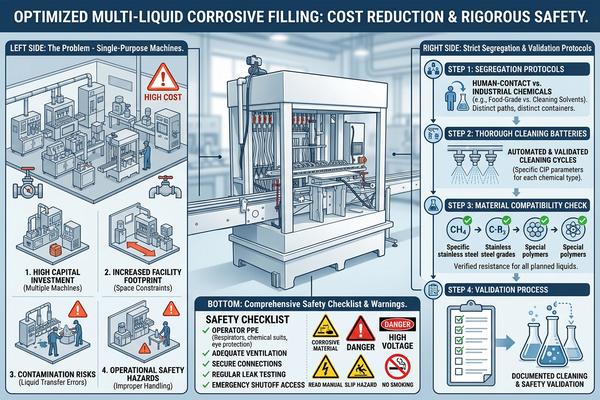
So, the short answer is yes, but it comes with some very important rules. Using one machine for multiple corrosive products is a great way to improve efficiency and save money, but doing it wrong can be disastrous. To get it right, you need a solid plan that covers contamination, cleaning, and the materials of your machine. Let's break down exactly what you need to consider to do this safely and effectively, based on our years of experience helping clients just like you.
How do you prevent cross-contamination between different liquids?
You need to switch between different chemicals for your production line. But you know that even a tiny amount of the last liquid can ruin an entire new batch.
To prevent cross-contamination, the safest method is dedicating separate machines to fundamentally different product types, such as food-grade versus industrial chemicals3. If using one machine, a validated, deep cleaning process is non-negotiable. An even better strategy is to use dedicated sets of contact parts.
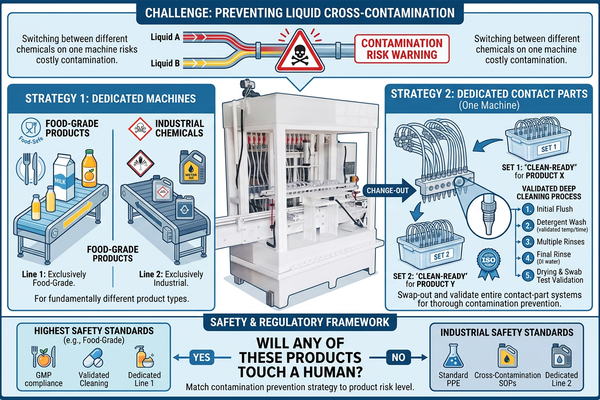
At RITO PACKAGING, we've seen this challenge countless times. The single biggest risk is not a chemical reaction, but a safety and regulatory one. That's why we always start with one simple question: will any of these products touch a human?
Product Categorization is Your First Safety Check
The most important rule is to draw a clear line between products intended for human contact and those that are not. This includes:
- Human-Contact: Food products, beverages, cosmetics, pharmaceuticals, personal care items.
- Industrial: Strong acids, bases, solvents, cleaners, agricultural chemicals, lubricants.
You should never, under any circumstances, use the same machine for both categories without an extremely rigorous, and often impractical, full teardown and sterilization process4. The risk of a small amount of industrial cleaner ending up in a cosmetic lotion is a catastrophic failure. We always advise our clients to purchase separate machines for these categories. It's not an upsell; it's a fundamental safety requirement.
Use Dedicated Contact Parts for Efficiency
For liquids within the same category (e.g., two different industrial acids), a popular and effective method is using dedicated contact parts5. This means you have a separate set of hoses, nozzles, seals, and sometimes even the pump, for each liquid.
| Method | Time to Switch | Cost | Risk of Error |
|---|---|---|---|
| Deep Cleaning | High (1-3 hours) | Low (consumables) | Medium |
| Dedicated Parts | Low (15-30 mins) | Medium (upfront) | Low |
Switching parts is much faster than a full cleaning cycle and dramatically reduces the risk of human error during cleaning. This strategy keeps your production line running with minimal downtime.
What cleaning procedures are necessary when switching liquids?
You've decided to use one machine for several similar liquids. But you're worried that an incomplete cleaning job could damage your equipment or compromise your next product batch.
A standardized cleaning protocol is your solution. The necessary procedures, known as Clean-In-Place (CIP) or Clean-Out-of-Place (COP)6, involve flushing, washing with a specific detergent, rinsing thoroughly with pure water, and complete drying. The exact steps depend entirely on the chemicals you are using.
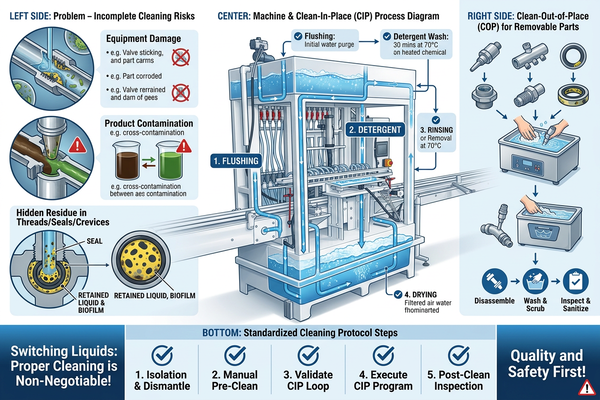
A "clean" machine isn't just about what you can see. Chemical residue can hide in threads, seals, and tiny crevices.7 A proper cleaning procedure is a scientific process designed to eliminate that residue chemically and physically, ensuring your machine is truly ready for the next batch. It’s a non-negotiable step for quality and safety.
The CIP/COP Process Explained
While the specifics vary, a robust cleaning protocol generally follows these steps. Let's imagine you are switching from a strong acid to a different product.
- Purge/Flush: First, run the machine to pump out as much of the remaining acid as possible. Then, flush the system with a compatible liquid, often water, to remove the bulk of the residue.
- Neutralization: Since you were using an acid, the next step is to circulate a neutralizing agent, like a weak base solution8, to chemically neutralize any remaining acidic traces.
- Detergent Wash: Use a detergent designed to break down any other contaminants. The choice of detergent is critical and depends on your product's composition.
- Rinse Cycles: This is crucial. Rinse the system multiple times with high-purity water (deionized or distilled) to remove every trace of the cleaning agent and neutralized salts.
- Drying: Finally, use filtered, compressed air to blow the system completely dry. Any remaining moisture can dilute your next product or cause unwanted reactions.
Document Everything with a Standard Operating Procedure (SOP)
You must document this entire process in a Standard Operating Procedure (SOP). This written guide ensures that every operator performs the cleaning in the exact same way, every single time. Your SOP should specify the exact cleaning agents, concentrations, circulation times, and temperatures. This not only guarantees consistency but is also a requirement for many industry certifications like GMP9 (Good Manufacturing Practices).
Are there material compatibility issues to consider?
Your machine is advertised as "corrosion-resistant," but you wonder what that really means. Assuming it works for every corrosive liquid is a dangerous gamble that could destroy your investment.
Yes, material compatibility is absolutely critical. "Corrosion-resistant" is not a universal guarantee.10 Materials like 316L Stainless Steel are excellent for many products but will be destroyed by others, like bleach.11 Always check a chemical compatibility chart against the specific materials in your machine.
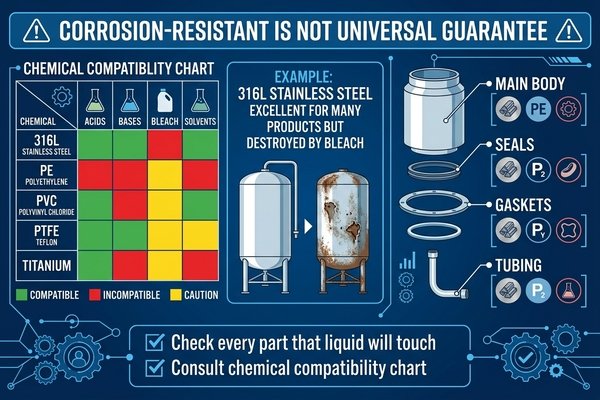
We build our machines to last, and that starts with choosing the right materials for the job. A machine's resistance to corrosion is only as strong as its weakest component. The main body might be one material, but the seals, gaskets, and tubing are often different. You have to consider every single part that your liquid will touch.
Common Materials in Filling Machines
Understanding the common materials helps you make better decisions.
- 316L Stainless Steel: This is the industry standard for food, pharma, and general chemical applications. It offers good resistance to a wide range of products but has weaknesses, particularly with strong chlorides.
- Titanium: When stainless steel isn't enough, titanium is a fantastic option. It is exceptionally resistant to chlorides12, making it perfect for filling products like bleach or certain saltwater solutions.
- Plastics (PTFE, PEEK, PVC): These polymers are essential for seals, gaskets, and tubing. PTFE (Teflon) has almost universal chemical resistance and is a premium choice. PEEK is strong and resistant, while PVC is a more economical option for less aggressive chemicals.
How to Verify Compatibility
Never assume. Always verify. The best way to do this is to consult a chemical compatibility chart. You need to check every liquid you plan to fill against every material it will touch.
| Material | Strong Acids (e.g., Sulfuric) | Strong Bases (e.g., NaOH) | Bleach (Sodium Hypochlorite) | Solvents (e.g., Acetone) |
|---|---|---|---|---|
| 316L SS | Good | Excellent | Poor - Do Not Use | Excellent |
| Titanium | Excellent | Excellent | Excellent | Excellent |
| PTFE | Excellent | Excellent | Excellent | Excellent |
| PVC | Good | Good | Good | Poor - Do Not Use |
This table is a simplified guide. When in doubt, talk to an expert. Our team at RITO PACKAGING has decades of combined experience and can help you configure a machine with the perfect combination of materials for your specific products.
Conclusion
Using one machine for multiple corrosive liquids is very possible and efficient. Success depends on smart planning: separate human-contact products, follow strict cleaning protocols, and always verify material compatibility for safety.
"Validation of Cleaning Processes (7/93)", https://www.fda.gov/inspections-compliance-enforcement-and-criminal-investigations/inspection-guides/validation-cleaning-processes-793. A neutral equipment-safety or process-validation source should support that multi-product processing on shared equipment is feasible only when cross-contamination controls, cleaning validation, and product-contact material compatibility are addressed. Evidence role: general_support; source type: institution. Supports: A single corrosion-resistant filling machine can be used for different liquids if strict controls are implemented.. Scope note: The source may support the general principle of shared equipment and validation rather than this specific filling-machine configuration. ↩
"Validation of Cleaning Processes (7/93) - FDA", https://www.fda.gov/inspections-compliance-enforcement-and-criminal-investigations/inspection-guides/validation-cleaning-processes-793. Regulatory guidance on cleaning validation supports that documented, validated cleaning procedures are used to prevent carryover and contamination between products manufactured on shared equipment. Evidence role: expert_consensus; source type: government. Supports: Thorough cleaning and validation between batches are essential for safety and product integrity when equipment is reused.. Scope note: Guidance is often written for pharmaceutical or regulated manufacturing and may require adaptation for non-regulated industrial chemical filling. ↩
"Hazard control by segregation in food factories - PMC - NIH", https://pmc.ncbi.nlm.nih.gov/articles/PMC7271199/. GMP and food-safety guidance support segregation or dedicated equipment where contamination risks cannot be adequately controlled, especially when materials have very different hazard profiles. Evidence role: expert_consensus; source type: government. Supports: Separate machines are the safest approach for fundamentally different product categories such as human-contact products and industrial chemicals.. Scope note: Such guidance may not explicitly name filling machines or the exact food-grade-versus-industrial-chemical example, but it supports the underlying segregation principle. ↩
"Food Chemical Safety - FDA", https://www.fda.gov/food/food-ingredients-packaging/food-chemical-safety. Contamination-control guidance can support that shared equipment between incompatible product categories requires validated cleaning, sanitation, and sometimes dedicated equipment when residue hazards cannot be reliably reduced to acceptable limits. Evidence role: expert_consensus; source type: institution. Supports: Using the same machine for human-contact products and industrial chemicals requires exceptionally rigorous validated decontamination, and separate equipment is often preferred.. Scope note: The source is likely to support risk-based segregation and validation rather than the article’s stronger practical judgment that teardown is often impractical. ↩
"Cross-Contamination Control: Hygienic Design Focus - Vikan", https://www.vikan.com/us/knowledge-center/the-vikan-blog/cross-contamination-control-hygienic-design-focus. Process-contamination guidance and hygienic-design literature support the use of dedicated product-contact components as a control measure to reduce residue carryover between products. Evidence role: mechanism; source type: institution. Supports: Dedicated product-contact parts can reduce cross-contamination risk when one machine handles multiple compatible liquids.. Scope note: Evidence may describe the principle of dedicated product-contact equipment generally rather than quantify risk reduction for hoses, nozzles, and seals in corrosive-liquid filling. ↩
"Advanced CIP | The Wilbur A. Gould Food Industries Center", https://foodindustries.osu.edu/cip. Technical references from food or pharmaceutical engineering define Clean-in-Place and Clean-out-of-Place as established cleaning approaches for process equipment and describe their use in removing residues from product-contact surfaces. Evidence role: definition; source type: education. Supports: CIP and COP are recognized cleaning procedures for process equipment used between product batches.. Scope note: Definitions of CIP and COP do not by themselves prove that a specific corrosive-liquid filling process has been adequately cleaned; validation data would still be required. ↩
"Questions and Answers on Current Good Manufacturing ...", https://www.fda.gov/drugs/guidances-drugs/questions-and-answers-current-good-manufacturing-practice-requirements-equipment. Hygienic-equipment design standards and guidance identify crevices, seals, threads, and dead spaces as locations where residues and contaminants can remain, supporting the need for cleanable design and validated cleaning. Evidence role: mechanism; source type: institution. Supports: Residues may remain in threads, seals, crevices, and similar hard-to-clean areas of processing equipment.. Scope note: The evidence is contextual and describes known harborage points; it may not test the exact filling-machine design discussed in the article. ↩
"8.1 Acid–Base Reactions - Highland Community College", https://users.highland.edu/~jsullivan/genchem/s08_acidbaser.html. Chemistry references support that acids react with bases in neutralization reactions to form salts and water, providing the chemical basis for using a compatible weak base to neutralize residual acidic material. Evidence role: mechanism; source type: education. Supports: A weak base can chemically neutralize residual acid during a cleaning process when compatible and properly controlled.. Scope note: The chemistry principle does not determine the safe or compatible neutralizing agent for a specific industrial chemical; process-specific hazard assessment is still needed. ↩
"Questions and Answers on Current Good Manufacturing Practice ...", https://www.fda.gov/drugs/guidances-drugs/questions-and-answers-current-good-manufacturing-practice-requirements-equipment. GMP regulations and guidance require written procedures and records for cleaning, maintenance, and production operations, supporting the claim that SOP documentation is central to regulated manufacturing systems. Evidence role: expert_consensus; source type: government. Supports: Documented SOPs for cleaning procedures are required or expected under GMP-style quality systems.. Scope note: GMP requirements apply specifically to regulated sectors such as pharmaceuticals, food, or cosmetics and may not govern every industrial filling operation. ↩
"Material Selection & Corrosion Guide", https://www.ashcroft.com/wp-content/uploads/2024/06/material-selection-corrosion-guide.pdf. Corrosion-engineering references support that corrosion resistance depends on the specific alloy, chemical environment, concentration, temperature, and exposure conditions, so a generic corrosion-resistant label cannot imply universal compatibility. Evidence role: expert_consensus; source type: education. Supports: Corrosion resistance is material- and environment-specific rather than universal.. Scope note: The source would support the general materials-science principle, not the performance of a particular manufacturer’s equipment. ↩
"[PDF] Stainless Steel Trap Corrosion - Office of Research Facilities", https://orf.od.nih.gov/TechnicalResources/Documents/DTR%20White%20Papers/FinalTrapCorrosionWhitePaperdocsanitized_508.pdf. Materials-corrosion data and compatibility charts report that austenitic stainless steels, including 316/316L, can be vulnerable to chloride-containing solutions and sodium hypochlorite, supporting caution about bleach service. Evidence role: mechanism; source type: research. Supports: 316L stainless steel can perform well in many environments but may be unsuitable for bleach or chloride-rich solutions.. Scope note: Actual corrosion severity depends on hypochlorite concentration, pH, temperature, oxygenation, and exposure time; some controlled low-concentration uses may differ. ↩
"[PDF] Corrosion Resistance of Titanium", https://www.nrc.gov/docs/ML9932/ML993210187.pdf. Corrosion literature describes titanium’s strong resistance to many chloride-containing environments due to a stable passive oxide film, supporting its use where stainless steels may suffer chloride attack. Evidence role: mechanism; source type: paper. Supports: Titanium has exceptional resistance to many chloride-containing solutions.. Scope note: Titanium is not universally immune; reducing acids, high temperatures, fluoride ions, or certain concentrated chemical conditions can compromise resistance. ↩