

Your factory floor is crowded, and switching between filling and capping is a hassle. Imagine streamlining this into one simple, efficient step, saving both space and time.
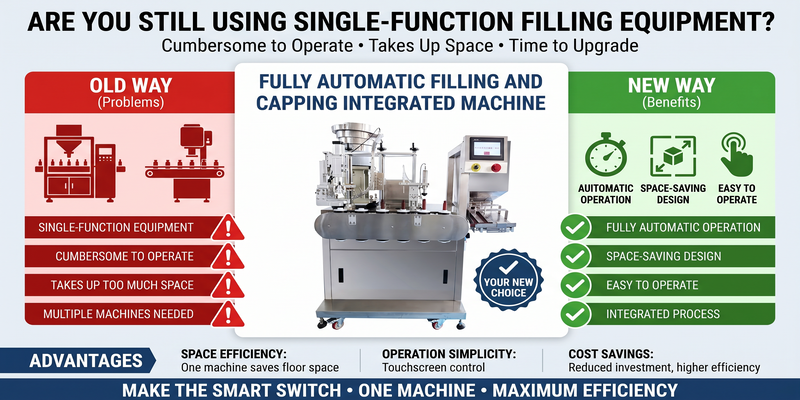
A fully automatic filling and capping integrated machine1 is your new choice. It combines bottle filling and capping into one compact unit, boosting efficiency, saving valuable factory space, and simplifying your entire production line with its automated, user-friendly operation2.
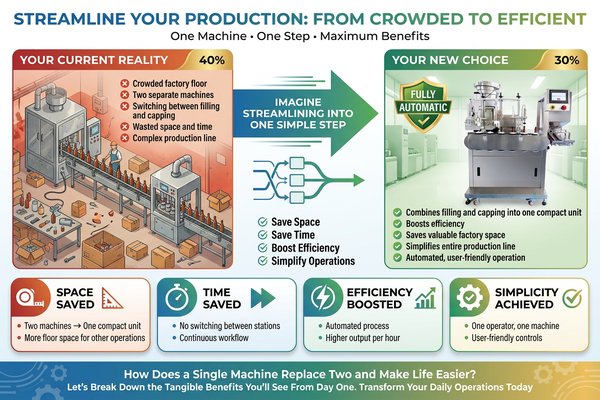
It sounds great in theory, but you're probably wondering what this really means for your daily operations. How does a single machine3 truly replace two and make life easier? Let's break down the tangible benefits you'll see from day one.
How can one machine double your efficiency and halve your space requirements?
Separate filling and capping stations create bottlenecks and eat up floor space.4 This inefficiency costs you time and money, limiting your production capacity every single day.
An integrated filling and capping machine5 combines two processes into a single, compact footprint. It automates bottle unscrambling, filling, cap placing, and capping into one continuous flow, eliminating manual transfers and idle time. This seamless integration significantly boosts output while freeing up valuable factory space.
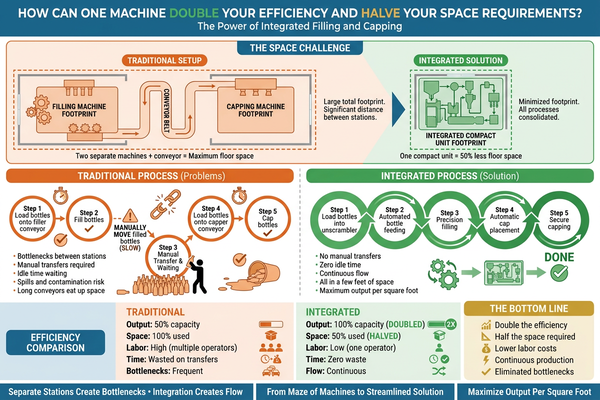
I've visited countless factories where the production floor is a maze of separate machines connected by long conveyors. Operators have to move heavy batches of filled, uncapped bottles from the filler to the capper. This manual step is not just slow; it's a major source of spills, contamination, and production delays. An integrated machine solves this entire problem. The bottle's journey is fully automated. It starts at an unscrambling table, moves smoothly onto the conveyor, gets filled with precision, receives a cap automatically, and is securely tightened—all within a few feet of linear space. This eliminates the "in-between" stage completely. The difference in workflow is night and day.
| Traditional Process (Two Machines) | Integrated Machine Process |
|---|---|
| 1. Load bottles onto filler conveyor. | 1. Load bottles into unscrambler. |
| 2. Fill bottles. | 2. Automated bottle feeding, filling, cap placement, and capping in one continuous flow. |
| 3. Manually move filled bottles. | |
| 4. Load bottles onto capper conveyor. | |
| 5. Cap bottles. |
This streamlined approach means no more waiting for a batch to finish before the next step can begin. It's a continuous, efficient flow that maximizes your output per square foot6.
Can you really achieve consistent ±1% filling accuracy7 for every bottle?
Inconsistent fills lead to product waste, customer complaints, and compliance issues. Over-filling wastes money, while under-filling damages your brand's reputation. It's a constant worry.
Yes, achieving ±1% accuracy is possible with modern technology. Our integrated machine uses a high-precision servo motor to drive a magnetic gear pump. This combination allows for exact control over the filling volume for every single bottle, eliminating inconsistency.
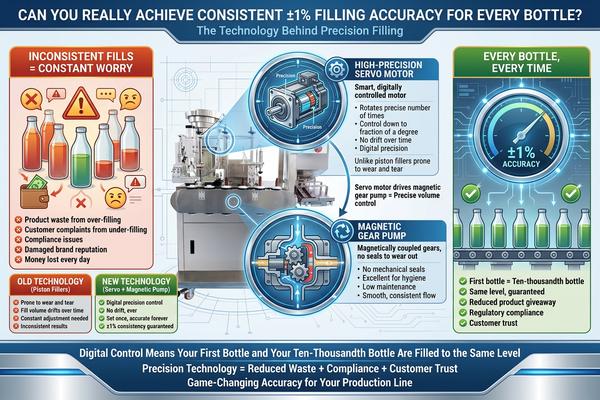
Let's dive into why this technology is a game-changer. In the past, many machines used simple piston fillers. While effective, they can be prone to wear and tear, causing the fill volume to drift over time. You end up constantly adjusting them. Our solution is different. We use a servo motor, which is essentially a smart, digitally controlled motor. Instead of just spinning, it can be told to rotate a precise number of times—down to a fraction of a degree. This servo motor drives a magnetic gear pump. The pump's gears are magnetically coupled, meaning there are no seals to wear out8, which is great for hygiene and maintenance. By telling the servo motor exactly how much to turn, we can dispense an incredibly precise volume of liquid, time after time. This digital control means your first bottle and your ten-thousandth bottle are filled to the same level, with an accuracy of ±1%. This reduces product giveaway, ensures regulatory compliance, and builds customer trust in your brand.
What if you could switch products without needing a specialized technician?
Changing over your production line from one product to another is often complex and time-consuming. Every minute of downtime is lost profit, and training operators is a constant challenge.
You can absolutely switch products easily without special training. Our machine features a user-friendly Human-Machine Interface (HMI). You can save settings for different products as "recipes." When it's time to change, simply select the recipe and you're ready to go.
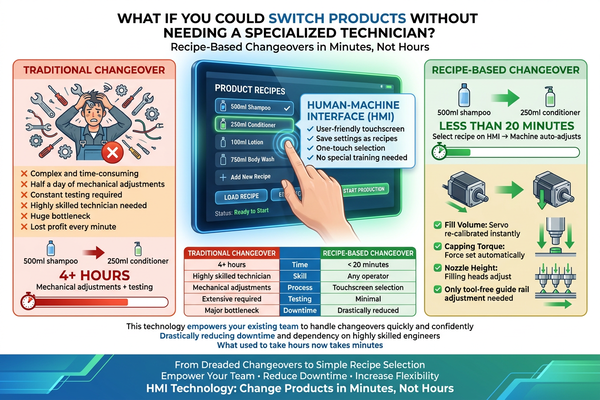
I remember a client who used to dread changeovers. Switching from their 500ml shampoo to a 250ml conditioner would take their team half a day of mechanical adjustments and testing. It was a huge bottleneck. After we installed one of our integrated machines, their process changed completely. Now, the operator just walks up to the touchscreen HMI, selects the pre-saved "250ml Conditioner" recipe, and the machine does the rest. Key parameters are adjusted automatically:
- Fill Volume: The servo motor is instantly re-calibrated.
- Capping Torque: The force needed for the smaller cap is set.
- Nozzle Height: The filling heads adjust to the new bottle height. The operator only needs to make simple, tool-free adjustments to the guide rails for the different bottle width. What used to take hours now takes less than 20 minutes. This technology empowers your existing team to handle changeovers quickly and confidently, drastically reducing downtime and dependency on highly skilled engineers for routine tasks.
Is there one machine that can handle everything from milk to toilet cleaner?
You produce multiple products with different viscosities and chemical properties. Buying a separate machine for each product line is incredibly expensive and impractical for most businesses.
Yes, a single highly versatile machine can handle a vast range of liquids. By using appropriate contact materials and easily swappable parts, our integrated filler-capper is designed to manage everything from thin liquids like milk to thick sauces and even corrosive chemicals.
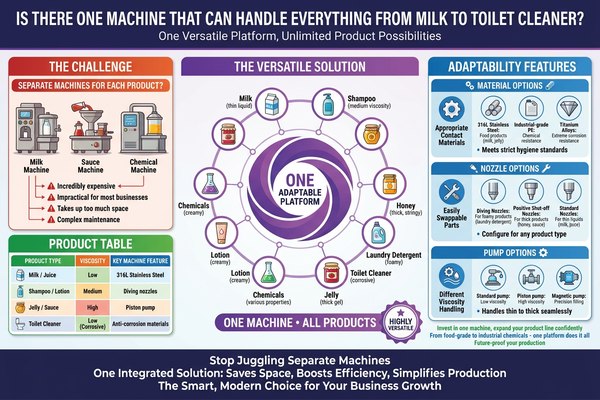
The secret to this versatility lies in the design and materials. It’s not a one-size-fits-all approach, but rather a single, adaptable platform. For example, when a customer needs to fill food products like milk or jelly, we build the machine with 316L stainless steel for all contact parts to meet strict hygiene standards. If that same customer also wants to fill a corrosive toilet cleaner, we can equip the machine with components made from industrial-grade plastics like PE or even titanium alloys that resist chemical breakdown. The flexibility doesn't stop there. We can configure the machine with different types of filling nozzles. For foamy products like laundry detergent, we use diving nozzles that fill from the bottom up to minimize foam. For thick, stringy products like honey or sauce, we use positive shut-off nozzles to prevent dripping. This adaptability means you can invest in one machine and confidently expand your product line in the future.
| Product Type | Viscosity | Key Machine Feature |
|---|---|---|
| Milk / Juice | Low | 316L Stainless Steel contact parts |
| Shampoo / Lotion | Medium | Diving nozzles to prevent foaming |
| Jelly / Sauce | High | Piston pump for thick products |
| Toilet Cleaner | Low (Corrosive) | Anti-corrosion materials (PE/Titanium) |
Conclusion
Stop juggling separate machines. An integrated filling and capping solution saves space, boosts efficiency, and simplifies your production. It’s the smart, modern choice for your business's growth.
"[PDF] The Justification of a packaging line based on capacity issues", https://repository.rit.edu/cgi/viewcontent.cgi?article=1564&context=theses. A technical source describing monoblock or integrated packaging machinery as performing bottle filling and cap application within a single automated unit would support the claim that a filling-and-capping integrated machine consolidates two production steps and can reduce handling and floor-space requirements. Evidence role: mechanism; source type: education. Supports: A fully automatic filling and capping integrated machine combines bottle filling and capping into one compact unit, improving efficiency, saving factory space, and simplifying the production line through automation.. Scope note: Such evidence would support the general principle of integrated filling-and-capping systems, not the specific performance of this manufacturer’s machine. ↩
"Human-Machine Interface (HMI) in Factory Automation - Cyngn Inc.", https://www.cyngn.com/blog/human-machine-interface-hmi-in-factory-automation-what-you-need-to-know. A scholarly source on industrial human–machine interfaces (HMIs) and automation can substantiate that well-designed operator interfaces and automated controls reduce operator workload, support easier machine supervision, and simplify production-line operation. Evidence role: general_support; source type: paper. Supports: An integrated filling and capping machine can simplify a production line through automated, user-friendly operation.. Scope note: This would support the general principle of user-friendly automated operation, not the specific performance or usability of this particular filling-and-capping machine. ↩
"(PDF) Processing and packaging automation systems: a review", https://www.academia.edu/1183705/Processing_and_packaging_automation_systems_a_review. A technical source on monoblock or integrated packaging machinery should document that filling and cap-applying/closing operations can be combined in one automated unit, supporting the claim that one machine can replace separate filling and capping stations. Evidence role: mechanism; source type: paper. Supports: An integrated filling and capping machine can replace separate filling and capping stations by combining both processes into a single automated machine.. Scope note: Such evidence can support the general integration principle, but it may not verify the exact efficiency, footprint reduction, or performance of the specific machine described in the article. ↩
"Facility Planning - Montana Manufacturing Extension Center", https://www.montana.edu/mmec/services/facility-planning.html. Operations-management sources explain that separated process steps with intermediate handling or queues can create bottlenecks and increase work-in-process space requirements. Evidence role: mechanism; source type: education. Supports: Separate filling and capping stations can create bottlenecks and consume floor space.. Scope note: The source would support the production-flow principle rather than proving that every separate filler-capper installation has bottlenecks. ↩
"Dictionary", https://www.eecis.udel.edu/~lliao/cis320f05/dictionary.txt. A technical source on automated bottle filling and capping systems can document that filling, cap placement, and cap tightening may be integrated into a single automated packaging line, supporting the claim that such machines streamline production and reduce manual handling. Evidence role: general_support; source type: paper. Supports: A fully automatic filling and capping integrated machine combines bottle filling and capping into one compact unit, improving efficiency, saving factory space, and simplifying the production line through automated operation.. Scope note: This would support the general operating principle and workflow benefit, but not the specific performance claims of any particular commercial model. ↩
"Lean Thinking and Methods - Cellular Manufacturing | US EPA", https://www.epa.gov/sustainability/lean-thinking-and-methods-cellular-manufacturing. Lean manufacturing literature uses space productivity and reduced non-value-added movement as measures of improved production efficiency, supporting the link between compact flow layouts and higher output per unit area. Evidence role: general_support; source type: education. Supports: Continuous compact layouts can improve output per square foot.. Scope note: The source supports the manufacturing principle; it does not quantify output per square foot for this particular machine. ↩
"Special Aids for Placing Naval Personnel in Civilian Jobs - GovInfo", https://www.govinfo.gov/content/pkg/GOVPUB-PR32_5200-8824535e28ae245ee6870a187f480de3/html/GOVPUB-PR32_5200-8824535e28ae245ee6870a187f480de3.htm. A peer-reviewed engineering source on servo-controlled volumetric filling or dosing systems can substantiate that servo actuation with positive-displacement pumping enables tightly controlled dispensed volumes, making ±1% filling accuracy technically feasible. Evidence role: mechanism; source type: paper. Supports: Modern integrated filling equipment can achieve ±1% filling accuracy by using a high-precision servo motor to drive a magnetic gear pump, enabling precise volume control for each bottle.. Scope note: This would support the feasibility of ±1% accuracy for this type of technology, but not independently verify the performance of the specific machine under every liquid, bottle, and operating condition. ↩
"[PDF] USING AXIAL FIELD, PERMANENT MAGNET, DISK MOTORS", https://oaktrust.library.tamu.edu/bitstreams/a68d3014-0454-4347-b39f-1f8127f1823a/download. Engineering descriptions of magnetically coupled pumps explain that torque is transmitted through a containment shell without a dynamic shaft seal, reducing leakage paths associated with conventional shaft seals. Evidence role: mechanism; source type: education. Supports: Magnetic gear pumps can avoid dynamic shaft seals that would otherwise wear and leak.. Scope note: Magnetically coupled pumps may still contain bearings or other wear components; the support is specific to the absence of a dynamic shaft seal. ↩