

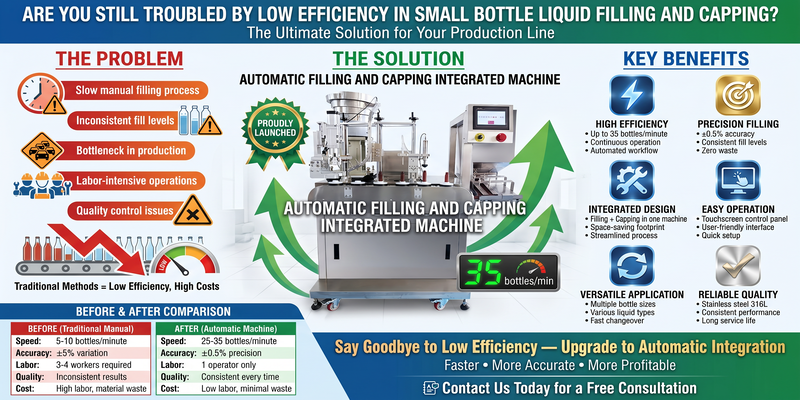
Are you tired of production bottlenecks caused by manual filling and capping? This slow process costs you time and money, holding your business back from its true potential.
Our new automatic filling and capping integrated machine1 is the answer. It combines multiple production steps into one seamless, automated process, designed specifically for small bottles. This machine boosts efficiency, ensures accuracy2, and dramatically reduces your labor costs3, solving your biggest production headaches.
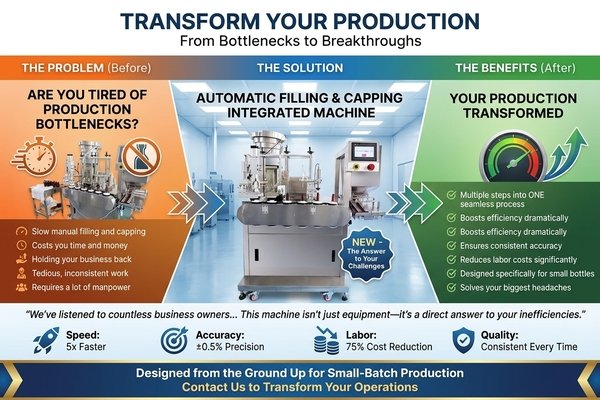
We've talked to countless business owners who face the same challenges. They have a great product but struggle to get it into bottles and out the door quickly. The manual work is tedious, inconsistent, and requires a lot of manpower. We listened to these problems and designed a solution from the ground up. This machine isn't just another piece of equipment; it's a direct answer to the inefficiencies that plague small-batch production. Let's explore how it can completely transform your operations.
How Can You Achieve Full Automation with Just One Operator?
Managing a team for filling4, capping5, and sorting is expensive and complicated. Coordinating multiple people leads to errors, downtime, and high labor costs that eat into your profits.
Our integrated machine6 automates the entire workflow: automatic bottle feeding, precise liquid filling7, automatic cap placing, and secure tightening. This allows the entire process to be managed by a single operator8, streamlining production and maximizing your return on investment.
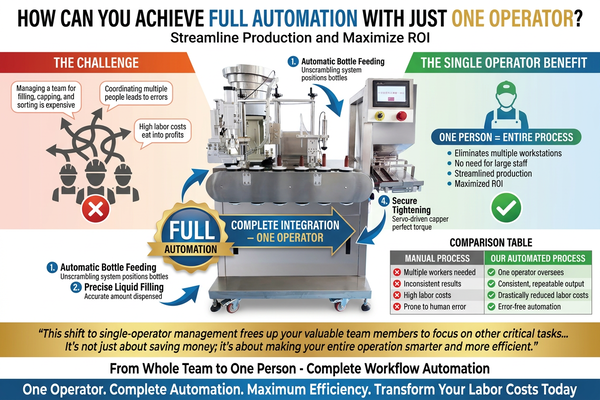
The magic of this machine is in its complete integration. We designed it to handle everything from start to finish without manual intervention. The process is simple and elegant. First, empty bottles are automatically fed and positioned correctly by the unscrambling system. Then, they move to the filling station, where the precise amount of liquid is dispensed. Next, the machine automatically places a cap on each bottle. Finally, the servo-driven9 capper tightens each cap to the perfect torque. This entire sequence happens in a smooth, continuous flow. By consolidating these tasks, you eliminate the need for multiple workstations and the staff to run them. One person can now oversee a process that previously required a whole team.
| Manual Process | Our Automated Process |
|---|---|
| Multiple workers needed | One operator oversees |
| Inconsistent results | Consistent, repeatable output |
| High labor costs | Drastically reduced labor costs |
| Prone to human error | Error-free automation |
This shift to single-operator management frees up your valuable team members to focus on other critical tasks, like quality control or packaging for shipment. It's not just about saving money on salaries; it's about making your entire operation smarter and more efficient.
How Do We Guarantee Filling Accuracy Down to ±1%?
Inaccurate filling is a silent profit killer. Over-filling wastes valuable product10 with every bottle, while under-filling can lead to customer complaints and damage your brand's reputation.
We achieve incredible precision by using a state-of-the-art servo control system paired with a magnetic gear pump. This combination gives us pinpoint control over the filling volume, ensuring a consistent accuracy of ±1%11 and practically eliminating product waste.
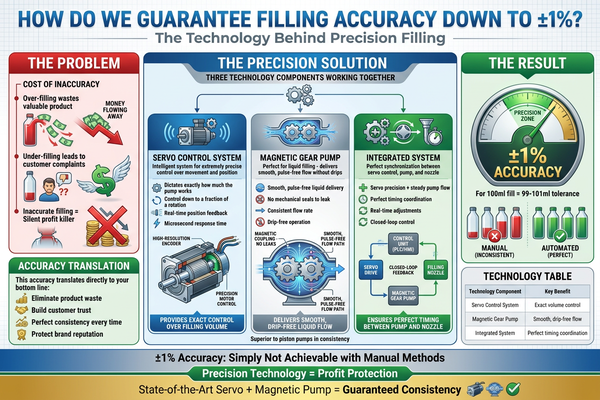
Let's break down this technology. A servo motor is not just any motor; it's an intelligent system that allows for extremely precise control over movement and position. In our machine, it dictates exactly how much the pump works, down to a fraction of a rotation. This is paired with a magnetic gear pump, which is perfect for liquid filling because it delivers a smooth, pulse-free flow12 without any drips. This is a huge advantage over older technologies like piston pumps, which can be less consistent. The combination of servo precision and the steady flow from the magnetic pump is what allows us to confidently promise ±1% accuracy. For a 100ml fill, that means every bottle is filled within a 1ml tolerance. This level of consistency is simply not achievable with manual methods.
| Technology Component | Key Benefit |
|---|---|
| Servo Control System | Provides exact control over filling volume. |
| Magnetic Gear Pump | Delivers a smooth, drip-free liquid flow. |
| Integrated System | Ensures perfect timing between pump and nozzle. |
This accuracy translates directly to your bottom line. You save money by eliminating product waste and build customer trust by delivering a perfectly consistent product every single time.
How Does Our Machine Handle Different Bottles Without Damaging Caps?
Using the wrong amount of force when capping can be disastrous. Overtightening can crack caps or strip threads, while under-tightening leads to leaks, product spoilage, and unhappy customers.
Our machine features a sophisticated servo-driven13 claw capping system. The tightening force, or torque, is precisely adjustable to match your specific caps. This guarantees a perfect seal every time without causing any damage, and it's versatile enough for various bottle sizes.
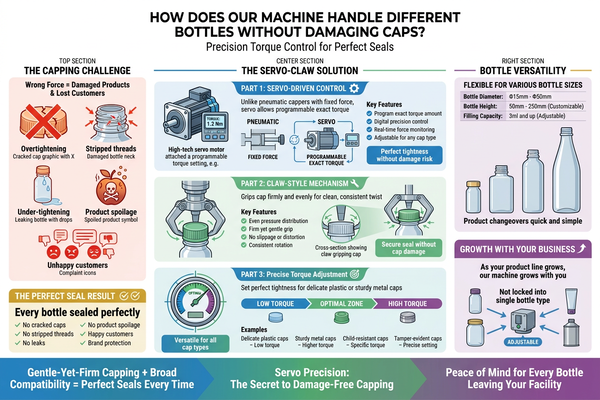
The secret is in the "servo-driven" control. Unlike simple pneumatic cappers that apply a fixed force, our servo system allows you to program the exact amount of torque required for your caps. Whether you're using delicate plastic caps or sturdy metal ones, you can set the perfect tightness to ensure a secure seal without any risk of damage. The claw-style mechanism grips the cap firmly and evenly for a clean, consistent twist. This machine is also incredibly flexible. We built it to be a workhorse for businesses that handle different products. It easily accommodates a wide range of bottle shapes and sizes, making product changeovers quick and simple.
| Specification | Range |
|---|---|
| Bottle Diameter | Φ15mm - Φ50mm |
| Bottle Height | 50mm - 250mm (Customizable) |
| Filling Capacity | 3ml and up (Adjustable) |
This adaptability means you are not locked into a single bottle type. As your product line grows or changes, our machine can grow with you. The combination of a gentle-yet-firm capping system and broad compatibility gives you the peace of mind that every single bottle leaving your facility is sealed perfectly.
What Makes This Machine a True Powerhouse for Production?
Production slowdowns are frustrating and mean lost revenue. If your filling line can't keep up with demand, you miss sales opportunities and risk falling behind your competitors.
Engineered for continuous, stable operation, our integrated machine hits speeds of 15 to 30 bottles per minute14. This consistent, high-speed output provides the reliable throughput you need to scale your business and meet growing market demand without hesitation.
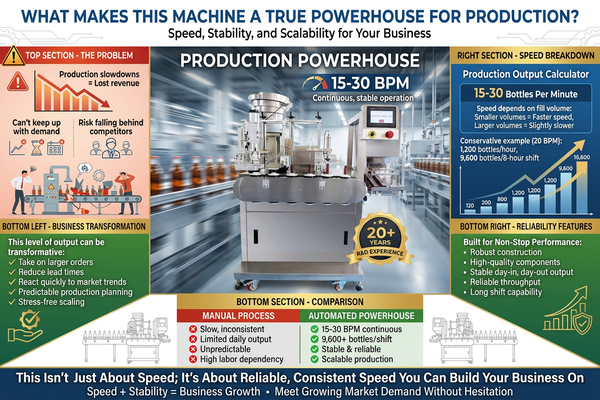
This machine is built for non-stop performance. Its robust construction and high-quality components, born from our 20+ years of R&D experience, ensure it can run reliably through long shifts. The speed of 15 to 30 bottles per minute15 (BPM) depends on the fill volume—smaller volumes run faster, while larger ones take a bit more time. But let's put that into perspective. Even at a conservative 20 BPM, you are producing 1,200 bottles an hour. In a single 8-hour shift, that's 9,600 bottles filled and capped perfectly. Compare that to a manual process. This level of output can be transformative. It allows you to take on larger orders, reduce lead times, and react quickly to market trends. The stability of the machine means you can count on this output day in and day out, making production planning predictable and stress-free. This isn't just about speed; it's about reliable, consistent speed that you can build your business on.
Conclusion
Stop letting inefficient filling and capping slow you down. Our all-in-one machine offers the automated, precise, and high-speed solution you need to grow your business with confidence.
"From Filling to Capping: How Integrated Packaging Machines ...", https://www.accutekpackaging.com/from-filling-to-capping-machine/. Engineering literature on automated packaging lines describes integrated bottle-filling and capping systems as combining sequential operations—such as container handling, metered filling, cap placement, and closure tightening—into a continuous automated workflow, thereby supporting claims of reduced manual handling and improved production consistency. Evidence role: general_support; source type: paper. Supports: An automatic filling and capping integrated machine combines multiple bottle-production steps into one automated process, improving efficiency, consistency, and reducing manual labor compared with separate manual filling and capping.. Scope note: Such evidence can support the general principle of integrated filling-and-capping automation, but it does not independently verify the specific performance, accuracy, or labor-cost reductions of this particular machine. ↩
"Process performance of a new liquid medication dispensing robot", https://pmc.ncbi.nlm.nih.gov/articles/PMC10647870/. A peer-reviewed study or technical source on automated liquid dispensing/filling systems can show that controlled pump- or servo-based filling provides repeatable fill volumes with reduced variation, supporting the claim that automated filling equipment improves filling accuracy. Evidence role: mechanism; source type: paper. Supports: The automatic filling and capping integrated machine ensures accurate, consistent filling of small bottles.. Scope note: Such evidence would support the general accuracy mechanism of automated filling systems, but it would not independently verify the specific performance of this particular machine model unless the source tests it directly. ↩
"How automated machines influence employment in manufacturing ...", https://pmc.ncbi.nlm.nih.gov/articles/PMC10914295/. Studies of industrial automation report that substituting automated equipment for repetitive manual tasks can reduce direct labor requirements; this supports the labor-cost mechanism in general, but the magnitude of savings depends on wages, staffing patterns, and utilization. Evidence role: mechanism; source type: paper. Supports: Automating filling and capping can reduce labor costs.. Scope note: Does not substantiate the word “dramatically” for this machine or any individual buyer. ↩
"[PDF] ANALYSIS OF AUTOMATION OF BULK PACKAGING LINE ... - K-REx", https://krex.k-state.edu/bitstreams/1ead7278-de26-41ee-9dee-51f4d6bcf042/download. Evidence from manufacturing or packaging-line studies showing that automation of repetitive filling and capping tasks increases throughput and reduces labor requirements would support the claim that manual filling and capping can create production bottlenecks. Evidence role: general_support; source type: paper. Supports: Manual filling and capping can cause production bottlenecks because the process is slow, labor-intensive, and costly.. Scope note: Support should be framed generally; it would not verify the specific performance of the advertised machine unless the source evaluates that model directly. ↩
"(PDF) Processing and packaging automation systems: a review", https://www.academia.edu/1183705/Processing_and_packaging_automation_systems_a_review. Studies of packaging-line automation document that integrating bottling steps such as filling and cap application can increase throughput and reduce manual handling requirements compared with manual operations. Evidence role: general_support; source type: paper. Supports: Manual filling and capping can create production bottlenecks, while an automatic integrated filling and capping machine can streamline the process and reduce labor needs.. Scope note: Supports the general industrial claim about automation benefits, not the specific performance or labor savings of this particular machine. ↩
"Bottling Machines - Shemesh Automation", https://shemeshautomation.com/machinery/core-line/bottling-machines/. Studies of automated packaging and bottling lines show that integrating sequential operations such as bottle handling, filling, and capping reduces manual intervention while improving throughput and process repeatability. Evidence role: general_support; source type: paper. Supports: An automatic filling and capping integrated machine combines multiple production steps into one automated process for small bottles, improving efficiency, accuracy, and reducing labor needs.. Scope note: This would support the general automation claim, not the specific performance or cost-savings figures of the advertised machine. ↩
"Research and design of internal meshing gear pump separating ...", https://pmc.ncbi.nlm.nih.gov/articles/PMC11303723/. An independent engineering or fluid-power source should document that gear pumps are positive-displacement pumps capable of delivering controlled, relatively smooth liquid flow, supporting their use in metered liquid-filling applications. Evidence role: mechanism; source type: education. Supports: A magnetic gear pump is suitable for liquid filling because it delivers a smooth, pulse-free flow.. Scope note: The source may support low-pulsation controlled flow generally, but exact claims such as being “perfect” for all liquid filling or completely “without any drips” would depend on the specific pump, nozzle, fluid viscosity, and machine design. ↩
"A new look at how automation changes the value of labor - MIT Sloan", https://mitsloan.mit.edu/ideas-made-to-matter/a-new-look-how-automation-changes-value-labor. Automation and production-line design sources note that automated material handling and machine sequencing can reduce the number of operators needed for repetitive production tasks; this supports the operational rationale but does not verify that this specific line can be run by one person under all conditions. Evidence role: mechanism; source type: research. Supports: A sufficiently automated filling and capping workflow can be overseen by one operator.. Scope note: Contextual support only; actual staffing depends on line layout, inspection requirements, and maintenance needs. ↩
"Field Programmable Gate Array Based Torque Predictive Control for ...", https://pmc.ncbi.nlm.nih.gov/articles/PMC9316601/. A technical source on servo motor control and closure application torque can substantiate that servo-driven actuators enable programmable, repeatable torque control, which is relevant to achieving consistent cap tightness while reducing risks associated with over- or under-tightening. Evidence role: mechanism; source type: paper. Supports: A servo-driven claw capping system can precisely adjust tightening torque to match specific caps, helping achieve a secure seal without damaging caps.. Scope note: The source would support the general engineering principle, not the specific performance of this manufacturer’s machine unless independently tested. ↩
"[PDF] 2023 NIST Handbook 133 Checking the Net Contents of Packaged ...", https://www.nist.gov/system/files/documents/2023/02/10/2023%20NIST%20Handbook%20133.pdf. Weights-and-measures guidance on packaged goods explains that producers must control net quantity while avoiding excessive giveaway, which supports the economic concern that overfilling wastes product; the source does not calculate waste for the article’s bottle sizes. Evidence role: mechanism; source type: government. Supports: Overfilling packaged products can create product giveaway and economic waste.. Scope note: Supports the principle of product giveaway, not the amount of waste in this application. ↩
"[PDF] 2023 NIST Handbook 133 Checking the Net Contents of Packaged ...", https://www.nist.gov/system/files/documents/2023/02/10/2023%20NIST%20Handbook%20133.pdf. Legal-metrology and packaging-control standards describe methods for verifying net quantity and fill-volume tolerances in packaged goods; such sources support the importance of measured fill accuracy, but a ±1% claim for this machine would require product-specific test data. Evidence role: general_support; source type: government. Supports: Consistent filling accuracy of ±1% is a measurable performance claim relevant to packaged-goods compliance and quality control.. Scope note: A standards source can support the relevance of fill accuracy, not independently validate the stated ±1% machine performance. ↩
"Structural design and performance analysis of external gear pump ...", https://pmc.ncbi.nlm.nih.gov/articles/PMC12635321/. Technical literature on gear and magnetic-drive pumps explains that positive-displacement gear pumps provide relatively steady metered flow and that magnetic drives can eliminate shaft seals; this contextually supports the suitability of such pumps for controlled liquid dosing, but pulse level depends on pump design and operating conditions. Evidence role: mechanism; source type: education. Supports: A magnetic gear pump can provide smooth, controlled liquid flow for filling applications.. Scope note: Does not prove that this specific pump is completely pulse-free or drip-free. ↩
"The Role of Torque Control in Capping Machines", https://www.accutekpackaging.com/torque-control-in-capping-machines/. A technical source on servo-controlled capping or closure application explains that servo drives can regulate application torque with programmable precision, supporting consistent cap tightening and reducing risks associated with over- or under-torque. Evidence role: mechanism; source type: paper. Supports: A servo-driven claw capping system allows the tightening torque to be precisely adjusted for specific caps, helping achieve a consistent seal without damaging caps.. Scope note: Support may establish the general mechanism and benefits of servo torque control, but it will not independently verify the performance of this specific machine. ↩
"Timed Flow Filling Machines - Accutek Packaging Equipment", https://www.accutekpackaging.com/filling-machines/timed-flow-volumetric-filling-machines/. Packaging-line performance documentation typically reports throughput in bottles per minute and evaluates it by fill volume, container handling, and closure operations; this supports the appropriateness of the metric, but the stated 15–30 BPM requires a machine-specific performance test. Evidence role: statistic; source type: other. Supports: The machine operates at 15 to 30 bottles per minute.. Scope note: A general source can contextualize throughput measurement; it cannot verify the advertised speed without machine data. ↩
"Why Choose FL-12 as Your Cosmetics Bottle Filling Machine", https://www.packleaderusa.com/blog/why-choose-fl-12-as-your-cosmetics-bottle-filling-machine. A third-party performance test report or technical specification documenting sustained operation at 15–30 bottles per minute under defined bottle sizes and fill volumes would substantiate the stated throughput range. Evidence role: statistic; source type: other. Supports: Engineered for continuous, stable operation, our integrated machine hits speeds of 15 to 30 bottles per minute.. Scope note: Throughput is configuration-specific and may vary with fill volume, liquid viscosity, bottle geometry, cap type, and operating conditions. ↩